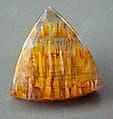
Quartz: It’s Good To Be “Included”
3 Minute Read

The "hottest" trend among jewelry designers today is the use of these lesser known gemstones of the quartz family. If we were looking at almost any other gem, an inclusion of anything would devalue the gem. This, however, is not the case with certain varieties of this little beauty. Due to its soft, porous nature, other minerals are able to grow in it!

Quartz and Its Inclusions
Color: Clear, Pink, Purple, Blue, Green, Golden, Brown
Moh's Scale: 7 (hearty, good for everyday wear)
Crystal System: Trigonal, Hexagonal Prisms
Chemical Composition: Silicon Dioxide
Macrocrystalline Quartz
These crystals are identifiable with the naked eye. This group is represented by most of the stones gemologists classify as varieties: Amethyst, Rose-de-France or "Pink" Amethyst, Citrine, Rock Crystal, Prasiolite or "Green Amethyst, Smoky Quartz (and the various browns - whisky, beer, champagne and cognac), Rose Quartz, Aventurine, Tiger's-Eye, etc.
Quartz is the most common gem on earth…literally found in almost every corner of the world. Important deposits are found in Bolivia, Brazil, the Swiss Alps, Madagascar, Russia, the Ukraine, Mexico, Namibia, Sri Lanka, Zambia, Uruguay and the United States.
Rock Crystal Quartz
While some gemstones are valued chiefly for their inclusion, this is a transparent variety valued for its clarity. Rock Crystal is the perfect showcase for Mother Nature's surprises, due to the amazing clarity of a quality stone.
Rutilated Quartz Pendant
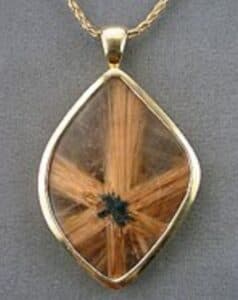
This is the most popular of the inclusion category. In this variety, golden needles of rutile organize in bundles, sprays, and various patterns inside the clear quartz. Sometimes called "Angel Hair," each pattern is different, and some are breathtakingly beautiful.
Tourmalinated Quartz


This variety shows black or dark green tourmaline crystals in a thicker, rod-type inclusion. This can be in heavy patterns and sprays or random spikes. One of the favorites of faceters is to facet a round with a single rod of tourmaline running from the culet to the table - the optical illusion is quite spectacular.
"Stuff in Quartz"

This moniker has become a collecting category - today some of the more popular varieties include (pun intended)…Pyrite (gold), manganese oxide, form crystal "dendrites" (small branch-like), Chlorite (mossy, green), black Hematite (often seen at the "hub" of a wagon wheel spray of rutile needles), red Hematite platelets or Lepidocrosite (can give an overall pink or red color), green Edenite, golden Goethite needles, Epidote (thick green crystals), Actinolite…

…and my current favorite - Medusa Quartz, a clear crystal quartz with small Gillilite inclusions…named for their resemblance to the Medusa Jellyfish!
Asterism

The star effect that appears as rays of a star on the domed surface of a cabochon gem. This occurs when a strong, single light source reflects off layers of thread-like inclusions that inhabit these unique gems.
Chatoyant Quartz
If those threads align themselves in a single direction, much like the strands in a spool of thread, the reflection will appear as a single ray of light called a Cat's-Eye. Other examples of chatoyancy in quartz are the Hawk's-Eye, Ox-Eye and Tiger's-Eye varieties. These finely fibrous, opaque aggregates form when quartz replaces the mineral crocidolite (a type of asbestos).
From Past to Present - A Gem Like No Other
Throughout history, quartz has been a jeweler's chameleon, standing in for more expensive gemstones ranging from diamond to jade. Now, finally, it is coming into its own, allowing the average consumer the "luxury" of beautiful jewelry…with less common varieties beginning to show their appeal. Designers are using included quartz today for "high-end" pieces due to it's "one-of-a-kind" nature.
Some Final Words
This article originally appeared on Ganoksin User Blogs in 2008. It has been lightly edited to reflect updates.
Related Articles

An Interview Michael David Sturlin

Meet Gordon Uyehara
Meet Wendy Culpepper
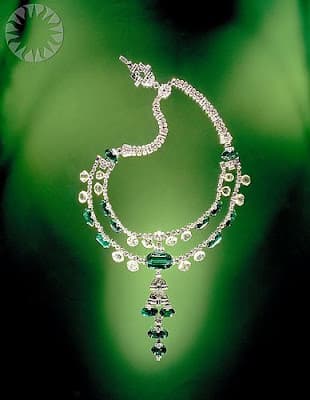
The “Spanish Inquisition Necklace”

The All-In-One Jewelry Making Solution At Your Fingertips
When you join the Ganoksin community, you get the tools you need to take your work to the next level.