Optical and Physical Properties of Gemstones
The beauty, color, and brilliance of each different gemstone variety is a result of its unique set of physical and optical properties. Gemologists study these properties to identify gemstones and to read where they are from and how they were formed. Many people spend their lives studying this subject but a basic summary is not difficult to learn and can make looking at gemstones more interesting. The beauty of a gem, the distinctive way it handles light, its color are all a result of these properties.
13 Minute Read

The beauty, color, and brilliance of each different gemstone variety is a result of its unique set of physical and optical properties. Gemologists study these properties to identify gemstones and to read where they are from and how they were formed.
Many people spend their lives studying this subject but a basic summary is not difficult to learn and can make looking at gemstones more interesting. The beauty of a gem, the distinctive way it handles light, its color are all a result of these properties.
Color
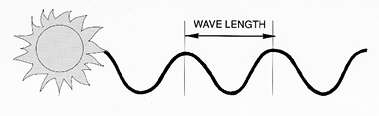
Optics is the study of light. Light is transmitted in waves just like sound is. The length of each wave, usually measured in Angstrom Units, is about one ten-millionth of a millimeter. Visible light ranges in wavelength from 7600 Angstroms for RED to 4000 Angstroms for VIOLET. All other colors visible by humans fall between red and violet.
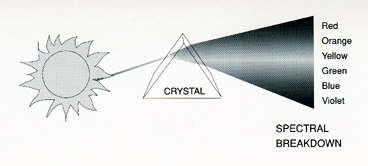
Sunlight has all the components of light, so it is pure white light. When the components of sunlight are fanned out by a prism, we see the rainbow of the color spectrum. The color of gemstones, like the color of all of the objects we see around us, is a result of the combination of wavelengths that are absorbed and reflected by it. A black object absorbs all light; a white object reflects all light.
When you are examining gemstones, it is important to understand the type of light you are using to view it. Professional gemstone buyers prefer indirect daylight from the northern sky (or southern sky, south of the Equator) early in the day. Realistically you probably will not have the opportunity to use indirect northern daylight for buying gems. In a jewelry store undoubtedly you will be shown the stones under some intense artificial light; these lights will bring out the full potential beauty of the gemstone, but when you view it under regular incandescent light or fluorescent light it may appear slightly different and less vivid. Certain gems are even a completely different color when looked at under different types of light! For example, fine quality alexandrite, a variety of chrysoberyl, will change from blue-green in daylight to violet-red in incandescent light.
Pink, blue and violet stones can be especially affected by the light illuminating them. Sapphires with violet tones under incandescent light will usually appear more blue in daylight. Sapphires are often sold under fluorescent lights because that, too, enhances the blue. Tanzanite will noticeably change under different lighting conditions. Some pink stones, especially tourmaline may have an awesome pink color under artificial light and then appear brownish in daylight. Some do and some don't, but it is a good idea to check. Gems usually look better under intense light or spotlights; an experienced buyer will also examine them under the light that the gems will be worn in. What are the lights you use at your home or office?
Refractive Index
Refraction is the bending of light as the light travels into another medium. If you put a stick into a pond or stream, the stick will appear to be broken where it enters the water: the two halves do not meet. Each gem material has a characteristic rate of refraction. The measurement of the refraction is the refractive index; it is measured with a refractometer. Gemologists use the refractometer as one of the tools to identify gemstones. In general, the higher the refractive index the more brilliant a gemstone will be.
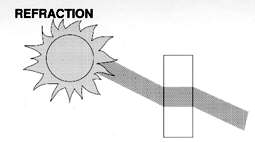
Gems that form in the isometric system refract light the same rate at all angles. These stone are singly refractive. Light entering gemstones in all the other crystal systems will be polarized into two rays which are transmitted through the substance at different rates of vibration. These gems are doubly refractive.
Understanding refractive index is essential when you are viewing gemstones. The higher the refractive index the greater the potential for brilliance the gemstone has if it is transparent and is cut properly. The refractive index is very high in diamonds and in zircons, so these have the potential for exceptional brilliance.
Birefringence
Birefringence is the difference between the two refractive indices of in a doubly refractive gemstone. Most doubly-refractive gems have two rates of refraction that are almost the same. However some have very different rates and are highly birefringent. Zircon and peridot are good examples. To observe birefringence, look at a zircon or peridot under magnification: the back facet junctions will appear to be doubled.
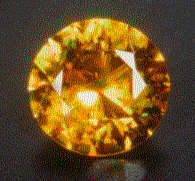 |
| Sphene shows strong birefringence. Note doubling of back facet junctions. Photo by ICA/Bart Curren |
The high birefringence of peridot and zircon can add a velvety appearance to the gemstones; which softens the color in a way you might find very appealing.
Pleochroism
Since light waves are absorbed at different rates along different crystal axes of a doubly refractive gemstone, different axes can appear to be different colors; this is called pleochroism. Pleochroic gemstones may have a different color when looked at from different directions. This can be simply observed in a rectangular shaped dark green tourmaline: if you look down one end one color, usually green, is visible and another color, usually brown, is visible when you look at it sideways. Iolite is another gemstone where pleochroism is easily observed: it appears blue when looking at it through the table, but may look completely colorless when viewed from the side! In most pleochroic gemstones this is not so obvious.
A gemological tool, the dichroscope, aids in observing pleochroism. Stones that have two pleochroic colors are dichroic. Examples of dichroic gems are tourmaline, amethyst, rubies and sapphires. When a gem exhibits three pleochroic colors it is called trichroic. Trichroic gems include tanzanite, andalusite and iolite.
Pleochroism creates unique color qualities in gemstones; it can add the richness of a gemstone. It is necessary to examine pleochroic gemstones at all angles to see the full color potential. This is most obvious when looking at tourmalines and andalusite where the pleochroic colors are easily observed. Tourmalines that appear to have a pale orange color generally have a pink color obvious in one axis and a yellow color apparent on the other axis; if the cutter had oriented the stone in another direction, the color would appear differently.
Dispersion
When light is broken up into a full color spectrum by a gemstone it is referred to as dispersion. Some gemstones have a higher dispersive power than others; these gemstones have little rainbow flashes in their brilliance. Diamonds and zircons have relatively high dispersion; some rare stones that are extremely dispersive are benitoite, demantoid garnet, and sphene.
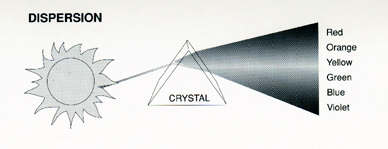
A diamond that is properly cut exhibits dispersion that adds a fiery appearance to the gem; if it is cut with a very shallow crown dispersion is minimized and the diamonds full potential for beauty is not realized.
Fluorescence
When viewed under ultraviolet light some gemstones fluoresce. They absorb ultraviolet radiation and emit visible light in return. Because sunlight includes ultraviolet light, in strong sunlight a very fluorescent gemstone may flash a bit of its fluorescence. Some diamonds fluoresce, some do not. Of the 30% or so that fluoresce under long wave ultraviolet light most are blue, but fluorescence can be yellow, green or in rare cases pink. If the fluorescence of a diamond is very strong the diamond will appear "oily" in strong sunlight; the beauty is diminished in this case and the diamond is not so desirable. A moderate blue fluorescence can make a diamond very beautiful in sunlight. The blue fluorescence makes a diamond with a slight yellow tint appear more colorless, which makes it look better and more expensive than its actual color grade would suggest. Other gemstones also fluoresce; in rubies some mines produce stones with higher fluorescence than others. Burmese rubies are higher in fluorescence that those mined in other localities; the fluorescence of Burmese rubies adds to their beauty and value.
Transparency
Light passes through a transparent gemstone perfectly, like a window pane. When a stone is semi-transparent you can partially see through it, but not completely. A translucent gem passes light through but you can not see through it. Semi-translucent gemstones pass some light through them. No light passes through an opaque gem.
Terms describing transparency are important in describing gemstones. Some stones will always be translucent, such as chrysoprase, or opaque, such as lapis lazuli. Stones that are found in transparent form are generally evaluated based on their transparency; as transparency is lessened, value generally drops. Transparency is most important in the valuing of jadeite; the more transparent the jadeite the more valuable it will be in a given color.
Toughness and Durability
The durability or toughness of a gemstone depends on several factors as well as hardness. The internal structure of the gem material is critical to its durability; nephrite jade is an example of a gem with moderate hardness (6 1/2 on Mohs scale, Mohs scale is explained below) but with excellent toughness. Nephrite has a fibrous structure that makes it very resistant to breaking or chipping.
Some minerals have cleavage planes; cleavage is the tendency that some minerals have to split down certain planes. Diamonds and topaz have perfect cleavage. A blow at a certain angle can easily break these stones into two pieces.
Internal fractures can also weaken a gemstone and affect durability. Brittleness also affects durability. Garnets and opals are quite brittle and must be set with care and placed in mountings that protect them from blows when they are worn.
Some gems abrade quite easily at facet junctions; peridot and zircon are examples of gems that should be set into protective settings to avoid wear on the surface of the gemstone. When choosing a gemstone to be worn in a ring the overall toughness is an important consideration in determining whether the stone needs a protective setting, on what occasions it should be worn, and how to care for it.
Hardness
Hardness refers to the scratchability of a gem. Hardness is rated on a scale from one to ten called the "Mohs scale". The scale is not composed of even steps: the first eight minerals graduate in hardness on a more or less linear scale, but corundum and diamond are much harder. The distance between 8 and 9 and 9 and l0 is greater than any other hardness steps in the scale.
MOHS SCALE
Some minerals will have a variation in hardness within one crystal depending on the direction in which it is scratched.
Hardness is an important consideration in determining the toughness of a gemstone, but it is not the only consideration. The hardness of diamond is one of its important features; it is unique in nature due to its extreme hardness. This does not mean a diamond is indestructible, it means it is almost impossible to scratch. Rubies and sapphires have a hardness of "9" on Moh's scale and they are stones that wear quite well. On the other hand, topaz, with a hardness of "8" will not scratch easily, but topaz has perfect cleavage and should be set and worn with care. Generally gemstones with a hardness of "7" or more will not easily scratch when worn in a ring. Stones with hardness below "7" may not wear well as ring stones. Nephrite jade is an exception to this.
Luster
Luster denotes the surface appearance of a gemstone; it is a phenomena of reflected light. Luster may be metallic or non-metallic. Non-metallic luster is usually described in the following terms:
- dull - light not reflected
- resinous - resin like appearance
- greasy - surface appears to have oily coating
- silky - reflects in a fibrous way
- pearly - iridescent or pearl-like
- vitreous - glass-like appearance
- adamantine - diamond-like luster
The luster of a gemstone is an important aspect of a gemstone's beauty; proper polishing and finishing of a gem brings out its luster.
Specific Gravity
The specific gravity is the measurement of the density of a substance. Scientifically, specific gravity is defined in a ratio of the mass of a given material to the mass of an equal volume of water at 4o centigrade. Most gemstone substances are two to four times denser than an equal volume of water. Specific gravities are expressed in decimal numbers, for example, 4.00 for corundum , 3.52 for diamond , and 2.72 for quartz. Specific gravities can vary slightly with variations of the trace elements.
Knowledge of specific gravities is important for the buyer because gemstone are sold by weight but jewelry mountings are often manufactured to take gemstones of a standard size. In the retail jewelry industry diamonds set the standard for size. A well proportioned one carat round brilliant cut diamond is generally 6.5 mm in diameter; an amethyst that is 6.5 mm in diameter would generally weigh about .80 carat; a sapphire or ruby with a 6.5 mm diameter would weigh around l.25 carats. If you were replacing a one carat diamond in a mounting and looking for another type of gemstone to replace it, the weight of the other type of gemstone would be different than the diamond weight. It is important to remember if you are replacing a gemstone of one type with another that they will have different weights even though they have nearly identical dimensions.
Inclusions
The internally visible crystals, fractures, bubbles, and other small flaws in a gemstone are referred to as inclusions. Most gemstones have some inclusions that are only visible under magnification; some have inclusions that are visible with the naked eye. Gemstones that are flawless or that have few flaws will be more expensive. Internal fractures are the most serious because they may adversely affect the durability of a gemstone. But inclusions are not always bad: they can provide a means of identification for some gems and can even indicate the origin of the gem.
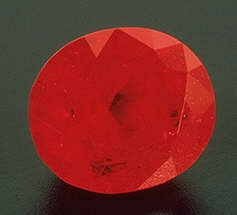 |
| Ruby, 8.02 carats, Burma. Excellent red color for ruby, but lack of transparency indicates stone has many inclusions. Photo by ICA/Bart Curren |
Inclusions in diamond are very important in diamond clarity grading and have a great influence on the diamond's price. In other gemstone species, microscopic flaws have less bearing on the price. When looking at colored gemstones it is important to determine if the inclusion or inclusions have a detrimental effect on the stone's beauty or if they are easily visible. Many very minute inclusions could create a cloudy appearance but only be seen individually with a microscope. Transparency is an important consideration in quality evaluation in most gem materials; any thing that lessens the transparency will lower the value (with a few important exceptions). A Kashmir sapphire may have minute inclusions interfering with transparency and yet if the color is good this would not lower the stone's value but would provide a means for identifying the origin of a gem and actually add to its value. Inclusions that create phenomenal effects can add to the gems value also.
Occasionally very minute inclusions in a gemstone will produce phenomenal effects. "Stars" and "eyes" are possible phenomenal effects found in gemstones. Phenomenal stones are usually cut into cabochons.
The ability of a gemstone to show a "star" is called asterism. The best way to see the star is to examine the stone using one strong concentrated light source; a penlight is an excellent tool for this. Stars are created by the reflection of light by the inclusions in the stone. The best known examples are the six-rayed stars which occur in rubies and sapphires and rarely in spinels. Four-rayed stars occur in garnets but they are rare. Quartz may show multiple stars in one stone. Other species may exhibit stars.
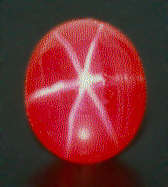 |
| Star Ruby, 21.89 carats, shows six ray star. Photo by ICA/Bart Curren |
Chatoyancy is the ability of a gemstone to form a cat's-eye. Eyes are also created by the reflection of light of inclusions within the stone. Chrysoberyl, quartz, beryls, tourmalines and moonstone exhibit this phenomena.
Adularia is the "flash" observed in moonstone. It is created by reflections of light of tiny platelets within the stone.
See also:
Gem Dealers's Secrets - Handbook for the Gem Buyer - Table of Content
Related Articles
Gemstone Glossary List

A Journey to Burma’s Jade Mines
A Look at Pearl Quality

Topaz Gemstone Kinds and Colors

The All-In-One Jewelry Making Solution At Your Fingertips
When you join the Ganoksin community, you get the tools you need to take your work to the next level.