
Andalusite Stones: Nature and Rarity
Andalusite is an unusual stone. It shows flashes of several different earth tones in the same stone. Because of its combination of colors, it has been called "poor man's alexandrite," but it does not look like alexandrite at all. Andalusite has very strong trichroism; if you examine the green stones carefully, you can see green running in one direction and a reddish brown color in the other direction. The third color, yellow, is difficult to see with out a dicroscope. Andalusite was named after Andalusia, Spain where it was first discovered. Today it is mined in Brazil and Sri Lanka..
1 Minute Read
Andalusite stones is an unusual stone. It shows flashes of several different earth tones in the same stone. Because of its combination of colors, it has been called "poor man's alexandrite," but it does not look like alexandrite at all.
Andalusite stones has very strong trichroism; if you examine the green stones carefully, you can see green running in one direction and a reddish brown color in the other direction. The third color, yellow, is difficult to see with out a dicroscope. Andalusite stones was named after Andalusia, Spain where it was first discovered. Today it is mined in Brazil and Sri Lanka.
| Andalusite 4.75 carats, Brazil Photo by ICA Bart Curren |
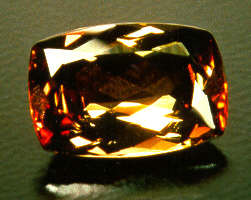
Andalusite stones are not a common stones, but can be found by the gem enthusiast. You probably won't run across a large selection of andalusite, but the best stones are those that have the strongest colors generally with a dark green predominating.
Andalusite that appears washed out will be of lower value. It is slightly fragile because it is brittle and has perfect cleavage in one direction. Large stones, over five carats, are rare; stones smaller than this fall in the low price range in per carat price.
Andalusite Attribute
| Colors: | Pinkish, green and brown |
| R.I.: | l.63 - l.64 |
| Durability: | Slightly fragile |
| S.G.: | 3.l6 - 3.20 |
| Treatment: | None known |
| Hardness: | 7 - 7 1/2 |
| Availability: | Supply available in stones up to 5 carats |
| Localities: | Brazil and Sri Lanka |
| Price: | Low to moderate |
| Common shapes: | Cushions, ovals and rounds |
Related Article:
- Gem Dealers' Secrets - Handbook for the Gem Buyer - Table of Contents
About the Author
Sondra Francis has scoured every major colored gemstone market in the world since 1978. She was a charter member of the American Gemstone Association and served as a board member. She was a founding member of the International Colored Gemstone Association. A true gem lover, Sondra has marketed her treasures on the wholesale and retail markets.
Acknowledgments
- A special thanks to Pam Dulgar, Alex Edwards, Cheryl Kremkow, Kate Kirby, Helen Mitchell, Carol Morgan Page, David Pond, Elaine Proffitt, and Ray Zajicek for their help.
- Photographs by Bart Curren, ICA Gembureau Alex Edwards, Pearl Sales Institute and David Dikinis
You assume all responsibility and risk for the use of the safety resources available on or through this web page. The International Gem Society LLC does not assume any liability for the materials, information and opinions provided on, or available through, this web page. No advice or information provided by this website shall create any warranty. Reliance on such advice, information or the content of this web page is solely at your own risk, including without limitation any safety guidelines, resources or precautions, or any other information related to safety that may be available on or through this web page. The International Gem Society LLC disclaims any liability for injury, death or damages resulting from the use thereof.
Related Articles
The Kinds of Opals

GemBits – Turquoise for Jewelry
A Second Look at Tiger’s Eye
Birthstones: Which one are you and what does it mean?
The All-In-One Jewelry Making Solution At Your Fingertips
When you join the Ganoksin community, you get the tools you need to take your work to the next level.
Trusted Jewelry Making Information & Techniques
Sign up to receive the latest articles, techniques, and inspirations with our free newsletter.