
950 Palladium Bench Guide
The palladium bench guide reviews the working characteristics of palladium for the jewelry bench staff and provides an overview of the unique advantages and benefits of palladium jewelry for managers, sales professionals and consumers. It is intended to serve as a source for information on the most commonly encountered palladium jewelry scenarios and the related materials available in the industry today.
7 Minute Read

The palladium bench guide reviews the working characteristics of palladium for the jewelry bench staff and provides an overview of the unique advantages and benefits of palladium jewelry for managers, sales professionals and consumers. It is intended to serve as a source for information on the most commonly encountered palladium jewelry scenarios and the related materials available in the industry today.
950 Palladium Alloys
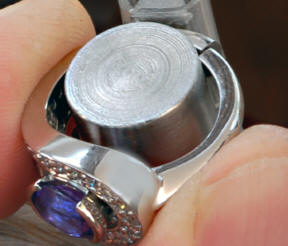 Palladium is alloyed for use in jewelry. Standard alloys contain 950 parts of palladium and 50 parts of other metals (this portion of the alloy may vary among suppliers and origin). The most common alloy component in the U.S. is ruthenium, which, along with palladium belongs to the platinum group of noble metals. Ruthenium usually comprises about 4.8 percent of the 5% mixture, leaving room for trace elements of other metals that improve working, wearing or casting characteristics. The common alloy ingredient used in China, where palladium jewelry is mass produced is 950 parts palladium and the balance copper.
Solder
Palladium or platinum solder is used for soldering 950 palladium alloys. Palladium solder is usually supplied in 'hard', 'medium' and 'easy'. The general flow temperatures for them are:
- Hard - 2,365°F
- Medium - 2,210°F
- Easy - 2,005°F
950 platinum solders are made with gold/silver/palladium or gold/platinum/palladium. More palladium and platinum is present in the higher melting point or "harder" solders. Platinum solders used for soldering palladium are 1,100, 1,200 and 1,300 and they have the same general melt and flow ranges as listed above for palladium solders.
SolderingWhen soldering a palladium assembly, do not use fire coating solution or flux. Use rated No. 5 or darker welding lenses for eye protection. Palladium loses its polished luster during the soldering process, in much the same way as karat gold. However, palladium's luster is easily restored through minor re-polishing. Palladium solder is available in hard-, medium- and easy-flowing temperatures. You can also use 1100, 1200 and 1300 platinum solder as it has very similar melting points and composition. | |
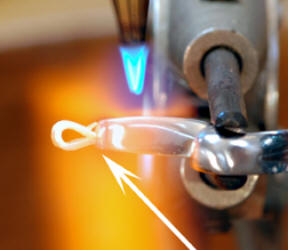 | When soldering karat gold to palladium, firecoat the assembly as you would with gold. Standard gold soldering flux and easy flowing gold solders should also be used. The link being soldered to the pendant in this image was first tacked in place using an ABI Tack II. For positioning palladium pieces to be soldered, place them on a platinum soldering block or hold with high-heat cross locking tweezers. |
Annealing | |
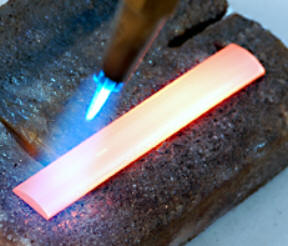 | Use a high-heat soldering block for annealing and always eye protection. In this example, a No. 5 rated welding lenses is used to shield harmful white light. Bring the piece being annealed to an orange color, hold it for about 20 seconds and allow it to cool. Wire being annealed from Hoover & Strong |
Soldering Settings and Retipping Prongs | |
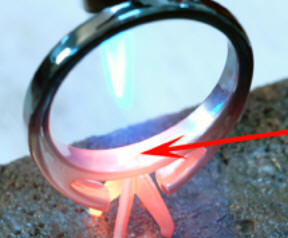 | Easy palladium solder (as shown in image), 1,000 or 1,100 platinum solder are all suitable for soldering settings in place. Direct soldering procedures are used. When prongs wear down, it is recommended to replace the prong or setting. It is best not to risk soldering new prong tips on prongs if you are uncertain of the stability or identification of the set stone. However, if it is documented that the set gemstone is stable, untreated and can withstand the heat of soldering temperatures, new prong tips can be made of palladium and then soldered in place using hard white gold solder.Easy solder, ring and setting from R Findings |
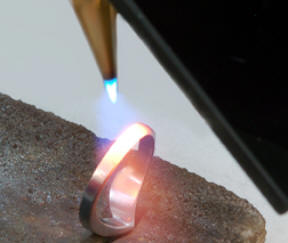 | This image shows the soldering process through a No. 5 welding lens. A torch tip with no vents and an opening of about 1.2 millimeters is used to directly heat the joint. The torch is positioned so the hottest part of the flame (the area about a 1/4 inch beyond the blue cone) directly heats the joint. The torch is moved slowly from side to side. Because of the low thermo conductivity of palladium, the heat is concentrated in this specific area. The ring is heated and the solder melted into the joint. Ring cast by TechFrom, Portland, OR using Johnson Matthey 950 Pd |
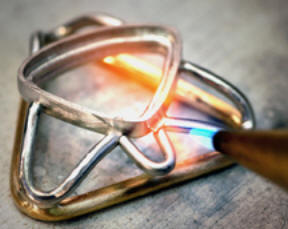 | When soldering 950 palladium to karat gold, it is important that cadmium-free solders are used. If not, the resulting joint will fail under normal wear. |
Sizing 950 Palladium Rings | |
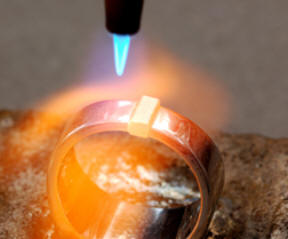 | For sizing rings up or down, they are cut at the bottom portion of the shank and the appropriate amount of metal removed or included. The ends of the shank should be precisely rejoined with no visible gaps or spaces. To solder the joint, place it on a ceramic platinum soldering block or hold with high heat cross locking tweezers. Use hard palladium solder or 1300 platinum solder. Directly heat the joint using an oxidizing flame to melt and flow the solder. Use rated No.5 or higher welding lenses for eye protection. |
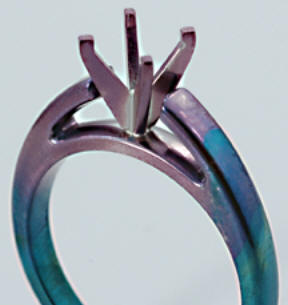 | When 950 palladium alloys are heated to high-heat ring soldering temperatures, they may develop a bluish-purple surface discoloration. It's easily removed by briefly and mildly heating the piece with a neutral flame. A neutral flame has equal parts of gas and oxygen. The surface discoloration can also be removed by using fine abrasives.Ring and Setting from R Findings |
Hallmarking | |
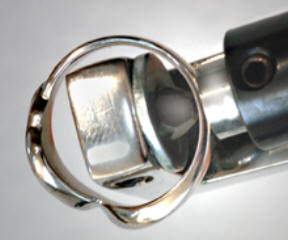 | This ring is made from Johnson Matthey's palladium alloy and contains 950 parts palladium, about 050 parts ruthenium with a small amount of gallium. The appropriate quality marking is 950Pd. |
Investment Casting | |
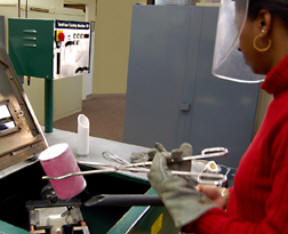 | Palladium, like platinum requires high heat when casting so use of platinum casting materials and equipment is necessary. Palladium absorbs gas when melted and releases it upon solidification. When palladium solidifies, gasses can be trapped resulting in pieces that contain gas porosity. For the best results and to minimize gas porosity when casting, use an induction melt casting machine with a sealed melt chamber and an argon cover. Because of the above, palladium is best cast by properly equipped casting facilities with experienced personnel.TechFrom Casting, Portland, OR |
Laser Welding | |
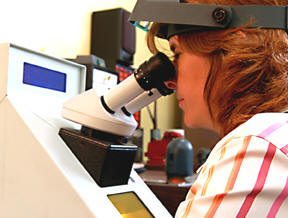 | Laser Welding featuring Brenda Warburton, Austin & Warburton A laser welder works with palladium however the technique required for success is different than when laser welding gold or platinum. When filling voids and pits or building up joints with a laser start by directing pulses of energy directly into the void. This will melt the bottom exposing fresh metal from which to build upon. For the best results use small diameter filler wire, narrow joints and the pulse shaping feature with your laser. This technique can be used to avoid over-heating of the material, because the settings begins with high laser intensity, and then incrementally reduces laser power once the melting point has been reached. Pulse shaping can also reduce cracking in the metal which can occur during quick cooling of a weld, important for 950 palladium alloys. |
Gemstone Setting | |
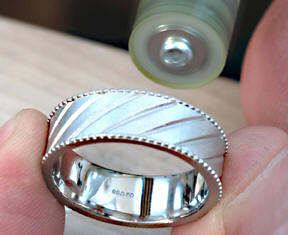 | Setting gemstones in palladium is quite like setting in platinum. When bending and forming prongs or bezels to secure gemstones, the metal does not spring back like with most white gold alloys. This is referred to as "dead-setting". And with palladium's purity, it is not a candidate for prong failure due to corrosion. |
Pre-finishing, Finishing and Polishing
Pre-finishing and polishing requires fewer steps to accomplish as compared to platinum and an extra step or two as compared to white gold. To finish a casting, begin with No. 4 cut files and finish with No. 6 cut or fine abrasive sanding sticks. Grits from 400 to 1,200 are ideal. After using abrasives of 1,200 grit, polish the piece with Bendicks white rouge. For the final step in polishing use a 6,000 grit white rouge. For the best results use files, abrasives and polishing materials dedicated for palladium. Palladium alloys brighten during tumbling and magnetic finishing procedures. Magnetic finishing also restores palladium's polished luster after soldering procedures. No rhodium or other plating is required to improve the color of 950 palladium alloys.
Tools and Equipment
For the best results when working with palladium, use palladium dedicated files, sanding sticks, rotary abrasive materials and polishing wheels. Keep your workbench clean and free of debris from gold and platinum projects. Use high-heat soldering tweezers and pads and always use eye protection.
Palladium Detection
Iodine can be used to detect the difference between palladium, platinum and white gold. To use Iodine, place a drop of it on the cleaned surface of the unknown white metal. As the small drop of Iodine evaporates and dries, it may take on a body color that will assist in the detection of the metal. Here are the most common reactions you can expect with a drop of Iodine after it has dried.
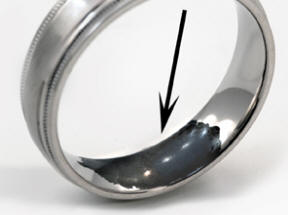
Ring by Novell
| Alloy | Reaction |
| 950 Palladium | Iodine turns black (as shown in example) |
| 900 and 950 Platinum | Iodine is mostly colorless |
| 14- and 18-karat white gold (below a rhodium plated surface) | Iodine turns brownish |
The above reactions will not occur on a rhodium plated finish. If a rhodium plated surface is present it must be removed at the location where the test drop is placed.
Cost Analysis - Palladium, 14-karat White Gold & Platinum
At the time of this printing, the market prices for metals were:
| Metal | Market Price (per ounce) | Price Per Pennyweight |
| Palladium | $324.00 | $16.20 |
| Platinum | $1,120.00 | $56.00 |
| Gold | $621.00 14-karat - $363.29 18-karat - $465.75 | 14-karat - $18.16 18-karat - $23.28 |
Since metal supplier markups vary, they are not included in this analysis.
Considerations for Palladium
Refining For the best return when refining palladium keep palladium filings, bench sweeps and polishing debris separate from the same containing other precious metals. Also keep palladium hard scrap separate from other precious hard scrap. This will maximize your return and speed the settlement.
Related Articles

Production Methods for Palladium Chain Making

Palladium Sizing, Welding and Engraving

950 Palladium: Superior White Color

950 Palladium: Laser Welding Techniques


The All-In-One Jewelry Making Solution At Your Fingertips
When you join the Ganoksin community, you get the tools you need to take your work to the next level.
