The Treatment of Gemstones
The treatment and enhancement of gemstones has existed for centuries. Some enhancements improve on nature slightly, are undetectable, and they are permanent; this provides the gem market with a larger supply of beautiful gemstones. Other treatments produce dramatic changes in the gemstone; the irradiation and heating of colorless topaz that permanently transforms it into blue topaz is an excellent example. A few treatments are less stable and should be avoided by the knowledgeable buyer..
10 Minute Read

The enhancement and treatment of gemstones has existed for centuries. Some enhancements improve on nature slightly, are undetectable, and they are permanent; this provides the gem market with a larger supply of beautiful gemstones.
Other treatments produce dramatic changes in the gemstone; the irradiation and heating of colorless topaz that permanently transforms it into blue topaz is an excellent example. A few treatments are less stable and should be avoided by the knowledgeable buyer.
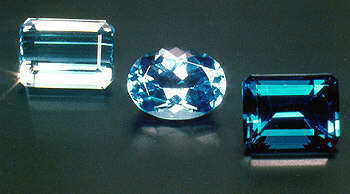 |
| Three Colors of Irradiated Topaz, Brazil. Photo by ICA/Bart Curren |
Generally treatment of a gemstone is done by the cutter or lapidary. Since he makes the investment of buying the gems rough he wants the final product to be as salable as possible. Sometimes gemstones are treated as rough stones. The heating of sapphires and rubies is done before the rough stones are sold to the cutters. Most of this treating is done in countries that cut and mine the stones. By the time the stones enter into the United States market it may have passed through several hands and disclosure of treatment may not always occur.
Ideally disclosure of enhancement is the job of the seller, but it does not always happen. Realistically an informed buyer protects himself. How does treatment affect the price of gemstones? Each gemstone variety must be considered individually as well as each type of treatment. Some gemstones would not be commercially available if they were not enhanced. Citrine and tanzanite are extremely rare in nature; these varieties are dependent on heating to produce enough supply to meet the demands of the market.
There are some gemstones that are not enhanced by present technology; these include: garnets, peridot, iolite, spinel, all varieties of chrysoberyl, catseye tourmaline , malachite, hematite, and all feldspar including all varieties of moonstones. Keep in mind that new technology in gemstone treatment is always changing and new treatments are appearing.
Heating
Heating is the most common treatment; it can improve color by lightening it, darkening it, or it can clarify and brighten gems. In rare cases, it can change the color entirely. Assume the following are heated: rubies, sapphires, tanzanite, citrine, pink topaz, aquamarine, and blue and colorless zircon. Occasionally tourmaline and amethyst are heated to lighten their color.
Heating is not generally detectable by today's method and it is irreversible under normal conditions. In general, there is no price difference between heated and unheated gemstones because it is not detectable. In most cases the heating enhances the gemstone to make it more beautiful, so a higher price may result. Tanzanite, citrine, pink topaz, blue and colorless zircon would not be available without heating, so the enhanced product will command a higher price than the rough material from which it originated. However, unheated rubies and sapphires may contain microscopic rutile needles or tiny gas bubbles in pockets of liquid which are evidence that laboratories can use to guarantee that these stones have not been heated. If these gems are the finest color they will command premium prices due to their extreme rarity.
Oiling
Oiling of emerald is universal; when the rough emerald is mined it is thrown into a barrel of oil; when it is cut, oil is used as a lubricant on the cutter's lap. The colorless oil seeps into the fissures on the surface of the emeralds. When the fractures contain the oil they are less eye visible. To complete this process oil is pressurized into the fissures of the polished stone. No problem, this is the way emeralds are. The only way you will find an emerald that isn't oiled is if there are no fractures at the surface of the emerald, so no oil can get inside the stone. If color is equal, obviously you will pay more for an emerald if it has no fissures that reach the surface; they simply will have fewer inclusions.
But remember, if an emerald is put into an ultrasonic or is steamed clean, then the oil may be leached out and fractures could reappear whiter and more obvious. In this case, the stone can be re-oiled.
Rarely you may see a ruby which is oiled; but only if it is of very low quality. Very rarely colored oils are used on emeralds and rubies. The idea is to add color while concealing fractures. You want to avoid buying these because you can't judge the true color. This is done to deceive the buyer. Fortunately this is not common and it is unlikely you will encounter this if you buy from a reputable source in the United States. Synthetic resins can be used to fill in fractures in emeralds and other stones with fractures that reach the surface of the gem. Hardeners are often applied to make the process permanent.
Irradiation
Irradiation is the bombardment of a material by subatomic particles or radiation. Sometimes irradiation is followed by heating to produce a better or new color for the gem. Blue topaz is the most common example. Although blue topaz occurs in nature, it is quite rare and pale in color. In the United States irradiated gems are regulated by the Nuclear Regulatory Agency to insure there is no harmful residual radiation. You do not have this protection if you buy it out of this country. Today irradiation of blue topaz has created shades not found in natural blue topaz; prices are very reasonable for irradiated blue topaz since there is a great deal of competition in the wholesale end of this market. If you could find an untreated blue topaz of fine color you would pay a higher price if it could be proven that there was no treatment.
Tourmaline can be irradiated to darken pink stones into red ones; these are indistinguishable from natural red ones. In this case the tourmalines would sell for the same price if color were comparable.
Off colored diamonds can be irradiated and heated and turned into intense greens, yellows, blues and browns. These are not commonplace, but if you are buying a fancy colored diamond particularly a green one, it is a valid question to ask the seller. Irradiated diamonds will sell for much less per carat than the naturally colored ones of comparable color, clarity grade, and size. Cultured pearls can be irradiated to produce gray or blue colors; but dyeing in these colors is more common. Irradiated pearls will sell for about the same price as the dyed pearls, this should be well below the prices asked for pearls with very fine colors.
Dyeing
Dyeing may be good; it may not be good. Without dyeing there would be no black onyx: nature forgot that color in chalcedony! Chalcedony or more commonly known as agate, is often dyed blue, green, or orange and carved into bowls, statues, or cut into beads. The good news is that this stuff does not even look real — it is obviously dyed; but the color is attractive and both buyer and seller are happy.
Japanese cultured pearls, which are grown in an Akoya oyster that produces pearls up to about l0 millimeters, grow into a limited selection of colors with various overtones of colors. If they are dark gray, bluish, violet, nearly black, or intense bronze, assume they are dyed. To meet current demand for pearls with rose overtones, some cultured pearls have been given a pink tint; this can be detected by looking for concentrations of dye around drill holes or around blemishes. On the other hand, South Sea cultured pearls which are generally larger than the Japanese cultured pearls, may grow into a variety of exotic colors naturally because they are grown in a different variety of oyster. Tahitian black pearls are a good example of naturally colored black pearls. Cultured pearls with a natural exotic color will command a much higher price than a dyed one.
Dyeing of chalcedony and of pearls is prevalent, permanent, and acceptable. These colors do not occur in nature; no deception is involved. But dyeing of other materials, jade, lapis lazuli, turquoise, and coral, may be less acceptable. Generally, dyeing of these materials is done to disguise poor quality goods. Dyed lapis lazuli can be easily tested by rubbing it with a piece of cotton soaked with acetone (fingernail polish remover). If it is dyed, blue color will eventually rub off on the cotton. Dyed lapis should be much less expensive than fine natural lapis. In the case of lapis lazuli or turquoise, the natural material is not that expensive, so why bother with inferior material unless it is irresistibly cheap? Dyed lapis lazuli may bleed blue onto the wearer or his or her clothing.
Dyed jade may be tricky to detect, so be careful if the price seems "too good". Coral beads may also be dyed. But if you are buying your mother-in-law a gift from Waikiki you may justify a purchase of dyed coral beads if they are very inexpensive.
Impregnation and Stabilization
Impregnation and stabilization are common for turquoise. Impregnation is the infusion of wax or paraffin into a porous material. Stabilization is the introduction of a bonding agent, usually plastic, into a porous material. Of the two processes stabilization is the most permanent. Impregnated pieces must be kept away from heat or the wax could melt out. Some gems may have wax applied to the surface to improve the apparent luster; but this is not common. The advantage to stabilized turquoise is that it will not absorb foreign substances and discolor as would untreated turquoise. It should be less expensive than natural, but it is unlikely you will find natural turquoise on the market. Opal is rarely stabilized with plastic to conceal crazing. This is not a commercial product but it could be done to deceive the bargain hunter.
Bleaching
Bleaching is a process for organic gem materials such as ivory, coral, and for pearls and cultured pearls. It lightens the color and is permanent and undetectable. No price difference exists as a result.
Coating
Coating is a process infrequently used where a lacquer or films of some kind is applied to improve a gem's appearance. It is rarely used on diamonds to improve the apparent color of an off-colored stone and deceive a buyer. You probably will not run into this, but coated diamonds should be avoided. Opals may have a black coating on the back to intensify the play of color or to give the appearance of a black opal; this is called a "doublet." It is a fairly common practice and is acceptable if you know what you are buying and do not over pay for it. If an opal presented as natural black opal is mounted in a closed back mounting and it appears to have a black body color, examine the purchase carefully and get a written guarantee describing the material from the seller.
Surface Diffusion
Surface diffusion is used on sapphires. Chemicals are infused into the surface at high temperatures. It can improve color or create asterism. If the surface becomes chipped or abraded, it cannot be repolished without removing the color.
Filling
Filling is used on gems with surface fractures or cavities. Glass or plastic or other materials is used to fill these holes. This is sometimes done to rubies. With close examination with magnification you may be able to spot differences in surface luster. This is not an acceptable treatment; it is done to deceive the buyer.
Recently a new process to fill fractures in diamonds has been introduced. These are referred to as "Yehuda filled diamonds" after the creator of the process. The filling masks large inclusions that would be visible to the eye. Cracks must reach the surface to be filled; if the diamond is subject to high heat as it would during retipping the filling could melt out. This is considered an acceptable practice in the diamond trade but only if the seller tells you about it. Keep in mind that the original diamond before treatment would have had a very low clarity grade, so the treated stone should be priced accordingly. One difficulty is that you are unable to see what the stone really looks like so it is difficult to know what the price should be.
Lasering
Lasering is rarely used on diamonds; the process drills very tiny holes into a diamond to provide access to an inclusion which detracts from the beauty of the stone. The inclusion can then be bleached to make it less obvious if it is not burned out by the lasering. Under magnification laser holes are easily visible when seen perpendicular to the drill hole. A lasered diamond would be classified in the slightly imperfect or imperfect category regardless of the improvement in apparent clarity and should be priced accordingly.
Infilling
Filling of surface breaking cavities with glass, plastic or opticon to improve the durability and clarity of a gemstone. Hardeners may be used with opticon. This is used frequently on emeralds and rubellite (tourmaline).
See also:
Gem Dealers's Secrets - Handbook for the Gem Buyer - Table of Content
Related Articles
Chemically Induced Inclusions – Copper Inclusions
Power and Magic of Gemstones
Benitoite Gems
Chemically Induced Inclusions – Dendrites Moss Plume
The All-In-One Jewelry Making Solution At Your Fingertips
When you join the Ganoksin community, you get the tools you need to take your work to the next level.