Working With Niobium
Niobium has many properties that make it an excellent candidate for fabricated parts. Of particular interest to jewelry manufacturers and designers are niobium's hypoallergenic nature, formability, and the broad range of anodized colors that can be rendered on its surface. It is considered hypoallergenic and safe to wear for even those most sensitive to metal allergies..
10 Minute Read

During the past 20 years, thousands of pounds of wrought niobium have been sold to the jewelry industry both here and abroad. It is a small fraction of the metal used in jewelry manufacturing, but remains a viable choice for the designer.
Niobium features many of the characteristics of precious metals. It is rare, difficult to refine, and highly resistant to chemical attack. It is malleable and hypoallergenic - and its price is above the current silver spot. You might call it a "semiprecious" metal.
Niobium is a lustrous, light gray, ductile, metallic element that resembles tantalum chemically, platinum in color, and is produced in both pure and in alloy form. This article will focus on its pure metal form, certified as ASTM B 392 & 393-99. Number 41 on the periodic table, niobium falls into the transition metals, along with the more familiar precious metals. It has a melting point of approximately 2,468°C/4,474°F, and a density of 8.57 gm/cc. That density is about equal to cartridge brass (8.5 gm/cc) and a little less than copper (8.9 gm/cc). It sells in bulk, wrought form for $6 to $12/oz., on average.
Niobium has many properties that make it an excellent candidate for fabricated parts. Of particular interest to jewelry manufacturers and designers are niobium's hypoallergenic nature, formability, and the broad range of anodized colors that can be rendered on its surface. It is considered hypoallergenic and safe to wear for even those most sensitive to metal allergies. In the 20 years that I've been in business, there has not been a documented case of an allergic reaction to this metal due to its presence in pierced ears or contemporary body piercing.
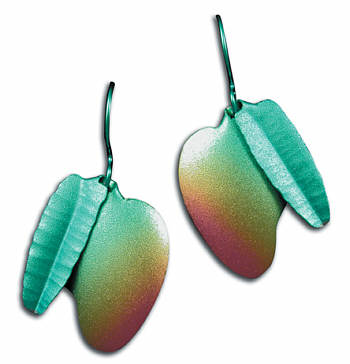 |
Mango Earrings |
Working with Niobium
Like the precious metals, niobium is very ductile and extremely slow to work harden. It cuts easily with a jeweler's saw and can be hand formed, dapped, chased, and forged with ease. It has moderate density-about a third that of gold, twice that of titanium, and 10 percent greater than that of iron. In cold working, such as rolling, drawing, forging, and swedging, niobium can be reduced as much as 90 percent in cross-sectional area before annealing. In some processes, annealing is not necessary and reduction is unlimited.
At room temperatures, a thin adherent oxide film forms on the metal's surface. This film is transparent and self-healing. It protects the metal from corrosion and protects the wearer from the metal. Niobium reacts with atmospheric oxygen and other gases at temperatures as low as 230°C/446°F. The metal should not be exposed to an atmosphere above 370°C/700°F for longer than a few minutes to prevent further oxidation.
Niobium's tendency to oxidize also means that annealing requires a high vacuum (10-4 Torr min.) or an inert atmosphere, vacuum being preferred. Heat treatment at 1,200°C/2,218°F for one hour provides for complete recrystalization of material cold worked over 50 percent.
The following is a list of techniques that can be used when working with niobium, special considerations for the metal, and tips for achieving the best results:
Drilling
Standard high-speed steel drills can be used with good results. The peripheral lands of the drill should be checked often for excessive wear to prevent drilling undersized holes. Cooling and lubrication will extend bit life.
Machining
Normal machining techniques can be used with niobium, which behaves very much like soft copper. The metal has a strong tendency to gall, so special attention must be given to lubrication and tool design. Although a variety of lubricants can be applied, one of the most successful problem solvers is a chlorotrifluoroethylene telomer mixture. This is an expensive lubricant, which is used in very small quantities and can be recycled easily. (Halocarbon 27 Oil, $76.90/lb, available from Halocarbon in River Edge, New Jersey.)
Both high-speed steel and carbide tools can be used, but the tendency to gall is more pronounced with carbide. When turning, metal should be removed with a shaving action and the chip should be allowed to slide off the tool surface. Chip build-up can result in pressure, breaking the cutting edge of the tool.
The recommended minimum surface speed is about 80 feet per minute, as slower speeds will tear annealed stock. Unannealed metal is preferred for lathe operations, where cooling and lubrication are of great importance. Water soluble and vegetable oils are recommended. However, if those do not work, use the more expensive chlorotrifluoroethylene telomer mixtures.
Thread Cutting
Standard techniques for thread cutting can be used with sufficient lubrication to eliminate galling and tearing. It is better to cut the threads on a lathe rather than with a threading die. When dies or taps are used, they must be kept free of chips and cleaned frequently. Rolled threads are an excellent alternative.
Grinding
Grinding niobium is difficult. Using silicon carbide wheels is best, but rubber impregnated Cratex-type wheels also work well. An adequate supply of cooling water is recommended.
Cleaning
Prior to annealing, joining, and anodizing, the metal must be cleaned to remove all traces of lubricant and soil. Niobium reacts with common gases as well as contaminants such as oil, grease, and residues from degreasing. Parts should be degreased in hydrocarbons or alkaline cleaners and rinsed in distilled or deionized water. Parts may be stored in water to help protect surfaces from contamination.
Joining
Niobium cannot be soldered using conventional jewelry equipment. The natural oxides of the metal protect it and resist the penetration of solders. Heating it just makes the oxides thicker and more impenetrable. Cold joining with rivets, blind rivets, miniature nuts and bolts, bezels, and adhesives is common. Standard fusion findings can be welded using equipment that is currently on the market. Fusion findings in sterling, gold, titanium, stainless steel, and nickel all weld well. It should be possible to laser weld in a purified argon atmosphere, as with titanium.
Niobium can be TIG (Tungsten Inert Gas), EB (Electron Beam), and GTA (Gas Tungsten Arc) welded with special consideration for argon shielding. It is essential to completely cover the area of the molten pool and the heated zone with inert gas to avoid contamination on the weld metal. This protection must be given to the back of the weld as well as the front, and remain through the cooling phase. This is best accomplished in a vacuum-assisted, inert-gas-charged enclosure.
Blanking and Punching
Dies and punches made of steels generally used for punching and blanking are satisfactory for niobium. Simple dies made with the RT Blanking System, which is available from Rio Grande, work well for small production. In standard die cutting, an allowance of six percent of the metal thickness for clearance between the punch and die is recommended. Light oils or similar lubricants should be used to prevent scoring the dies. It also may be necessary to provide "strippers" (a mechanical release in the die) to help release the part.
Forming and Stamping
Beryllium copper, aluminum bronzes, and steel may be used for form stamping tools. The techniques used for stamping of steel are adequate. Tools should be polished to prevent galling. Light oils or similar lubricants should be used and strippers may be required.
Hand forming is a viable option as well. Traditional techniques include die forming, chasing, repoussé, rolling, forging, fold-forming, and corrugation. The metal moves so easily that it is possible to use wooden and plastic tools.
Deep Drawing
Beryllium copper, aluminum bronzes, and steel may be used for drawing. Single draws, where the depth of the draw does not exceed the diameter of the blank, can be accomplished easily. If more than one draw is to be made, the first draw should have a depth greater than 40 percent of the blank diameter. Intermediate vacuum annealing may be desirable with multiple draws. Sulfonated tallow and Johnson's 150 Drawing Wax are suitable lubricants.
Spinning
Niobium can be spun by conventional techniques using wood formers and steel roller wheels in conjunction with an adequate lubricant, such as sulfonated tallow or Johnson's 150 Drawing Wax. Spinning should be performed at room temperature, never hot. Beryllium copper, Narite, or aluminum bronzes are also satisfactory for tooling. The metal should be worked in small steps or stages of about 10 percent with long sweeping strokes, using light pressure. (Niobium is often referred to as "gooey" and is prone to thinning.) The peripheral speed of the workpiece should be about 500 feet per minute.
Finishing
Niobium can be finished by hand and mechanical means. Hand finishing can proceed as with any other metal. Polishing compounds such as ZAM and Fabuluster work well. A high polish can be achieved with white diamond. Use soft mops and low pressures, and let the compound do the work. Surfaces that have been sandblasted, bead blasted, and scratch-brushed provide interesting contrasts.
Niobium can be mass finished to a high polish in standard vibratory equipment with the following caveats: It is very important to keep the process clean and the media specific to niobium. Some experimentation will be necessary to determine the correct processing times in the equipment being used. Overprocessing can lead to darkened finishes. This can also result from using certain finishing liquids, or using liquids at too high a concentration. (Rio Grande's Super Sunsheen Burnishing Compound is excellent at the recommended dilution.) Niobium has a strong tendency to gall and should not be burnished on itself: Always use tumbling media, such as clean stainless steel shot, and a liquid compound.
Anodizing
The process of anodizing members of the reactive metals family, including niobium, can be found in other publications, so it will not be described here in detail. Anodizing the reactive metals should not be confused with anodizing aluminum. The names of the processes are the same, but there are no other similarities. Anodizing the reactive metals is a high-voltage, low-amperage process performed with non-toxic electrolytes.
Niobium is easier and more predictable to anodize than titanium. It usually requires no special chemical treatments or electrolytes. Any finish, from sand and glass bead blasting to highly polished to deeply textured, will anodize without restrictions. A full range of colors, from 0 to 100+ volts DC, is available to the designer.
Anodizing produces a transparent oxide film on the surface that generates interference colors. It is essentially a patina-an oxide of niobium-and should be treated as such. The coating can be handled like other patinas. It can be applied to an entire piece and then buffed to remove the high areas. This is similar to working with patinas on sterling, but with niobium there is a choice of colors, not just black. Unlike other patinas, niobium oxides are chemically stable and will not change over time.
The anodic coating can be applied with brushes and other cathodic applicators. Masking can be applied by screen printing, painting, and resistive tape. Niobium can also be inlaid into settings or overlaid to protect the colors.
If you are combining niobium with other metals, such as gold or silver, the anodizing step must be finished before incorporating the niobium into the piece. Niobium will not anodize if it is submerged in the electrolytic bath with another metal: The electrical current passes through the other metal, leaving the niobium untouched. Because heat causes niobium to oxidize, all soldering on the other metals must be completed before the niobium is added via a cold joining method, such as rivets.
Currently, there does not appear to be a way to coat these thin films with a protective finish. The colors depend on the extremely high refractive index of the transparent oxide, and any coating tends to dull the colors. Usually this isn't a problem, since many pieces are designed as inexpensive jewelry for which long-term use is not expected and the color change due to wear is not material.
Safety
Niobium is non-toxic and there are no safety issues for working with it. However, breathing the dust of any metal should be avoided. Fire can be a minor hazard; powder, chips, and filings of less than 5 microns may autoignite and should not be allowed to accumulate. Small fires should be allowed to burn themselves out. To control them, use a Type D dry powder extinguisher or salt. Never apply water to a fire, as a violent explosion could occur.
The Semiprecious Metal
As you can see, niobium shares many of the characteristics of precious metals. I have tried in this article to offer a discussion of niobium's relevant mechanical working characteristics and cast off most of its mystery. What remains, I hope, is an enthusiasm for the "semiprecious," and an interest in further exploring niobium's qualities.

In association with

The award-winning Journal is published monthly by MJSA, the trade association for professional jewelry makers, designers, and related suppliers. It offers design ideas, fabrication and production techniques, bench tips, business and marketing insights, and trend and technology updates—the information crucial for business success. “More than other publications, MJSA Journal is oriented toward people like me: those trying to earn a living by designing and making jewelry,” says Jim Binnion of James Binnion Metal Arts.
Click here to read our latest articles
Click here to get a FREE four-month trial subscription.
Related Articles

Pinback Placement Hints

Cultured Baroque Pearl Necklace

Production Methods for Palladium Chain Making

How to Make Hoop Earrings

The All-In-One Jewelry Making Solution At Your Fingertips
When you join the Ganoksin community, you get the tools you need to take your work to the next level.