Combining Yellow Gold and Palladium
Jewelry designers are discovering that the bright, white color of palladium creates a beautifully distinct contrast to the warm rich hues of yellow gold. Its affordability and light weight can also provide an ample canvas for accents of colored gold without being uncomfortable to wear. More importantly, consumers are delighting in the unique bi- and multi-colored gold and palladium pieces they are offered in increasing number. Possessing the purity and brightness of platinum but with a heft more like gold, palladium is being lauded as '#39;the other white metal'#39;.
5 Minute Read

Jewelry designers are discovering that the bright, white color of palladium creates a beautifully distinct contrast to the warm rich hues of yellow gold. Its affordability and light weight can also provide an ample canvas for accents of colored gold without being uncomfortable to wear.
More importantly, consumers are delighting in the unique bi- and multi-colored gold and palladium pieces they are offered in increasing number. Possessing the purity and brightness of platinum but with a heft more like gold, palladium is being lauded as 'the other white metal'.Jewelers are finding that the whiteness of palladium doesn't need to be maintained by repeated rhodium plating.
This service can prove costly and time-consuming enough with white-gold-only wedding sets, but becomes a challenge where contrasting metals wrap, interlock or otherwise marry within the design. In the case of palladium, one-less-thing-to-worry-about translates to customer satisfaction with a savings of time and money. Methods for soldering palladium and yellow gold alloys are covered in this special feature.
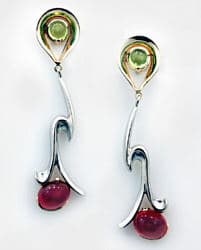
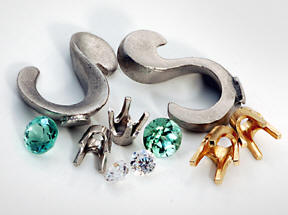 | The "S" shaped palladium earrings were cast using Johnson Matthey's 950 alloy by TechFrom, Portland, OR. There are 2 small 4 prong palladium and 2 14-karat yellow gold die-struck settings. For this project, palladium earring posts and nuts will be used. |
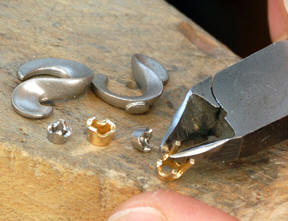 | The gemstones for this design are to be bezel set. Prongs were removed from standard 4-prong settings by clipping them off. Note: Innovative use of appropriate in-stock findings can make the difference in a sale. If you are in need of a quick solution to casting or hand-fabrication-try modification. Remember component assembly (heads, plates, jump rings and trims) when you're in a bind for time on a custom order, or trying to keep within budget constraints on time and materials. |
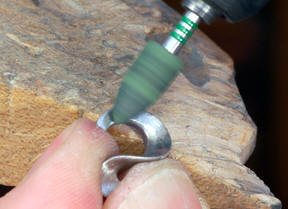 | A number 4 cut flat file was used to remove the remainder of the gates from the cast earrings. Then they were sanded using a moderately coarse bullet shaped rubberized diamond abrasive wheel. The diamond abrasive wheel quickly smoothed the rough surface left behind by the casting process. The shape of the wheel conforms to the shape of the contoured sides and top of the earrings. |
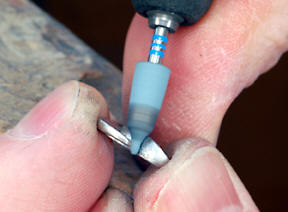 | Finer bullet shaped rubberized diamond wheels were used to smooth out the tool marks and to prepare the piece for assembly and soldering. This image shows the conformed shaped tip smoothing the side of the earring. |
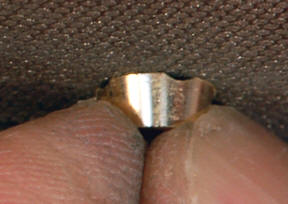 | A 200 grit 3M Diamond Flex® abrasive sanding stick was used to file the tops of the settings flat after the prongs were clipped off. |
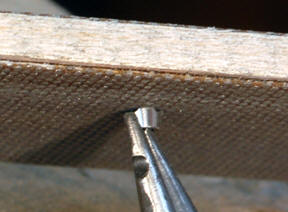 | The palladium setting was held round nose pliers for this part of the process. |
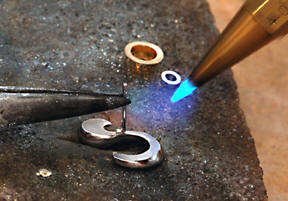 | After the pieces were pre-finished, the palladium earring posts were soldered using easy palladium solder. This customer was alerted that palladium posts may not be as rigid as white gold posts and could bend during normal wear if not careful. Palladium posts were selected for the purity of the metal. Note: Some white gold and platinum alloys are made using special ingredients that help with rigidity of parts or findings that may be vulnerable to bending or re-forming during normal wear. Metal suppliers are working on formulas for palladium alloys that can be work hardened, making them more rigid during normal wear. |
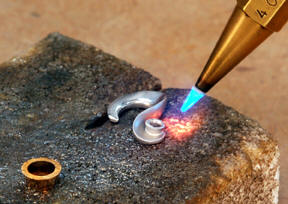 | The earring is turned upright after soldering on the post. There is a hole drilled in the soldering block which receives the post. This provides a heat sink and a place to hold the earring for soldering the bezels. The palladium bezel is soldered to the earring using easy palladium solder. The heat from the torch is deflected off of the high-heat soldering block onto the earring as well as over the earring. Easy palladium solder is again used. No firecoating solution or flux is used at this stage. |
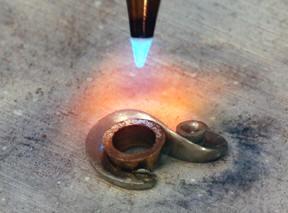 | The gold bezel is lightly sanded, cleaned and then firecoated. After positioning the gold bezel, the assembly is placed on a standard soldering board. Once pre-heated, a drop of flux is placed around the joint. For this assembly, 14-karat easy yellow gold solder is used. This is selected because it is easier to clean off of the yellow gold bezel if there is overflow. Note: When soldering karat gold to palladium, use firecoating solution and standard gold soldering flux. |
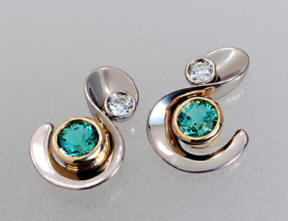 | The earring assemblies were pickled after soldering. Next they were placed in a magnetic finisher to restore the pre-finish. The palladium earrings did not tarnish since only easy flowing solder was used. After the magnetic finishing was completed, the earrings were polished and the diamonds and tourmalines were set. |
Additional Gold to Palladium Soldering Notes | |
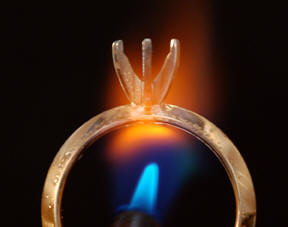 | For soldering palladium settings to a 14-karat yellow gold shank, it is important to have a good joint with a sufficient base. In this example, a notch wide enough to fit the base of the palladium setting was filed in the top of the ring. This provided a great platform and a good connection that will not fail. |
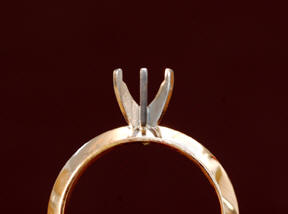 | Solder was placed at the base of the peg inside the ring shank. The ring was pre-heated with a broad flame. The solder melted and flowed up the peg and around the base of the palladium setting making a strong joint. |
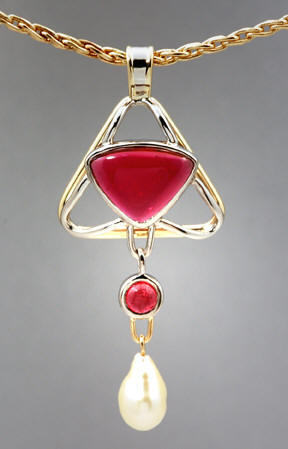 | This 14-karat yellow gold and palladium pendant was assembled using the same techniques. Notice the bail is palladium with yellow gold wire rims. 14-karat easy white gold solder was used for this assembly because white solder is easier to remove from the palladium piece. |
Palladium Jewelry Manufacturing: Frequently Asked Questions:
![[]](https://www.ganoksin.com/wp-content/uploads/2016/06/listblack.gif) How are 950 palladium alloys for hand engraving? How well does the engraved pattern hold up during normal wear?
How are 950 palladium alloys for hand engraving? How well does the engraved pattern hold up during normal wear?
This ring is a cast tapered band. It was smooth and highly polished prior to sending it out for setting and hand engraving. Thirteen 0.01 and 0.02 carat round brilliant diamonds were flush-set in the ring. After the diamond setting was completed, the floral pattern was hand-engraved. Bright-cuts with mill-graining were applied at the bottom portion on each side.
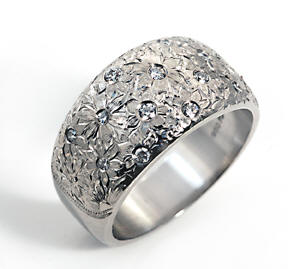
This ring design was laid-out using 3D jewelry design software. It was cast then pre-finished and polished. The final steps included stone setting and hand-engraving.
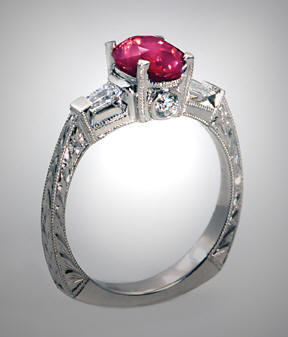
Both rings were cast using Johnson Matthey's 950 palladium alloy by TechForm, Portland, OR. Three samples of castings from the same lot of rings were tested for Vickers hardness by Koon-Hall-Adrian Metallurgical Labs in Portland, OR. The hardness of the 3 cast pieces ranged from 141 to 164. At this hardness, the rings will hold the engraved pattern during normal wear.
The stone setting and decorative hand-engraving were completed by Holman Design Group, a trade shop located in Dallas, TX. The hand-engraver attested, "The rings had a smooth consistent surface that engraved evenly. Achieving a nice deep evenly cut pattern was straight forward. The metal flaked away with ease and overall, it was not gummy".
Related Articles

950 Palladium: Laser Welding Techniques

950 Palladium: Custom Made Components

950 Palladium: Successful Design Considerations
950 Palladium: Manufacturing Tips and Techniques
The All-In-One Jewelry Making Solution At Your Fingertips
When you join the Ganoksin community, you get the tools you need to take your work to the next level.