Tanzanite Gemstones
Due to tanzanite fragile nature, the stone is very easy to abrade, scratch, or chip during the setting process. When hammering or tightening a tanzanite, use great care and develop a habit of regularly checking for proper fit and metal contact with the stone as you go. Abrasions and scratches often occur during the final prong shaping. Therefore, shape the prongs as much as possible before setting the stone. Once the stone is set, finish any shaping with a safety-edge file.
4 Minute Read

Tanzanite is named after Tanzania , the country in which the stone was discovered in the 1960s. The stone's unique combination of blue and purple is due to pleochroism, a property of some gemstones in which different colors are visible in different crystal directions. If the stone is cut skillfully, all of the colors can be seen. A stonecutter may also choose to orient the cutting of a tanzanite so that it appears more blue or more purple.
Tanzanite has a wide range of qualities and appearances. Stones are expected to be eye-clean and are usually clean under microscopic examination. Color is the deciding factor in determining the value. In general, the more blue the stone, the higher its value. High quality stones have a deeply saturated color with a velvety richness, while less valued stones are lightly colored.
When buying loose tanzanite, be careful of stones that are cut very deeply (a common way to increase color saturation) or have excessive pavilion depth, which can make setting difficult. We advise against having a very deep tanzanite re-cut for easier setting, since the color could change and reduce the stone's value.
In terms of its market status, tanzanite's short history has been volatile. There have been peaks of very high prices due to increased demand, as well as tragic accidents at the mines that have interrupted production. The peaks have been interrupted by very low pricing due to overproduction and false media accusations of links with terrorist organizations.
Rock Solid Facts
Mohs Hardness: 6 to 7
Cleavage: 1 perfect
Enhancements
The vast majority of tanzanite comes out of the ground a yellow-brown color with slight hints of violet. The stones are then heat-treated to create the rich blues and purples that have made tanzanite one of the most popular gems on the market today. This treatment is considered permanent and stable.
Clean It
A delicate stone, tanzanite is easily chipped or scratched. Most tanzanite also contains liquid-filled inclusions. These two factors mean that the stone requires special handling during cleaning. Ultrasonic cleaners are not recommended, as the heat can cause thermal shock and the ultrasonic vibrations can fracture the stone. Although damage due to ultrasonic cleaning is rare, risking a very expensive stone, a customer's stone, or a uniquely cut stone that is difficult to replace is not worth the potential hassle.
Steam cleaners and tanzanite are also not the ideal combination, since tanzanite can suffer from thermal shock and fracture. As with ultrasonic cleaning, problems with steam cleaning are rare but not unheard of. The safest route to avoid potential problems is not using an ultrasonic or steam cleaner.
So how can you clean a tanzanite?
We prefer to use a soft brush and warm water. You can dip the brush in hot ultrasonic fluid and then use it to clean the stone. You can also dip a tanzanite-set piece in the ultrasonic when the machine is off and the solution is not so hot that you can't put your fingers into it comfortably. If the solution is too hot for your fingers, the change from ambient temperature may be enough to cause thermal shock to the stone.
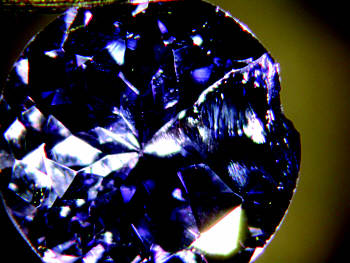 |
| This tanzanite was chipped in an attempt to push a heavy white gold prong over the stone. Photo by Anton Nash. |
At the Bench
Due to tanzanite's fragile nature, the stone is very easy to abrade, scratch, or chip during the setting process. When hammering or tightening a tanzanite, use great care and develop a habit of regularly checking for proper fit and metal contact with the stone as you go.
Abrasions and scratches often occur during the final prong shaping. Therefore, shape the prongs as much as possible before setting the stone. Once the stone is set, finish any shaping with a safety-edge file.
Tanzanite's softness also makes it vulnerable to polishing compounds. Pre-polish as much of the mounting as possible before setting the stone. For the final polish, use a flex-shaft with small polishing tools, as they offer greater control and decrease the possibility of hitting the stone.
When sizing or repairing a tanzanite piece, note that tanzanite cannot tolerate heat from a jeweler's torch. Removing the stone is the safest course of action during a torch repair. However, if a setting is particularly unyielding, removal may cause more damage to the stone than would leaving it in place. If removal is not possible, place the stone in water or cover it with a heat retardant.
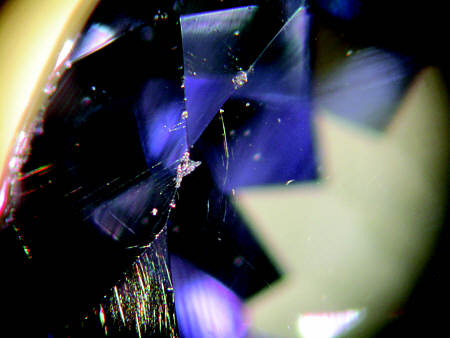 |
| This tanzanite shows the results of daily wear in a ring: abrasions on the facet junctions. The scratches on the facets may be a result of sloppy finishing or of daily wear.. Photo by Anton Nash. |
Tools That Rule
- A laser welder allows tanzanite to be left in place during repairs. Make sure a skilled operator uses the machine, since hitting the stone with the beam will likely result in damage.
- A hydro torch has a concentrated flame that can be directed to very specific areas, thus minimizing the chance of exposing the tanzanite to too much heat.
- Heat shields or water baths are critical in repair situations where the tanzanite cannot be removed from its setting.
- A flex-shaft equipped with small polishing buffs and disks is ideal for a last minute polish that won't damage the tanzanite.
This column is adapted from MJSA/AJM book Working with Gemstones: A Bench Jeweler's Guide with by Julie Nash, GJG, ASA, and Arthur Anton Skuratowicz, GJG, CGA. The authors co-own AntonNash LLC: Independent Jewelry Appraisers and Consultants, based in Colorado Springs, Colorado.

In association with

The award-winning Journal is published monthly by MJSA, the trade association for professional jewelry makers, designers, and related suppliers. It offers design ideas, fabrication and production techniques, bench tips, business and marketing insights, and trend and technology updates—the information crucial for business success. “More than other publications, MJSA Journal is oriented toward people like me: those trying to earn a living by designing and making jewelry,” says Jim Binnion of James Binnion Metal Arts.
Click here to read our latest articles
Click here to get a FREE four-month trial subscription.
Related Articles

The Treatment of Gemstones

Titanium – Properties – Design – Processing

Gem Dealer’s Secret – Table of Contents

A Journey to Burma’s Jade Mines

The All-In-One Jewelry Making Solution At Your Fingertips
When you join the Ganoksin community, you get the tools you need to take your work to the next level.