The Sprue System Design
A very high percentage of investment casting defects can be directly or indirectly attributed to the design of the sprue system feeding metal to the pattern. Defects such as incomplete pattern filling and shrinkage porosity are easily identified as directly related to poor sprue design. Gas porosity might be caused by a poor burnout but it could also be caused by casting at a higher than necessary temperature. And the elevated temperature could be necessary for complete pattern filling through an inadequate sprue system; this is an example of the sprue system indirectly causing a defective casting.
25 Minute Read

A very high percentage of investment casting defects can be directly or indirectly attributed to the design of the sprue system feeding metal to the pattern. Defects such as incomplete pattern filling and shrinkage porosity are easily identified as directly related to poor sprue design.
Gas porosity might be caused by a poor burnout but it could also be caused by casting at a higher than necessary temperature. And the elevated temperature could be necessary for complete pattern filling through an inadequate sprue system; this is an example of the sprue system indirectly causing a defective casting.
The Rule of Thumb and Best Practice
The rules of good practice are not well defined when it comes to sprues in jewelry casting. We say the main sprue needs to be larger than the feeds sprue and the cross sectional area of the feed sprue should be between 70 and 150% (depending on who you read) of the attachment point on the pattern and be attached to the pattern at its thickest section.
In practice, this guideline is almost useless except to warn us not to make feed sprues any smaller than they have to be and still there are exceptions. Some of the literature calls for the feed sprue to be as short as possible, but in the case of very large feed sprues feeding very thick patterns, it is written that lengthening the feed sprue can solve subsurface porosity.
There is general agreement that the junction between the feed sprue and the pattern should be filleted to smooth the flow of liquid metal and reduce investment erosion; however, there is much disagreement about how great the fillet should be and the transition shape. Some prefer the shape of the feed sprue to flare out widely at the junction and some think that such a wide flare is harder to cut and clean up and not otherwise necessary to get a sound casting. The latter group prefers a small fillet and little or no transition. Both groups seem to make good castings.
Fortunately, the casting process seems to be forgiving and allows jewelry casters great latitude when it comes to sprue design and placement. I think that every experienced caster has seen sound castings made with sprues that in theory should not have worked. Unfortunately, this has lead some casters to throw out the theory altogether though they may become very frustrated when a sprue that works on one pattern does not work on another.
Terminology
Another thing jewelry casters have not come to agreement on is what to call the various parts of a cast tree. A few years ago, in a presentation at the Santa Fe Symposium, Albert Schaler did one of his many services for the jewelry caster by bringing to our attention that we should not use the word sprue to name more than one part in a cast tree. He drove the point home by insisting that we all call the feed between the main sprue and the pattern the GATE, and we all had some fun ribbing anyone who called it a sprue thereafter.
However, now I believe we have created a new confusion. Mr. Schaler is not wrong, because the gate belongs in the feed sprue between the main sprue and the pattern, but giving something a name does not make it so. Technically, the gate controls the flow of metal and is called a gate because when it freezes it is closed and no more metal can pass that point. Gates will be discussed in more detail later, but now I want to get back to defining terms.
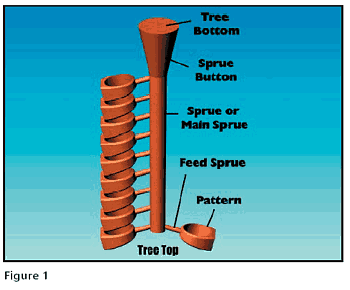
Figure 1 shows a tree, as we would build it for finger rings. The funnel-shaped opening in the investment mold forms the Sprue Button and that is always described as the bottom of the tree even if it is facing up. Of course, the opposite end is always the top of the tree. The trunk of the tree is called the Sprue or Main Sprue. The limb (branch) of the tree is called a Feed Sprue and the object of the casting is called the Pattern. There are also Runners and Secondary Sprues, but we can address them later.
What is the Best Shape for a Sprue and Feed Sprue?
The purpose of the sprue system is to hold the wax patterns in place until the wax tree is invested and then provide a route for that wax to drain out of the invested mold. After the burnout, the sprue system provides the conduit for the metal to get to the pattern cavities and its design controls how much turbulence andtemperature loss the liquid metal will experience along the way.
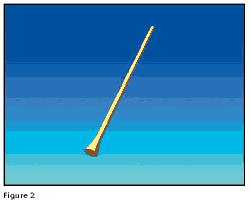
Turbulence is the enemy of casters. Turbulence can cause the metal to entrain gas and speeds temperature loss. While turbulence cannot be avoided altogether, we need to do whatever we can to minimize it. We can learn from industrial and dental casting that tapered sprues are best from the standpoint of reducing turbulence. A ratio of 1.1:1 for straight sprues and 1.3:1 for bent sprues are said to be adequate to reduce turbulence. The transition from the sprue button to the main sprue will either induce turbulence or reduce it, depending on the design, Figure 2. Round sprues are the best geometry because they will convey the metal with less temperature loss than any other shape of equal weight.
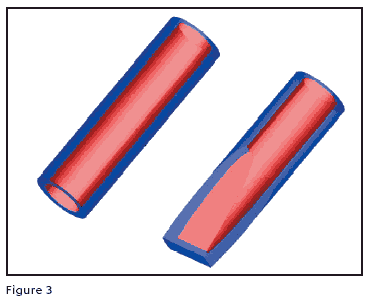
A few years ago, some simple experiments were carried out to help understand the fluid dynamics of feed sprues. Two 3 mm tubes were produced and attached to the end of a pipe. One tube was 3mm inside from end to end and the other was squashed flat on one end to mimic a sprue that had been hammered to a flat taper, Figure 3.
The pipe was filled with water and the time for the water to pour out of each tube was measured. The round tube drained the water in 21 seconds and the flattened tube drained the same amount of water in 38 seconds. So the round sprue allowed 45% more fluid through than the flattened sprue could in the same time. If we think about how the metal freezes we can imagine that the solidification starts at the interface with the investment on all sides and progresses inward to a point farthest from the surface. If the narrowest section of the flattened sprue were 1 mm and to keep the problem simple we said the rate of solidification was 1 mm per second, then it would take the flattened sprue one half second and the round sprue two and a half seconds to freeze solid.
These are rough numbers, but they indicate that the 3 mm round sprue will allow a pattern to fill in almost half the time the flattened sprue would require and that the round sprue stays open about five times as long. That is an impressive difference, but why is it important for the sprue to stay open a long time, doesn't the metal stop flowing as soon as the pattern cavity is completely filled? The answer is yes and no: in the first stage, the liquid metal completely fills the pattern cavity and it does stop flowing, because all the space is occupied.
But there is a physical property to the metal called the shrinkage of solidification. The metallurgist figure that the difference in volume between the liquid and solid state of most silver and gold alloys is 5 to 6%. That means that as the metal solidifies, it is losing volume and, if the feed sprue is still liquid, then more metal can now flow in to fill the space that the shrinkage is producing. If the feed sprue is not liquid when the metal in the pattern starts to freeze, then all the volume lost because of shrinkage will be shrinkage porosity in the casting.
The Basics
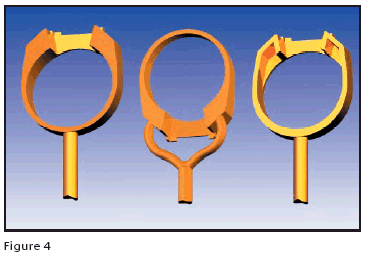
In Figure 4 we can see the same ring shape in three configurations. The ring on the left has a thin shank, the top is solid and heavy and a nice feed sprue is attached to the bottom. This ring would surely have a great deal of porosity if it were cast as shown. If the requirement was to cast the ring without secondary feed sprue starts to fill. This can be tested with a rubber mold by turning the wax injector pressure down until the pattern fill is incomplete. If the secondary feed sprue is feeding from the pattern as well as the primary feed sprue and is discontinued between the two points, then it is back feeding and not doing the intended job.
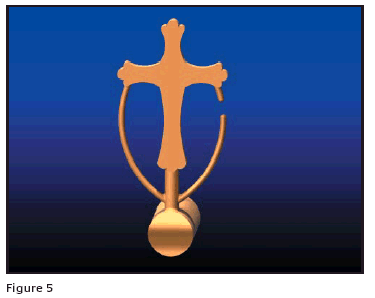
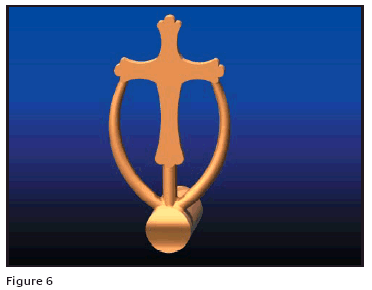
In Figure 5 is an example of an unbalanced feed sprue that back feeds. The metal will fill the pattern before the secondary feed sprues start to fill. The last point to fill will be mid-point of the secondary feed sprues. Figure 6 shows a more balanced feed sprue system in which the metal will flow to the top of the cross in about the same time it flows to the arms of the cross and the last points to fill will be mid-arm on each side. Notice that the attachment point to the main sprue is different than that in Figure 5.
Modifying it, then the feed sprue on the center ring would feed the two large sections and may give sound castings most of the time. If the ring could be modified, then the top portion could be hollowed out from the finger side and the shank made thicker as the ring on the right is done. The feed sprue can be attached at the bottom and this ring should make a sound casting every time if all other parameters are correct. Similar illustrations have been in many articles and, as you can see, the two rings to the right follow the rule of thumb. That is not the whole story however.
The V's and Y's of Spruing
When a feed sprue must feed more than one part of a pattern, then it is common to split the feed sprue and make a 'Y'. Attention needs to be given to the 'Y' feed sprue so that the metal starvation and investment erosion is not designed in. The stem of the 'Y' becomes the primary feed sprue and must have enough cross sectional area to supply ample metal to fill the two secondary feed sprues it splits into. Investment erosion can result from liquid metal washing against a sharp edge, so make the inside of the split rounded, not sharp.
If the temperature difference between the metal and the investment is expected to be large, as would be the case casting palladium white gold, concern for the turbulence and subsequent cooling that would be expected where the metal splits off into the two secondary feed sprues of a 'Y' can be relieved by using a 'V'. The wax can be produced with a 'Y' sprue that is cut off to form a 'V'. With all other parameters constant, the 'V' feed sprue will deliver metal to the pattern with less temperature drop than the 'Y', because the metal path is shorter and less tortuous.
A 'Y' is a balanced fluid system because, when the metal gets to the junction where it splits into two streams, the metal will not favour one side or the other unless some other force (such as centrifugal casting) is involved.
Unbalanced Secondary Feed Sprues
Once a liquid commences to flow down a pipe it will follow the line of least resistance. If a feed sprue has a secondary feed sprue branching to one side, the metal will not run into it until backpressure forces a change in direction. When the primary feed sprue is larger than the secondary feed sprue in an unbalanced system, the pattern is often filled completely before the secondary feed sprue starts to fill. This can be tested with a rubber mold by turning the wax injector pressure down until the pattern fill is incomplete. If the secondary feed sprue is feeding from the pattern as well as the primary feed sprue and is discontinued between the two points, then it is back feeding and not doing the intended job. In Figure 5 is an example of an unbalanced feed sprue that back feeds.
The metal will fill the pattern before the secondary feed sprues start to fill. The last point to fill will be mid-point of the secondary feed sprues. Figure 6 shows a more balanced feed sprue system in which the metal will flow to the top of the cross in about the same time it flows to the arms of the cross and the last points to fill will be mid-arm on each side. Notice that the attachment point to the main sprue is different than that in Figure 5.
Runners
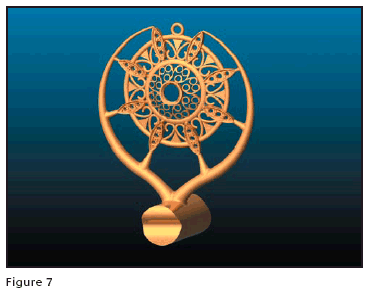
A runner originates at the main sprue and has several feed sprues attached to multiple patterns or multiple points on a single pattern. Runners generally fill to the end and then backpressure starts the metal to flow into the feed sprues. Figure 7 has an example of runners properly used. Having a stock of cast tapered runners and feed sprues on hand can greatly reduce the time required to prepare them for a master model.
Mixing Thick and Thin Patterns on a Tree
Thin patterns and thick patterns should not be cast on the same tree. If the temperature is high enough to cast the thin patterns beautifully, then the temperature should be too high to get good casting on the thick patterns if they are treed together. Thin patterns fill better at the top of a tree because the pressure is higher there than it is at the bottom of the tree. If thin patterns will not fill at the bottom of the tree, then the feed sprue may not be large enough or attached to the pattern in the best way or the temperatures may be too low. Patterns that cast well at the same flask and metal temperature can be mixed on the same tree with more challenging patterns at the top and easy to fill patterns at the bottom.
Heat Dissipation and System Temperature
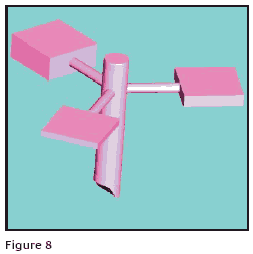
If we cast three patterns that were 15 x 15 mm x 1, 2 and 4 mm thick respectively, Figure 8, on the same tree we could say that the casting conditions were the same for all three patterns, because the investment and the metal were the same temperature when the metal was cast. The surface area on the top and bottom of all the patterns is constant; the only increase in surface area on the larger patterns is on the sides thus the volume increases much faster than the surface area, Table 1.
All the heat lost to the investment from the metal must be through the surface interface. We know that investment is a poor conductor of heat and measurements taken by Dieter Ott show that, after the metal is cast, only 1 to 1.5 mm thickness of investment material next to the metal will experience any temperature change and naturally, as the metal cools, the adjacent investment heats.

The temperature of the metal may have been the same when it was cast, but each pattern holds a different amount of metal and, therefore, a corresponding amount of heat energy. The 4 mm thick pattern will discharge 4 times the heat to the investment relative to the 1 mm pattern. This means the temperature rise of the investment will be much greater around the 4 mm pattern than around the 1 mm pattern and the 2 mm pattern should be in-between.
If the metal temperature and the flask temperature are correct for the 1 mm pattern (this is the hardest to fill and requires higher temperature), then the temperature will be too high for the larger patterns and gas porosity is likely.
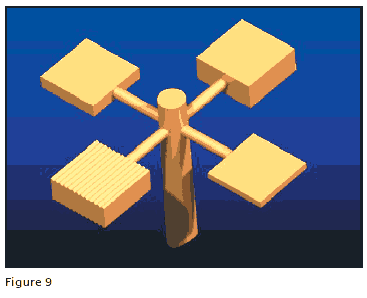
Casters have a practice of classifying their patterns for flask temperature, Heavy, Medium and Light. Most casters would classify two of the patterns on the tree in Figure 9 as heavy and one each as medium and light. The term System Temperature is used to describe the effect that surface area and volume (surface area to volume ratio) have on the cooling of the metal and the subsequent increase in the temperature of the investment at the metal interface for a specific pattern, flask and metal temperature and alloy. The pattern with the grooved surface has less volume of metal as the other 4 mm thick pattern and the surface area is somewhat more. Because of that it might cast better at the 'medium flask' temperature. We can conclude from this that:
- System temperature is pattern specific. When considering which patterns can be on the same tree, the surface to volume ratio should be noted, not just the cross sectional thickness.
- When the pattern has high surface area and low volume (thin patterns), the flask temperature influence is greater then that of the metal temperature. As volume increases in ratio to surface area (thick patterns), the flask temperature influence on the system temperature decreases.
- Flask temperature is controlled by the hardest to fill pattern on the tree.
- When thin and thick patterns are on the same tree, the flask temperature has to be high enough to fill the thin patterns, and would be too high to cast the thick patterns at their best system temperature.
- . System temperature is alloy specific. The casting temperature for a metal has to be above the liquid temperature and since various alloys melt at different temperatures, the casting temperatures will vary as well. For a particular alloy, the casting temperature will generally be lower for thick section patterns and higher for thin section patterns, but in every case the casting temperature of the metal is strongly influenced by size, shape and attachment point of the feed sprue. Betterdesigned feed sprues will allow casting at a lower system temperature.
Test for System Temperature
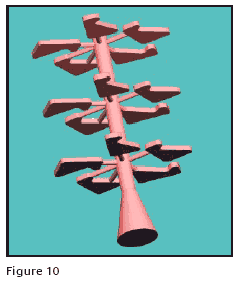
A simple experiment can be used to quickly find the best system temperature for a range of patterns cast with a specific alloy. Build five trees alike with five or six different patterns on each tree, as seen in Figure 10. The selection of patterns should represent the variety of patterns you cast; for example thin, medium, thick, large and small. Inspect all the wax patterns before using them and attach them the same side up. The patterns are attached in a vertical row at the top, center and bottom of the main sprue.
Do not expect all the different patterns to cast well on any one tree; rather, the purpose is to find out how each pattern casts at a temperature combination. If there are five patterns on the tree, one cast will give a good idea how each of these different patterns will cast at a given temperature set and, therefore, five experiments are performed in one cast. This is called a designed experiment, whereby the normal methodical testing process is shortcut.

A set of test trees, as described above, are cast using a grid of flask and metal temperatures. Your grid should note the alloy and the patterns being cast. Put the presumed temperature sweet spot in the center of the grid as shown, Table 2; in this case, the flask temperature is 550°C and metal 1000°C. Cast one flask at each temperature combination on the grid above, below and at each side of the sweet spot. Make sure all the flasks are well soaked at the casting temperature before casting. Holding the flask for three or four hours at casting temperature is considered prudent to get good experimental results.
After casting, inspect the casting in the as-cast condition, record the results and send any promising casting through finishing and normal quality inspection. A simple inspection criterion can be used to grade the casting for evaluating test results.
Inspection Criteria
All casting inspected and rated as a 1, 2 or 3 where
1 = any casting that can be finished and would pass internal quality control
2 = any casting that can be repaired, finished and would pass internal quality control
3 = any casting that is rejected, not economic to repair
In most cases, the casting graded #3 will be sorted out in the as cast condition. Some #2 castings may be identified in the as cast condition, or subsurface defects may show up later. Wax patterns must be free of any powder. By careful inspection of wax patterns before casting, defects attributed to the mold and wax pattern can be eliminated. Care should be given to identify any defect that can be attributed to investment or burnout. Fins from cracked investment, or voids caused by investment inclusions, for example, are not temperature related casting defects and should be excluded from this test grading. A short list of defects that should be attributed to wrong System Temperature are incomplete filling, gas porosity, shrinkage porosity, rough surface (where the wax was smooth), and cracks.

After the castings are graded, the score (1, 2 or 3) for each pattern number is recorded on a test results chart, Table 3. The test data is easy to understand in this form and trends can quickly be seen. The example in Table 3 clearly shows the best flask and metal temperature for casting pattern # 213 in alloy 18KY. Pattern 213 was picked to represent a larger selection of patterns that were judged to have similar surface-to-volume ratios and, therefore, would be expected to cast well at similar flask and metal temperature. So all patterns that are represented by pattern 213 in the test should be cast at metal 980° and flask 550°.
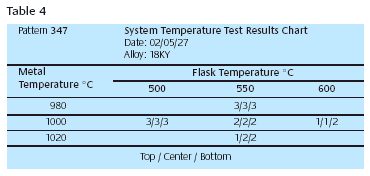
The goal is to get all grade one castings and it is possible that that is not achieved for a pattern in the temperature grid that was picked for the test. In Table 4, pattern 347 is used to show how the chart can identify trends. Metal 1000° and flask 600° is the best, but not good enough. Since Metal 1020° and Flask 550° is much better than Metal 980° and Flask 550°, the trend to improve would be to increase metal temperature to 1020°. This could be done as a single cast test, or a new grid could be formed with a new presumed sweet spot.

Test for Best Feed Sprue Design
After the system temperature is found and applied to the range of pattern styles produced, it may become evident that not all the patterns are casting with the desired quality at the system temperature chosen for it. This leaves two options: find a new temperature set for that pattern, or experiment with the feed sprue. If the casting surface is rough and such things as powder in the wax, or a rough wax coming from the mold are eliminated, then the temperature may be too high for that pattern and a lower temperature can be explored. If the surface is very fine but detail such as prongs are not filling, the feed sprue may be to blame.
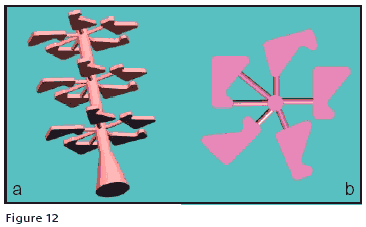
Another designed experiment can be used to find the feed sprue design that works best for any pattern. This time, only one pattern design will be used on the tree, but it will be attached with five different feed sprue configurations. Using wax wire (or wax feed sprues made in a rubber mold, Figure 11), attach feed sprues to the patterns in different locations. Build a tree in the same manner as the system temperature and test with three patterns on the tree with each of the five or six feed sprue configurations, Figures 12a and 12b. One flask may be all that is required to solve the defect, but if the results are not satisfactory, then make and cast additional flasks on a new temperature grid.
Attachment Point
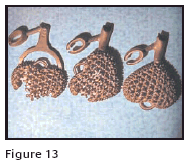
The geometry of the pattern itself can be used to enhance the effectiveness of the feed sprue. In Figure 13, the same pattern was cast on the same level of the same tree with a palladium white gold alloy. The pattern on the left was cast with a flat feed sprue and the two patterns on the right were cast with the same tapered round sprue. Attaching the feed sprue to the point of the heart allows the metal to flow more smoothly, providing a complete fill where the same size and shape feed sprue didn't do as well when attached to the side of the heart.
Pattern Position
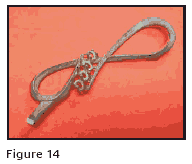
Sometimes pattern position can make a difference too. A silver pin in the form of a bow with stone setting prongs in the center is an example of such a feed sprue study. When the system temperature that produced the smoothest as-cast surface was used, several feed sprue configurations were tried with strongly varying results. The single feed sprue in Figure 14 produced shrinkage porosity on the opposite loop from the attachment point. Adding a second feed sprue, Figure 15, only moved the porosity. When the position was changed from vertical to horizontal with two feed sprues, Figure 16, the porosity was eliminated but prongs did not fill completely. The prongs could be filled in this position by increasing the metal temperature but the surface was not as good as desired.
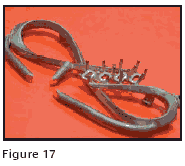
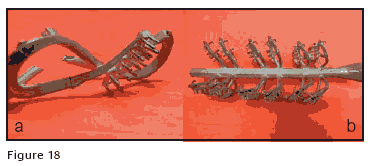
To our surprise, adding a third feed sprue to the center, Figure 17, still didn't fill the prongs completely. Finally, using two feed sprues and facing the pattern to the flask wall gave excellent results, Figure 18a. Figure 18b shows the successful feed sprue arrangement on the left side of a tree with a control pattern of a previous arrangement on the right. If the control patterns cast as expected and the new feed sprue is better, then you can be more certain that there is real improvement in the feed sprue design and the result was not an anomaly. Why the position made a difference in this case is not known and this subject needs more study.


Where is the Gate?
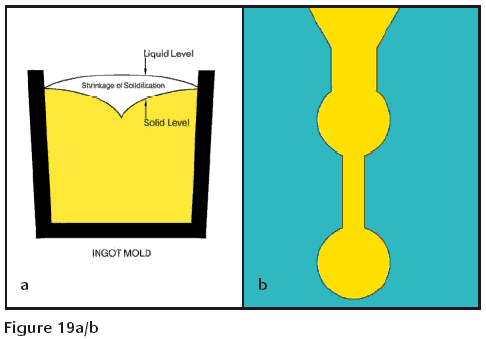
At the beginning of this article, a promise was made to discuss gates in more detail. Remember the discussion about the shrinkage of solidification and metal flowing to fill the void space it causes. If you have ever cast an ingot, you have undoubtedly been witness to this shrinkage. When the ingot is first poured, the liquid metal is slightly domed on the top, Figure 19a. When the metal has solidified, the top will have a big sink that is greatest in the center. The difference in volume is nature's graph of the volume lost to the shrinkage of solidification. If a casting were made with two spheres connected by a rod, as pictured in Figure 19b, and fed at one end by a large feed sprue, the metal would fill the entire cavity. The little rod would be the first place to start freezing, because it has relatively little volume compared to the surface area in contact with the investment.
The spheres, on the other hand have a great volume relative to their surface area. After all the metal has solidified, the sphere connected to the feed sprue would have little shrinkage porosity while the other sphere would have shrinkage porosity equal to the total shrinkage of solidification for that volume and alloy. The reason for the difference is the gate. When the little rod froze, it became the gate stopping the flow of metal to the second sphere, while the large feed sprue was able to continue feeding metal to the first sphere while it was shrinking. This is a classic thick-thin-thick pattern that is always a recipe for shrinkage porosity.
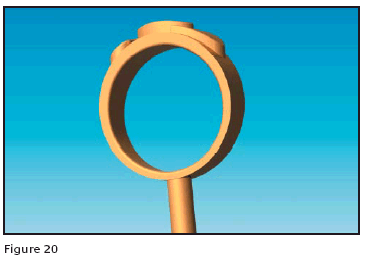
Putting a 3 mm round feed sprue on a 1 mm x 2 mm flat ring shank does not reduce shrinkage porosity at the thick top of the ring, Figure 20. In this case, the thin ring shank itself becomes the gate when it freezes on either side of the feed sprue.
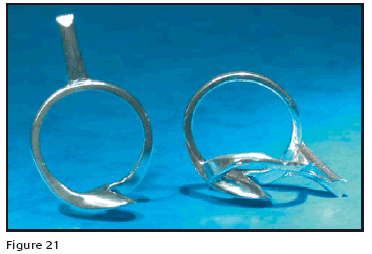
The ring on the right in Figure 21 has a secondary feed sprue and cast with porosity at the top. The ring on the left side was reworked making the top thinner and the shank thicker. The reworked ring has the same weight as the original and looks the same on the finger, but it is easier to wax, and will cast without porosity. This is an example of designing high cost of production in with the original pattern and designing high production cost out in the reworked pattern.

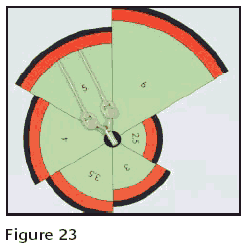
Properly designed feed sprues are one of the most important aspects of a master model and should be well studied before something is attached. Here is a simple little template that I call a Sprue Gauge. I made this to help the model maker design the feed sprue attachment*, Figure 22. The black line represents the cylinder or flask wall. The red area is the safety zone of investment into which the wax patterns should not extend. The black dot in the center is the main sprue. The red line on the pattern shows where a line is engraved on the master model so the tree maker knows where to cut the wax to get uniform feed sprue length.
A pattern can be placed on this little template for study about how to best attach the feed sprue before any metal work is done, Figure 23. These two patterns will best fit in a 125 mm or 5 inch diameter flask.

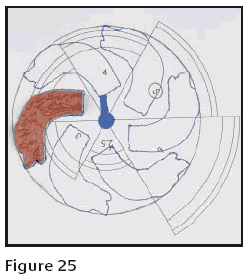
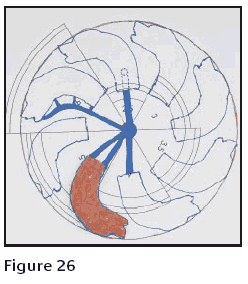
Three of the dog pattern, Figure 24, can be cast on a level in a 100 mm diameter flask. However, there are limited options for the gate attachment points. The attachment angle of the feed sprue becomes evident but might not have been without the sprue gauge. Six of the same dog pattern will fit on a level in a 125 mm diameter flask, Figure 25. The gate attachment points are more limited unless fewer patterns are on a level. A 150 mm diameter flask can hold 8 parts around with a lot of flexibility for feed sprue attachment points and design, Figure 26.
Depending on the structure of the pattern, any one of these gate designs could work. Casting all of them in the same test flask is the easy way to see which of them is the best. Make a temporary mold on the master model. Wax patterns from the temporary mold can have feed sprues attached by hand in different configurations and test cast before committing the master model to the feed sprue that will be used in production. Knowing the product can be cast economically before production starts will save a lot of wasted time and money.
Related Articles

5 Classic Casting Tips

Revving Up the Burnout Process

How to Make a Wax Injector

Testing the Ultra-Vest MAXX Investment



The All-In-One Jewelry Making Solution At Your Fingertips
When you join the Ganoksin community, you get the tools you need to take your work to the next level.