Testing the Ultra-Vest MAXX Investment
AJM recently asked Linus Drogs of AU Enterprises in Berkley , Michigan , to test the new Ultra-Vest MAXX Investment from Ransom ' Randolph in Maumee , Ohio . Designed to reduce the formation of gas porosity when casting white gold alloys, as well as provide smoother surfaces on castings made from resin rapid prototype model materials, Ultra-Vest MAXX is a reformulation of Ultra-Vest, the company's standard gold and silver casting investment. It promises to offer thermal stability under severe casting conditions. Drogs and his staff at AU Enterprises put the investment to the test in the shop. Their results follow.
3 Minute Read

Editor's Note: AJM recently asked Linus Drogs of AU Enterprises in Berkley, Michigan, to test the new Ultra-Vest MAXX Investment from Ransom & Randolph in Maumee,Ohio . Designed to reduce the formation of gas porosity when casting white gold alloys, as well as provide smoother surfaces on castings made from resin rapid prototype model materials, Ultra-Vest MAXX is a reformulation of Ultra-Vest, the company's standard gold and silver casting investment. It promises to offer thermal stability under severe casting conditions. Drogs and his staff at AU Enterprises put the investment to the test in the shop. Their results follow.
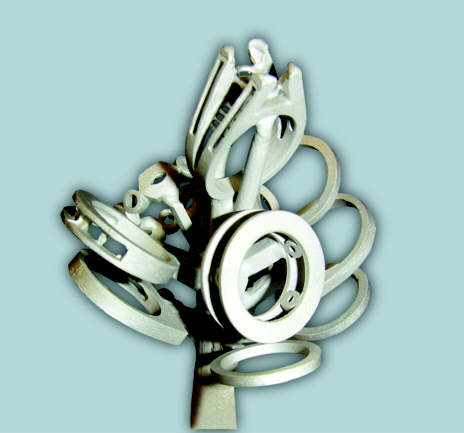 |
| There was a noticeable decrease in micro gas porosity in the white gold castings, without a tremendous increase in surface finish in the as-cast state. Photo by Linus Drogs. |
The Setup
To examine surface texture and fill, we began our testing of the Ultra-Vest MAXX with some basic flat plates and wax grids. After preliminary test-casts of these basic shapes in silver, we proceeded to cast 18k white gold trees. Our goal was to determine if the reformulation would affect permeability or surface finish in the as-cast state.
The grids, plates, and trees were set up on standard rubber bases with 4 inch by 6 inch perforated flasks. We followed the investing procedure recommended by the manufacturer: an eight minute total working time and a 40/100 deionized water/powder ratio. Both the investment and the deionized water were at room temperature. The powder was added to the water in a vacuum investing machine with the flasks in the lower chamber. Mixing time was a full five minutes, plus two and a half minutes for pouring. There was no detectable difference in gloss-off times compared to the standard Ultra-Vest investment, but the Ultra-Vest MAXX seemed to mix slightly thicker. After a one hour bench set, the flasks were ready to be loaded into the oven for burnout. We used a 12 hour burnout schedule with a maximum temperature of 1,350°F/732°C held for four hours, and a one hour hold at casting temperature.
The Cast
The burned out flasks were loaded in an induction casting machine fitted with a pressure-over-pour option, and argon was used as the cover gas. Flask temperature was 1,000°F/538°C for casting the grids and plates in silver, and 900°F/482°C for casting the tree in 18k white gold, with only a small superheat applied to the metal for casting.
After casting, the flasks were air-cooled for 20 minutes before quenching. De-vesting proved fast and efficient. The castings were water-pressure blasted to re-move 99 percent of the investment, and the remaining 1 percent was removed with the help of an ultrasonic. Finally, the castings were placed into a pickling solution for 20 minutes to remove the small amount of surface oxidation.
The Results
The castings were inspected for fill and surface defects before being advanced to the clipping stage. There was a very noticeable decrease in micro gas porosity in the white gold castings, without a tremendous increase in surface finish in the as-cast state. As a result, it appears that the Ultra-Vest MAXX decreases the formation of sulfur dioxide at the metal mold interface during the casting process, which causes gas porosity. Overall, this reformulation seems to benefit those who cast white gold by reducing the rejection rate caused by gas porosity. It is also a more cost-effective and efficient alternative to phosphate-based platinum investments, as it is cheaper and much easier to devest.
The Future
During this product testing, we conducted preliminary experiments to see if the Ultra-Vest MAXX would improve the burnout of rapid prototype (RP) models. These resin models are currently causing headaches for many casters because they leave behind an ash residue that ends up in our castings as voids. We wanted to see if the Ultra-Vest MAXX would enable us to increase the top-end temperature during the burnout cycle, therefore making burnout more effective at reducing ash residue.
Preliminary results show small downside risks associated with elevating the burnout temperature 100 degrees to 1,450°F/788°C. Since the binder in gypsum-based investments starts to break down at 1,350°F, any elevation of the burnout temperature above that point presents the risk of investment decomposition, which results in poor surfaces. However, it's essential to elevate the temperature to reduce ash residue.
Our early data indicates that by elevating the burnout temperature to 1,450°F, we significantly reduced the ash residue from the rapid prototype models, and did not obtain surface defects that would have resulted from investment breakdown.
It's important to note that our results are only preliminary and require extensive testing for validation. Further research in the area of casting rapid prototype models is ongoing.

In association with

The award-winning Journal is published monthly by MJSA, the trade association for professional jewelry makers, designers, and related suppliers. It offers design ideas, fabrication and production techniques, bench tips, business and marketing insights, and trend and technology updates—the information crucial for business success. “More than other publications, MJSA Journal is oriented toward people like me: those trying to earn a living by designing and making jewelry,” says Jim Binnion of James Binnion Metal Arts.
Click here to read our latest articles
Click here to get a FREE four-month trial subscription.
Related Articles
Casting Notes for Silver Lost Wax Casting

Revving Up the Burnout Process

How to Make a Wax Injector
Wax Casting Burnout Cycles


The All-In-One Jewelry Making Solution At Your Fingertips
When you join the Ganoksin community, you get the tools you need to take your work to the next level.