Overcoming Tool Limitations
True tales of how jewelers overcame out-of-the-box limitations - Most people who work with their hands become tool mad, and jewelers are no exception. They scoop up new tools, shop garage sales for used ones -- and then often alter what they find, grinding, sanding, drilling, and shaping their new tools to suit a specific task or way of working.
2 Minute Read

Most people who work with their hands become tool mad, and jewelers are no exception. They scoop up new tools, shop garage sales for used ones - and then often alter what they find, grinding, sanding, drilling, and shaping their new tools to suit a specific task or way of working.
"I tell my students, 'Always make sure there is enough material [in the tool] that you can change, carve, and bend [it] to suit your own needs,'" says designer Michael Good of Michael Good Designs in Rockport, Maine. As he notes, a jeweler's work should never be defined by the limitations of an out-of-the-box tool set. Instead, jewelers should ask one question: "If my hands were steel, how would I go about efficiently forming the metal in a specific way?" The answer will tell them not only what tool is needed, but how it might be modified so they have the freedom to focus on the work they want to do, not on what the tool will allow.
What follows are some examples of how a few "tool mad" jewelers have done just that, and have experienced the freedom of having a modified tool become an extension of their body.
Paens to Peens: Transforming Hammers
The hammer is one of the metalsmith's most vital tools. Good, for example, specializes in anticlastic raising, a technique that depends on forging and forming metal. Consequently, he has spent much of his working life altering the working heads (or "peens") of the hammers he uses.
Good modifies the curves and edges of the hammers so that they integrate with the curve of the stakes against which he works. Usually the modification is so slight that only another practicing metalsmith would see it, although the difference in working efficiency can be vast.
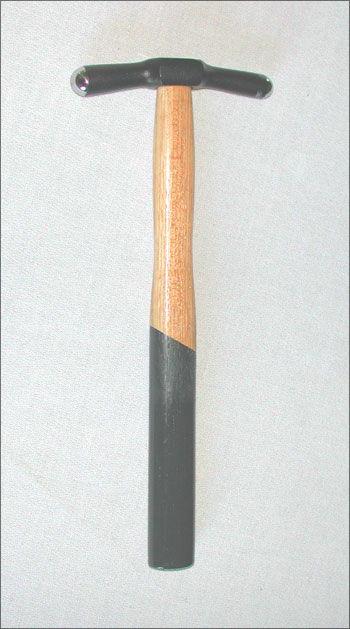 | 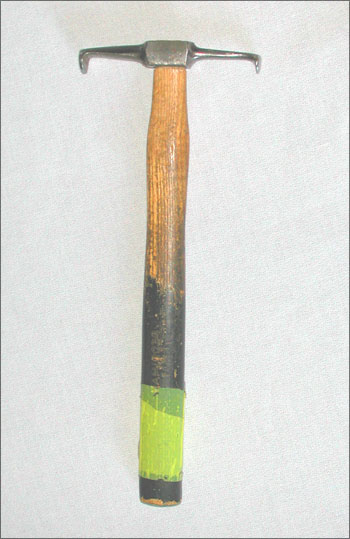 |
However, the alteration Good made to a standard embossing hammer (Figures 1a and 1b) is easy to see. Good removed much of the material from the hammer's necks (i.e., the areas directly behind the faces of the hammer heads), turning each neck into a thin bridge between the check (the part of the head into which the handle is fitted) and the face. Good finds four benefits to using this strange-looking tool for planishing:
- First, the thinned neck allows Good to work the interior surfaces of concavities without damaging the edges of the openings, as might happen with a wider hammer neck.
- Second, removing excess neck material allows him to see the working surface of the metal more clearly.
- Third, the reduction in hammer weight allows him to work with more sensitivity on delicate pieces.
- Fourth, the reduced weight of the hammer is a bonus for someone working with hammers as constantly as Good does.
Florentine Finish: Transforming a Multi-Line Graver
 |  |
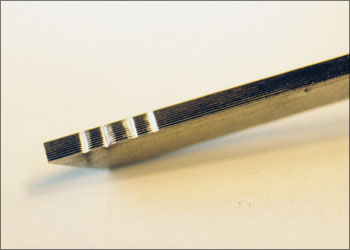 | |
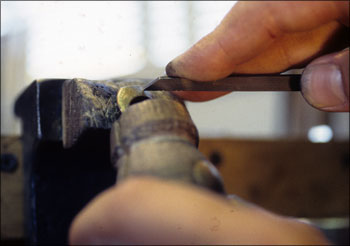
Putting a Florentine finish on a curved surface can be difficult without a lot of practice, explains Seattle studio jeweler Andy Cooperman, since the top of the graver tends to go in and out of the surface (Figure 2a).
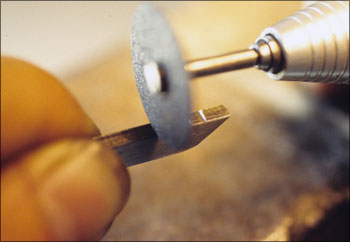
To help with this, another jeweler taught him a little trick: Using a separating disc, cut grooves, at uniform distances, perpendicularly across the lines on the face of the graver (Figure 2b). He now had a tool (Figure 2c) in which each one of those cut lines acts like the leading edge of the graver. He could now use the graver like a file (Figure 2d). The lines conform to the outside curve beautifully, he says, and he still had the tip of the graver to use in the standard way on flat surfaces.

In association with

The award-winning Journal is published monthly by MJSA, the trade association for professional jewelry makers, designers, and related suppliers. It offers design ideas, fabrication and production techniques, bench tips, business and marketing insights, and trend and technology updates—the information crucial for business success. “More than other publications, MJSA Journal is oriented toward people like me: those trying to earn a living by designing and making jewelry,” says Jim Binnion of James Binnion Metal Arts.
Click here to read our latest articles
Click here to get a FREE four-month trial subscription.
Related Articles

Customized Peg Head Holder & Stone Holder

Channel Setting Bezels with Customized Pulling Pliers
How to Modify Wooden Ring Clamps

Using Non-Jeweler’s Tools For Fabrication: How To Repurpose Painting Blades For Bezels
The All-In-One Jewelry Making Solution At Your Fingertips
When you join the Ganoksin community, you get the tools you need to take your work to the next level.