CAD/CAM Impact on Jewellery Fabrication
This paper looks at the impact computer technology, specifically CAD/CAM (Computer Aided Design/Computer Aided Manufacture), has had on jewelry fabrication during the 20th century. This is a topic not covered in the existing course outline, one that is controversial within the industry and one that has had a significant impact on how jewelry can be designed, produced and how it is perceived. In the broader picture CAD/CAM is being introduced across other artistic disciplines so the implications for a class can be seen in a broader context than jewelry alone.
17 Minute Read

This paper looks at the impact computer technology, specifically CAD/CAM (Computer Aided Design/Computer Aided Manufacture), has had on jewellery fabrication during the 20th century. This is a topic not covered in the existing course outline, one that is controversial within the industry and one that has had a significant impact on how jewellery can be designed, produced and how it is perceived.
In the broader picture CAD/CAM is being introduced across other artistic disciplines so the implications for a class can be seen in a broader context than jewellery alone.
Through my research on of this topic I've selected three readings that show the progression of jewellery through to the 20th century. The first article reviews the history of jewellery to set the stage; the second looks at CAD/CAM in the jewellery field from the perspective of the early 1990s and the third looks at craft at a crossroads, summarizing views of jewelers from both the traditional practice and those using CAD/CAM.
These readings, coupled with my other research, highlighted many of the same discussion issues raised throughout the semester: craft versus industry, the separation of the maker from the object, is the hand required in the making to call it handmade and finally is it art or is it craft.
First lets look at jewellery design and its significance to those who wore it. Body ornamentation has been around for as long as we can trace history but styles, types and the construction are a progression in time depending on circumstances, politics and materials available. Historically changes in fabrication techniques have happened very slowly.
In the Stone Age the initial human focus was on survival and simple items were worn as a talisman rather than as jewellery per se. It wasn't until Neolithic times that trades appeared, including jewellery.
By the days of the pharaohs in ancient Egypt almost everyone wore jewellery from simplistic to highly ornate depending on their status. Jewellery of the time was made from all kinds of materials - traditional metals, organic gems, manmade items and precious stones. However, like the Stone Age, much of it was an amuletic and used 'to protect the dead on their journey into the afterlife. i
The Industrial Revolution, in the 18th century, revolutionized the production of goods but created angst for the traditional crafts when artisans no longer made a complete product but only a single piece of the total work. The Arts and Crafts Movement was a reaction to this new world; they advocated the reunification of art and labour to bring the hand of the maker and the work back together. The Industrial Revolution 'had a tremendous influence on the evolution of jewelry design, the applied arts, and industrial design throughout the 20th century.ii
Art Nouveau was born of the ideals of the Arts and Crafts Movement and was popular in the 1890's using stylized natural forms and flowing lines as its signature style. This was the first time jewellery was also seen as art with 'design, creativity and imagination' being more valuable than the materials used.iii
Various movements and styles followed culminating in Art Deco signified by geometric designs and bold colours and outlines (themes that reappeared in the 1970s).
World War II interrupted any further evolution until the 1950s when jewellery found its own way forward independent of other disciplines; when jewellery became art as well as adornment.
The 1970s saw a 'redefinition of the social function of jewelry.'iv Historically apprenticeship was the training ground for new jewelers but this was now being transferred to the more open minded and less traditional art school. With all of this came the introduction of contemporary jewellery and with this 'good design was not [seen to be] in conflict with industrial production or economic remuneration.v
In the 1980s and 1990s jewellery returned to its roots - made with gold, precious stones and simply designed and by the end of the 20th century there were two jewellery streams: the first, market driven production pieces and the second, non-commercial artistic jewellery.
Going back to ancient Egypt how were those fabulous pieces of jewellery fabricated 3,000 or 4,000 years ago? Here is a comparison between then and the 20th century to put it all in perspective.
Ancient Egyptian jewelers used available materials to make tools - stones for hammers, copper or bronze for chisels, bow drills made holes, abrasive stones for sanding and charcoal fires and reed blowpipes to heat metal. Contrast this with our fully equipped studios in the 20th century, although we have the same basic tools our hammers are now metal, plastic or hide and job specific, we have saws and shears and many of our tools are motorized.
Working conditions were diametrically opposed as well. We mostly work indoors in well-appointed, clean and comfortable studios with torches that are easily lit and offer a consistent and reliable heat source. In ancient Egypt jewelers were outside exposed to the elements, sitting on stone, amid open fires, and the noise of others at work.
But some things remain the same, like today jewelers in ancient Egypt 'had to know the meanings of colors, how symbols worked together, [and] how to make each piece exactly right.'vi And many of the techniques are still in use today - forging and fabrication, repousse and chasing, as well as granulation and casting.
Then with the advent of computers the world changed again. CAD is a relatively new technology with the initial thrust 'developed by Ivan Sutherland as part of his PhD thesis at MIT in the early 1960s.vii
Although first used mostly for research and commercial applications CAD was mostly a replacement for drafting. 'Twenty-five years ago, nearly every drawing produced in the world was done with pencil or ink on paper.'viii In this system changes could mean completely redoing the drawings or maybe just an eraser and a few new lines. The major concern was if the changes had implications for other drawings these would all have to be manually identified and changed as well. With CAD the change is made once and is applicable to the entire set of drawings. So CAD 'fundamentally changed the way design is done.ix
As the technology improved and computers reduced in price CAD moved from specialist functions at large manufacturing operations to a day-to-day tool for smaller businesses.
To look at the impact of CAD on jewellery, I've selected excerpts from four writings that provide a prospective over the last part of the 20th Century. These are presented in chronological order to document the progression of the technology.
The first is by Charles Lewton-Brain and was authored in the early 1990s. Although CAD has been used in large jewellery manufacturing for some time, it is now making inroads into some smaller operations.
However designing in CAD for CAM is significantly different than for traditional fabrication and the technology can change design decisions because of what is now possible.
Another upshot of this new technology is that it is now possible for someone without any fabrication experience to create jewellery. This could then create new opportunities for CAM specialists in the jewellery industry. But having said that, the specialist must still have some knowledge of the jewelers ultimate needs to ensure the finished object comes together smoothly. Therefore in an ideal world the jeweler would be a CAM specialist with a formal jewellery education. This hybrid person would be much in demand in the near future.
Lewton-Brain sees the widespread use of CAD/CAM in jewellery stores in the future, allowing them to show prospective clients photo realistic samples of jewellery. Through 'virtual reality' the client can handle the jewellery to see how it looks. If all goes well, the order is taken, the prototyping gives a finished wax and the object is completed.
The second article is by Steven and Nancy Attaway and was written in 2001. They wonder if the Internet will become the vehicle to design and produce custom jewellery? Where maybe even the stone setting is incorporated into the CAD programs?'
They challenge us to imagine that with a few mouse clicks we could select a stone and a ring design, merge them, create a rendered image, then twist and turn it to view the result. If the client approves, a wax would be printed ready for casting. Maybe we will be able to even print the piece in metal with the stones already set. They point out that this is not all in the future, much of it happens now.
The biggest advantage and conversely the biggest disadvantage of this new technology is that it is so easy to make changes we sometimes do more work than is necessary.
The Attaway's caution that just because software is designed for jewellery does not mean it will be easy to use and that there is no one program that will do everything you want, each tends to specialize in one or two areas. However, they do not believe the technology will eliminate the need for the craftsman. In fact they conclude that although CAD and CAM are powerful tools, 'jewelry design still needs an artist's touch to make it special.x
In the third article, from 2004, Suzanne Wade writes, 'The jewelry industry has seen a veritable flood of new technologies in recent years … and after a tentative start, jewelry designers have begun to embrace them.xi
These new technologies create unique opportunities for both the veteran and the new talent alike; the boundary of possibilities is on the move, limited only by the designer's imagination. The bottom line is that 'it isn't the technologies that will create those new designs - it's the people who use them.xii
The fourth and final article, written in 2007, by John Shanahan states CAD/CAM 'maximizes … both creativity and time … [as the technology becomes] more user-friendly and artisan-intuitive.'xiii
For those who create designs 'CAD/CAM can make it easier, faster, and more efficient.xiv But like others, he cautions that without a firm footing in traditional jewellery fabrication and production 'CAD software users simply have a very detailed program that lets them draw on their computers.'xv
Part of the Lewton-Brain article addresses education in this new environment, noting that it would 'seem to offer a unique opportunity for art and industry training schools to educate their students in CAD systems.'xvi
At the time of writing this article he noted that the Tyler School of Art in Philadelphia was the primary jewellery educator integrating technology into their traditional jewellery program. This becomes an ideal situation because with cross training art schools would 'not be churning out computer operators but rather placing computers as a tool for expression in the art school
environment.'xvii In the end computers are not for everyone but they are a viable option for some.
It was interesting in light of the Lewton-Brain discussion of the Tyler Institute of Art that Rebecca Annand, a recent MFA graduate and a current teacher at Tyler, visited NSCAD on 26 November 2010.
During her presentation Annand said she was originally trained as a traditional jeweler and felt that this was an important component of her ability to integrate CAD/CAM into her work. Without her traditional fabrication background she wouldn't be making the work she is today in CAD.
Annand says the hand remains an important part of her work, even in the technological environment. This comes in her sketches, traditional fabrication, using the mouse, or finishing the final object. Sketching, testing and creating samples are just as important in CAD/CAM as in traditional fabrication to ensure your concepts are what you want. Not everything will work and it is important to know this.
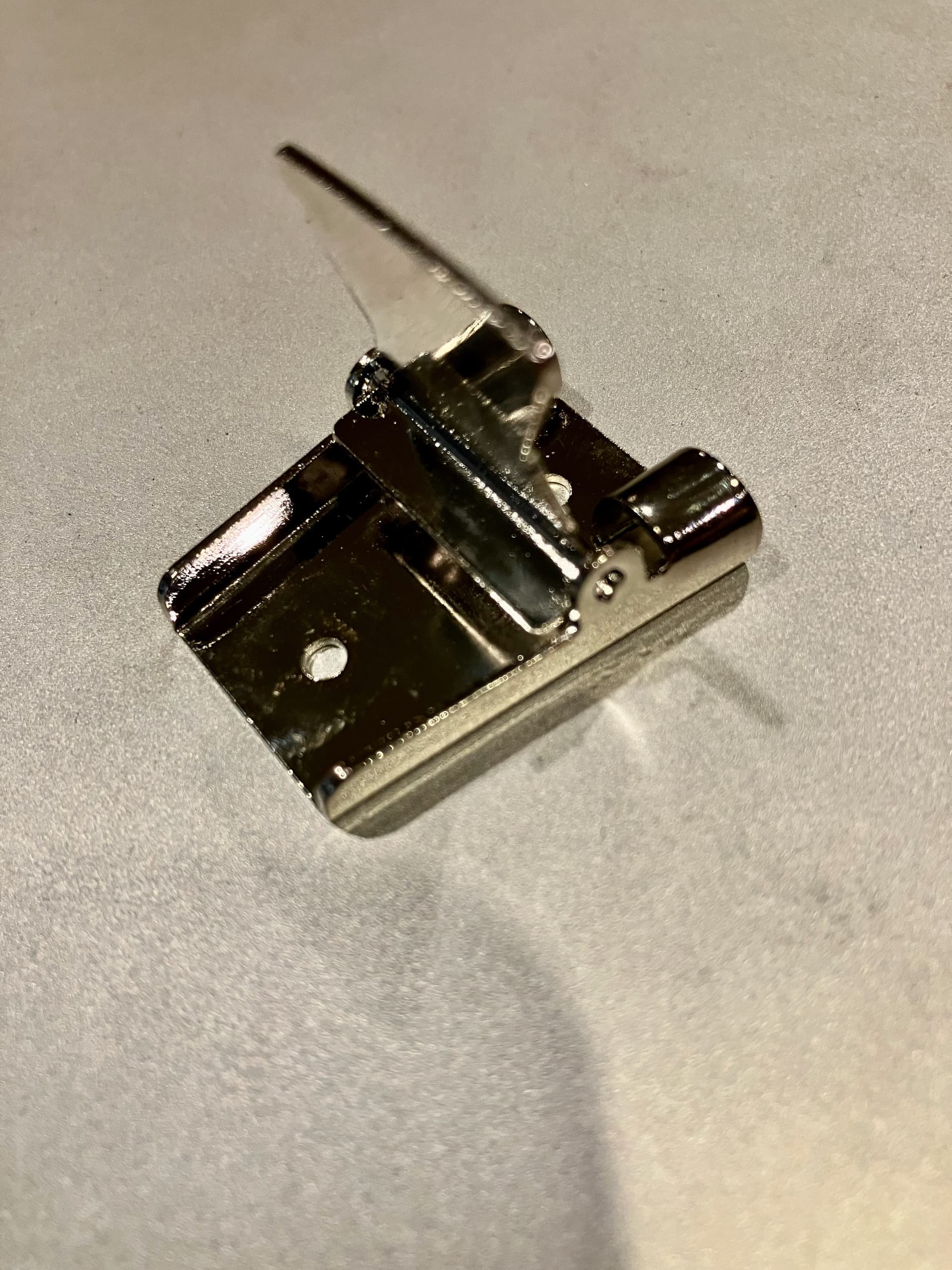
It is also important to rethink connections and attachments when working in CAD. For instance adding a metal pin to a CAD/CAM broach didn't seem right so Annand used an integral 'paper clip' style design instead.
When commenting on whether or not her work was craft oriented, Annand commented there is now a 'CAD Craft' and it is very real.
Tyler School of Art was ahead of the curve in adopting CAD/CAM bringing the program into the school in the late 1980s. Today jewellery students are constantly exposed to both technology and traditional crafts with the CAD computers and CAM printers located in the same area as jewellery workbenches. In fact a degree from Tyler is called Metals/Jewelry/CAD-CAM giving equal weight to the old and the new. xviii
CAD/CAM arrived at NSCAD over a decade later and sort of slide in the back door with Pamela Richie as its champion. Her first exposure to CAD was when she was on sabbatical in England. When she returned in the late 1990s NSCAD was not receptive to this new technology but Richie satisfied individual students curiosity with personal demonstrations and tutorials. Ultimately with the arrival of Paul Greenhalgh as President in 2001 the CAD program was placed on the jewellery curriculum at NSCAD.xix
With all of this is craft at a crossroads? In a 2006 article, Sharon Elaine Thompson wonders if the hand doesn't touch an object or it is made from industrial materials can it still be handmade? What about objects made using CAD/CAM?
To look at the impact CAD/CAM has had on the traditional jewellery industry Thompson talked to jewelers and although the responses were varied, there were a lot of similarities as well.
There seems to be general agreement in two areas: that the hand is still in the work even if it was created in CAD and printed in CAM and that having experience as a traditional jeweler is a definite asset when working in the CAD environment although there may be some who could master CAD without this background.
In the digital age, your studio can be your laptop and you can work from anywhere. But when making craft, regardless of the medium, the important considerations continue to be - ideas rather than the materials, well made objects that push the limits of what has been done before, and one-of-a-kind objects rather than designs for mass production.
Many artists today simply use whatever technology is needed to bring their designs to fruition, acknowledging that some materials cannot be accessed but through CAM and some pieces could not be produced using traditional fabrication.
One interesting view states that it is the skill of the maker that is important in the finished object rather than the method of making.
Thompson concludes that although things are different, members of today's and tomorrows jewellery industry are no different from those of the past - they are proud of the history of their chosen profession but want to do things there own way. They are proud of the objects created with their hands, 'whether they wield a hammer, a wax pen, or a mouse.xx Craft is continuing to change as it always has since time immemorial.
What do I think? After reading 'Craft at a Crossroad' in 2006 I was so intrigued with the possibilities of what could be I registered for the CAD/CAM course in the fall of 2007. Like anything new, I spent a lot to time learning the fundamentals; being frustrated and finding the breakthrough that allowed me to apply these new techniques to uniquely designed objects.
After studying traditional techniques at the bench and then learning CAD/CAM on the computer I'm convinced that it is not all or nothing; it is not one or the other; it is both. Each has its own strengths and limitations and each will inform the discipline in a different way, which is as it should be. I found it interesting as I reviewed my class notes, readings and did further research for this paper how new technology has impacted the production and perception of craft over time.
For instance, the Industrial Revolution saw William Morris declaring war on the machine because it was doing the work people should do and this ultimately spawned the Arts and Crafts Movement. Ironically the Movement failed because the public could not tell the difference between well-crafted inexpensive items and those that were mass-produced. By contrast the Bauhaus embraced industrial collaboration and one student Marianne Brandt even produced handcrafted items to look like machine made.
Another departure from the Arts and Crafts ideals was Frank Lloyd Wright who believed that the machine supported creative endeavours rather than tore them apart. Hermann Muthesius also felt that man and the machine should work together and there was no conflict between the artist and mass production. The academic community continues to add to the art-craft-industry debate but is now factoring in the digital age. Malcolm McCullough proposes that new computer technologies gives us another avenue for craft expression that requires using the hand or 'direct manipulation' by the operator. While Rafael Cardoso makes a case that because the digital environment now allows for 'flexible production' permitting one-of-kind or limited production items rather than massproduced ones, we've reverted to a craft scenario.
As a postscript to this paper the December 2010 Jewelry Arts & Lapidary Journal printed a list of the 10 changes in the last decade that have had the 'greatest impact on jewelry making today.' xxi Number one on the list was CAD/CAM. Noting that 10 years ago the question was 'how would [CAD/CAM] become 'a game changer' [the answer, based on this article, is that today] they're an integral part of the industry.xxii
Based on all of these factors, I believe that the topic 'The Impact of CAD/CAM on Traditional Jewellery Fabrication' would fit perfectly into the existing syllabus for 20th Century Craft and be a compliment to the existing topics covered.
Works Cited:
- Rebecca Annand, 'Artist Presentation: CAD-CAM Jewellery,' NSCAD University, Halifax, 26 Nov. 2010
- Attaway, Steven and Nancy. 'CAD-CAM For the Studio Jewelry Artist.' Lapidary Journal Jewelry Artist July 2001. 14 Nov. 2010
- CAD software - history of CAD CAM. CADAZZ 6 November 2010
- Cardoso, Rafael. 'Craft Versus Design: Moving Beyond A Tired Dichotomy.' The Craft Reader. Ed. Glenn Adamson. Oxford: Berg Publishing, 2010. 321-332.
- Codina, Carles. The Complete Book of Jewelry Making. Ed. Maria Fermanda Canal. Trans. Laurie C. Jones. New York: Lark Books, 2000. Trans. of La Joyeria. 1999
- 'The History of CAD.', MB Solutions 3 June 2003. 14 November 2010
- Lewton-Brain, Charles. 'Some thoughts on computer use in the Metals/jewelry Field (1996).' Ganoksin. 16 Nov. 2010
- Morris, William. 'The Socialist Ideal.' The New Review. 1891. 11 Sept. 2010
- Muthesius, Hermann. 'Art and the Machine.' The Craft Reader. Ed. Glenn Adamson. Oxford: Berg Publishing, 2010. 111-119
- McCullough, Malcolm. 'Abstracting Craft: The Practiced Digital Hand.' The Craft
- Reader. Ed. Glenn Adamson. Oxford: Berg Publishing, 2010. 310-316
- Richie, Pam. Personal interview. 26 Nov. 2010
- Shanahan, John. 'Taking a Practical Approach to CAD/CAM.' MJSA Journal 2007. Ganoksin. 16 Nov. 2010
- Thompson, Sharon Elaine. 'Craft at a Crossroads.' Jewelry Arts & Lapidary Journal Dec. 2006 30-36
- Thompson, Sharon Elaine. 'Tut, Tut: Jewelry making in the days of the pharaohs.' Lapidary Journal Jewelry Artist Oct. 2010 20-25
- Thompson, Sharon Elaine. '10 Most Influential Developments.' Jewelry Arts & Lapidary Journal Dec. 2010 60-67
- Wade , Suzanne. 'Creative Freedom - Technology has opened doors for jewelry designers.' MJSA Journal. Ganoksin. 2004. 15 Nov. 2010
- Wright, Frank Lloyd. 'In the Cause of Architecture: The Architect and the Machine.' The Craft Reader. Ed. Glenn Adamson. Oxford: Berg Publishing, 2010. 107-110
- i Sharon Elaine Thompson , 'Tut, Tut: Jewelry making in the days of the pharaohs,' Lapidary Journal Jewelry Artist October 2010
- ii Carles Codina, The Complete Book of Jewelry Making, trans. Laurie C. Jones (New York: Lark Books, 2000) 9.
- iii Codina 9. iv Codina 10.
- v Codina 10.
- vi Thompson, Tut 22.
- vii 'CAD Software - History of CAD CAM.' CADAZZ 6 Nov. 2010
- viii 'The History of CAD.' MB Solutions 3 June 2003. 14 Nov. 2010
- ix History of CAD
- x Steven and Nancy Attaway, 'CAD-CAM For the Studio Jewelry Artist.' Lapidary Journal Jewelry Artist July 2001. 14 Nov. 2010
- xi Suzanne Wade, 'Creative Freedom - Technology has opened doors for jewelry designers.' MJSA Journal. Ganoksin. 2004. 15 Nov. 2010
- xii Wade
- xiii John Shanahan, 'Taking a Practical Approach to CAD/CAM.' MJSA Journal 2007.Ganoksin. 16 Nov. 2010
- xiv Shanahan
- xv Shanahan
- xvi Charles Lewton-Brain, 'Some thoughts on computer use in the Metals/jewelry Field
- (1996).' Ganoksin. 16 Nov. 2010
- xvii Lewton-Brain
- xviii Rebecca Annand, 'Artist Presentation: CAD-CAM Jewellery,' NSCAD University, Halifax, 26 Nov. 2010
- xix Pamela Richie, personal interview, 26 Nov.2010
- xx Sharon Elaine Thompson, 'Craft at a Crossroads.' Jewelry Arts & Lapidary Journal Dec. 2006 36.
- xxi Sharon Elaine Thompson, '10 Most Influential Developments.' Jewelry Arts & Lapidary Journal Dec. 2010 60
- xxii Thompson, 10 60.
Related Articles

Risking Failure to Master New Things
Studio Multiples/Portfolio

How to Use Time Fully

The Check Is in the Mail
The All-In-One Jewelry Making Solution At Your Fingertips
When you join the Ganoksin community, you get the tools you need to take your work to the next level.