Cyclosilicate: Dioptase
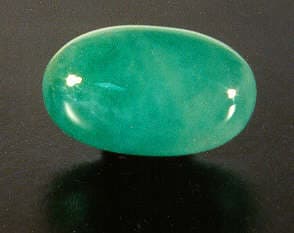
Dioptase incorporates the native metal, copper in the Si6O18 ring structure with water to form the only gem material that so closely approaches the finest color of emerald. The small and well-defined deep green rhombohedral crystals develop in oxidation zones of weathering copper ore deposits. Its growth in voids of dolomite and limestone formations and irregular druse cavities is often in association with malachite and smithsonite, but admixtures and inclusions seldom occur.
3 Minute Read

Dioptase incorporates the native metal, copper in the Si6O18 ring structure with water to form the only gem material that so closely approaches the finest color of emerald. The small and well-defined deep green rhombohedral crystals develop in oxidation zones of weathering copper ore deposits. Its growth in voids of dolomite and limestone formations and irregular druse cavities is often in association with malachite and smithsonite, but admixtures and inclusions seldom occur.
Alluvial finds in nodular form attest to its chemically stable nature and its resistance to corrosion. Crystals exhibit characteristic dense striations of the rhombohedral faces. Numerous readily visible internal cleavage fractures frequently impart a pearly lustre and cause unusual reflections from within the transparent stones. This dictates the use of only the purely transparent ends of larger crystals for faceted gemstones and also presents difficulties in making table and step cuts. Thus, gems of more than a carat are extremely rare. Cabochons are sometimes fashioned from compact fine-grained translucent nodules.
According to Jaroslav Bauer and Vladimir Bouska in A Guide In Color To Precious And Semi-Precious Stones, the first known crystals of dioptase were brought to Semipalatinsk in Kazakhstan from the Kirgiz Steppes in Siberia in 1870 by the Bukharan merchant Akhir Mahmed. They were found on the western slopes of the Altai Mountains on calcite deposited in the numerous crevices of the limestone hill of Altyn-Tyube. Specimens sent to the Academy in St. Petersburg were identified by member German mineralogist R. Ferber as an emerald variety and named "achrite". Its low hardness made it less valuable than emerald, and it became known as "emerald for the poor". When it was determined in 1801 to be a new mineral, the French mineralogist Rene Just Hauy used the Greek words dia (through) and optasis (vision) to create the name dioptase. This describes the visible reflections on the internal cleavage cracks. "Copper emerald" is a name also used by some collectors of mineral specimens, and this term appears in almost all collections.
The discovery of some fairly large worn crystals extracted from the gold-washings in the Yeniseisk area and the failure to discover other deposits led to the assumption for many years that Siberia was the only source of the mineral dioptase. Fine cuttable dioptase material now comes from Reneville in Zaire's Congo. The Otavi Range at Guchabo in Namibia produces small amounts of dioptase. Pinal County, Arizona in the USA, Copiapo in Chile, Baita in Romania, and Peru are other world sources for dioptase. Despite its beauty, fragile dioptase is not suitable for use in jewelry.
The Mineral Museum at the New Mexico Institute of Mines and Technology in Socorro showcases a magnificent dioptase specimen that is worth the drive to Socorro to view it. Many other mineral museums have wanted this particular dioptase specimen for their collections, but, hopefully, it will remain in Socorro.
More on Cordierite
In regards to my cordierite article in the January/February 1998 issue of the New Mexico Facetor, I wish to clarify the spelling on both "praseolite" and "prasiolite". According to An Illustrated Dictionary of Jewelry by Harold Newman, "praseolite" is a variety of iolite that is leek-green. From the same source, "prasiolite" is a variety of amethyst from Montezuma, Brazil that has been changed by heat-treatment to a leek-green color. Newman says that the name is deprecated, owing to confusion with "praseolite", which was earlier so named. A variety of amethyst discovered in Arizona has been similarly changed by heat. The "e" in "praseolite" denotes the association with iolite, while the "i" in "prasiolite" applies to quartz. To add even more confusion to this topic, we also have "prase", the cryptocrystalline translucent leek-green variety of quartz.
It is interesting to note that the prefix "pras" originates from the Greek word "prason", which means leek. This term has been used in conjunction with several varieties of gemstones, including prasopal.
| SPECIE | Dioptase |
| Composition: | Cu6(Si6O18)6H2o (a hydrous copper silicate) |
| Class: | Silicate (Cyclosilicate) |
| Species: | dioptase |
| Crystal System: | hexagonal (trigonal) |
| Varieties: | dioptase |
| Colors: | intense green and blue-green |
| Phenomena: | none |
| Streak: | pale blue-green |
| Diaphaneity: | transparent to translucent |
| Habit: | stubby six-sided columns and compact fine-grained nodules |
| Cleavage: | one perfect (Joel Arem); three perfect (Richard T. Liddicoat) |
| Fracture: | conchoidal, uneven, and brittle |
| Fracture Lustre: | greasy |
| Lustre: | vitreous |
| Specific Gravity | 3.28 to 3.35 |
| Hardness | 5 |
| Toughness: | very poor; brittle with cleavage |
| Refractive Index | o=1.644-1.658 e=1.697-1.709 |
| Birefringence: | 0.053 |
| Optic Character | uniaxial positive |
| Dispersion: | 0.022 (Walter Schumann), 0.036 (Joel Arem); 0.028 (Jaroslav Bauer and Vladimir Bouska) |
| Pleochroism | weak emerald green-blue green |
| Ultraviolet Flourescence | inert |
| Spectra | strong absorption of violet and blue; band at 5500 |
| Color Filter | no information |
| Solubility | rapid etching/dissolution in HCL, HNO3, and ammonia |
| Thermal Traits | avoid thermal shock |
| Treatments | none known |
| Inclusions | rare; darker color caused by traces of iron |
Related Articles
Chalcedony Gemstones
From Beryllium to Beryl
Jade – Jadeite and Nephrite

Morro Redondo Tourmaline

The All-In-One Jewelry Making Solution At Your Fingertips
When you join the Ganoksin community, you get the tools you need to take your work to the next level.