Protecting Gems While Soldering
Repair jewelers are frequently called upon to solder close in to a set gemstone. Besides the normal dangers of heating a gem in these days of glass infills and other challenges it behooves a jeweler to keep a gemstone cool during soldering if at all possible. Remember Some 'Old-time' repair goldsmiths pride themselves on their speed using a mini-torch and they hold the set gem on a ring being sized in their fingers, going in very rapidly on the shank solder join with a pinpoint flame, so fast and hot that 'if your fingers get hot you were too slow'. While this method works with the right mini-torch and has a certain macho charm it does not fit every circumstance - and may lead to singed fingers..
4 Minute Read

Repair jewelers are frequently called upon to solder close in to a set gemstone. Besides the normal dangers of heating a gem in these days of glass infills and other challenges it behooves a jeweler to keep a gemstone cool during soldering if at all possible.
Remember some 'Old-time' repair goldsmiths pride themselves on their speed using a mini-torch and they hold the set gem on a ring being sized in their fingers, going in very rapidly on the shank solder join with a pinpoint flame, so fast and hot that "if your fingers get hot you were too slow".
While this method works with the right mini-torch and has a certain macho charm it does not fit every circumstance - and may lead to singed fingers.

To avoid endangering the stone while soldering it is often packed in some cooling or refractive material, Kool Jool® and similar proprietary products, wet matted paper towel and so on to protect it. Another material used to protect gems is paper clay, a product found in many craft shops and originating in Japan. In my experience wet paper towel wadded up around the stone is the best of these because there is good control of its degree of wetness and hence the safety of the stone.
I use a plant mister to refresh the moisture on the wet paper towel during the soldering operation. Gold objects are reasonably easy to deal with in terms of heat conductivity but silver (which has the best heat conductivity of all the metals) can be a real problem to deal with.
This is why many jewelers will simply unset a silver ring before soldering it. Silver conducts heat so fast that it is a good idea to use the hottest torch flame available (i.e. an oxy-acetylene, oxy-hydrogen or oxy-propane), have the gem itself immersed in water during the soldering and to have a flame reflector positioned above the water line to increase the heat on the join.
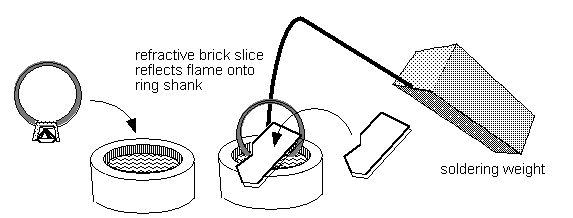
I place the ring head with the gemstone under water in a crucible while the ring is held down with a soldering weight. Using a jewelers saw one cuts off a thin slice of soft refractive kiln brick which is tucked inside the ring above the water level to additionally reflect heat upwards and slow the evaporation of the water. Keep tabs on the water level so as not to have it inadvertently go too low and endanger the stone.
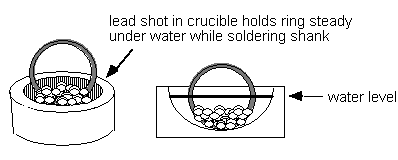
A method of protecting gemstones from heat comes from the shop of Robert and Barbara Kaylor in Boise, Idaho. They use a crucible with lead shot in it to hold the ring steady for soldering. When the ring is positioned correctly in the shot water is added to the crucible to cover and protect the gem. It is important to monitor the water level while heating to ensure it does not go too low, as if it does one has a nasty lead mess on the ring, not to mention potential stone damage. Stainless steel shot would be a good alternative to lead shot, no health problems and no danger of accidentally melting on your piece.
A really excellent way of doing repairs without heat endangering gems is to use a laser welder; clean, fast, almost any material: and still too expensive for me to have one of my very own. There are ever more shops have one though, and for specialty repairs it can be worth sending a piece out for service repair with a laser welder. I have also used a miniature fusion welder to 'spot weld' a failed seam on a 24k karat bezel around a piece of amber. I attached an electrode of 24k gold, dialed up the power to 'high' and proceeded to fuse the seam closed. A little clean up required, but it neatly solved my problem without damaging the amber.
Heat and Gems
In repair shops diamonds are routinely soldered against in re-tipping operations. Rumor has it that diamonds are subject to heat damage cumulatively, that after twenty minutes or so cumulative high temperature time they can begin to suffer from work such as soldering; so that after numerous repairs on a piece one might have to consider this as a potential problem (don't know whether this is true or not-just a story I heard).
Glass in-filling, which can be found in diamonds and corundum will not work well when heated. Corundum is often heated during repairs but it is susceptible to borax flux damage at high temperatures. Synthetic corundum, synthetic spinels and garnet are quite good with heat. Every so often a garnet will turn to a small black magnetic lump.
In all cases with heat avoid rapid temperature changes-very jeweler has at least one bad story about this. Heat will cause colour changes in certain stones. If liquid or gas filled inclusions are present (beryl for example) then heat may cause expansion of the gas or liquid and lead to stone breakage. Many stones have been treated or enhanced and are thus unsuitable for heating; 'stabilized' materials, dyed stones etc. It might be noted that in the field of SIP (stone-in-place casting) diamonds, cubics, and surprizing things like peridot are being successfully cast in place now.
Related Articles
Special Repair Work

Soldering Demystified: Debunking a Soldering Myth

How to Repair a Hollow Rope Chain

Perfectly Fit Bezel
The All-In-One Jewelry Making Solution At Your Fingertips
When you join the Ganoksin community, you get the tools you need to take your work to the next level.