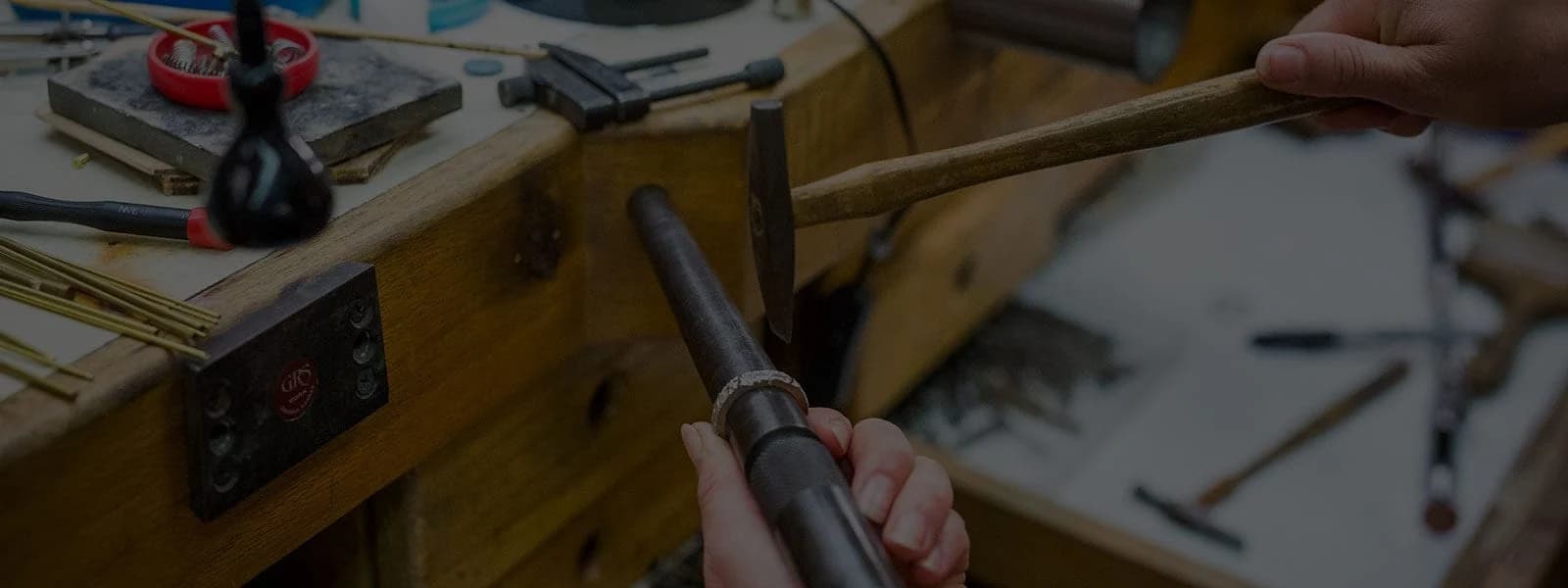
Jewelry Workshop Safety Report
This talk briefly reviews issues of studio safety and discusses ways of recognizing risks in the studio and reducing hazard by substitution of materials or processes. The premise is that any reduction in risk improves the safety conditions of the goldsmith and artist. This approach to safety is practiced officially in European countries but is fairly new to North America. This paper today can only touch on things, be a skim, a snapshot. It is in fact a work in progress. The subject is a gigantic one, it feels rather like climbing a mountain where when you crest what appears to be the top of the rise there is yet another peak in front of one. This paper therefore skips and minimizes many important details. The book we are working on will address things in more depth.
65 Minute Read

This text is that of a paper given to the Society of North American Goldsmiths Conference in Seattle on March 28, 1998,. The citations are incomplete and will be properly outlined in the book that is being written on this subject. Brain Press is the publisher.
THIS IS A DRAFT COPY
This talk briefly reviews issues of studio safety and discusses ways of recognizing risks in the studio and reducing hazard by substitution of materials or processes. The premise is that any reduction in risk improves the safety conditions of the goldsmith and artist. This approach to safety is practiced officially in European countries but is fairly new to North America. This paper today can only touch on things, be a skim, a snapshot. It is in fact a work in progress. The subject is a gigantic one, it feels rather like climbing a mountain where when you crest what appears to be the top of the rise there is yet another peak in front of one. This paper therefore skips and minimizes many important details. The book we are working on will address things in more depth.
I heard one story of a safety lecture where the pictures projected were so graphic that a number of people were injured in the doorway trying to leave. To avoid this situation I won't be showing much in the way of repulsive imagery.
It is worth noting that I am still no paragon of virtue in regard to safety, though since embarking on this project I've improved quite a bit. Let's put it this way, 'One may describe Utopia and move towards it without actually being there yet'.
This report cannot offer to give you panaceas, absolute truth, the right way to do things or anything else liable to land us in litigation hell. A report is a snapshot, a way of looking at an observed state of things, a kind of journalism. And you hopefully read journalism with a jaundiced eye, a pinch of salt and so on. So, we have done a reasonable job of reviewing literature and asking questions. As John Henkell says 'Be very careful how and what you suggest for safety measures: hungry (greedy) lawyers are everywhere.' (John Henkell, personal communication, 8/27/97) Ted Rickard, a jewelry safety specialist in Ontario told us about several low cost but acceptable ventilation options but expressly warned me not to actually describe them to any Americans for fear of getting sued. So-Let's not sue people sharing information and trying to improve things. Make a better world for ourselves.
The good news is that it is immeasurably safer to work in a jewelry shop now than it was twenty years ago. This is due to the pioneers who paved the way in the 70's and 80's in safety consciousness. We do, in fact have one of those important pioneers here today in the audience, SNAG's very own Linda Edwards, who wrote the 1978 paper on Jewelry workshop safety in the Metalsmith Papers who has kindly allowed us to reprint it today for this presentation. I will now ask Linda to stand up and be recognized for her contributions to yours, and my safety in the workshop. [applause]
Thank you Linda!
Here's something to aim for. A well laid out, orderly workshop, electrically and fire safe, with low dust and few solvent procedures, with excellent local ventilation at the appropriate work stations, the use of work clothing cleaned frequently, lots of personal safety equipment (earmuffs, safety glasses etc.), different heights to work at over the work day and a conscious attitude and consciousness of safety. Choose procedures that don't involve exposure to risks. Set things up so that you can't hurt yourself. Mark Twain said 'If you don't lie you don't have to remember anything', we could crudely paraphrase that to 'If you don't have an unsafe workshop you have less to worry about'. Make safety a habit and then it won't seem like work.
The bad news is that safety issues are real. You can actually do damage to yourself and others by behaving unsafely, shorten your life, go blind, need oxygen to breathe and more. While many of the really brutal dangers such as asbestos have been removed, there remain numerous others, and in old shops and traditional practices lie continued risk for jewelers.
What is Safety?
We might say it is acting in a manner which precludes or avoids injurious behaviors and circumstances. That is, not hurting yourself or others presently or in the future by doing something which causes injury, now or 20 years down the road. Dave Arens says 'the best safety device is a careful worker' (Dave Arens, Orchid list, Jan. 8, 1998, 'Survey')
Milt Fischbein writes: 'I think that studio safety must be divided into a number of pieces -
- Understanding the hazards associated with each chemical/tool/machine
- Designing the studio to minimize these hazards
- Having safe procedures in place for each work process (i.e….sawing, soldering, polishing etc……)
- Making absolutely sure that each work process is followed and that no shortcuts are taken'. (Milton Fischbein, personal communication 1/10/98)
Small Shops and Big Shops
There is a real difference between small shops and big shops. It is a lot more controllable to be a small shop-providing safety measures are taken. The larger a workshop is the more power tools there are and the more aggressive are the working processes used. Large scale production methods in general require ever more dangerous chemicals and procedures. We will confine ourselves to the small shop in this paper. But whether you are a big shop or small shop you should work with OSHA and government agencies-there is a ton of help and advice available.
Power Tools Hurt You More
A few years ago a study compared the murder rates in Seattle and Vancouver. Both, at that time had similar populations and sizes. In Seattle there were dozens more murders than in Vancouver in the same time period. When they looked closer they found that the assault rate was in fact fairly similar in both cities. It turned out that the main difference was the accessibility of guns in Seattle. While the assault rates were similar in both cities it is a lot harder to kill someone with a knife than a gun-hence the difference in the murder rate. In other words Canadians and Americans were quite similar. However the more power at your fingertips the more damage you can do-only in a studio situation we are talking about damage to yourself. Mary Hu reports a student who was using the power rolling mill and had two long fingernails yanked out by the roots. Ow! I knew of a guy who literally got his head rolled through a large jewelry factory rolling mill.-He was lucky and recovered-though he was somewhat flat headed. Everyone reports injuries seen or experienced at the polishing machine. Hand tool operations are less likely to hurt you-certainly possible but its a lot harder to hurt yourself seriously with a hand tool than with a power tool. It is because so many operations are hand tool based that our accident rates are not all that bad compared with other industries. When dealing with power tools always have a great deal of respect for them.
The Research
I have to thank my colleagues at Brain Press, Katie Harse, Tara Owen and Dee Fontans who have helped me research and gather information. I used the internet extensively and Katie tirelessly followed up odd questions like 'Find me a hydrogenated oil company president who can talk about nickel residues in oils used for processed foods'. The EPA, the Center for Disease Control, Medical University libraries and various US and Canadian government sources have been most helpful. We did eventually find a number of health and safety case studies in the jewelry industry. The journals of Occupational health and Safety Medicine proved most fruitful for this and for some hints about the long term effects of the trade on its workers. Information is still coming in.
The best book on safety in the arts is 'The Artist's Complete Health and Safety Guide" by Monona Rossol. Close on its heels are the volumes 'Health Hazards Manual for artists' and 'Artist Beware' by Michael McCann. Linda Edwards paper gives an excellent synopsis of safety considerations. The internet has a great deal of safety information on it. If anyone is interested in receiving a copy of a list of safety web sites email me after the conference and I will send you one.
I have considered internet mailing lists as a form of publishing for this project, much like a book. The Orchid Mailing list, the Jewelry Design list, the Artmetal list, Health and Safety Canada list were all used. A survey asking for anecdotes regarding safety was sent to the Orchid and Jewelry Design lists. Of some 1300 recipients about a hundred and twenty responded and their comments have been incorporated into this paper.
Things are different now, because in the 1970's pioneers changed the field by their efforts. The first stirrings of health consciousness in the arts begin in the 1940's but did not take off until the 1970's. Michael McCann, Monona Rossol and Linda Edwards are all vitally important sources. Linda Edward's excellent work in 1978 on jewelry safety information was a major and long lasting contribution. Her original article in the Metalsmith papers is really good and it would be a duplication for this presentation to simply reiterate her writing and conclusions. I refer you to her paper, which she has kindly allowed us to reprint for today. A really great book oriented to factory work in the jewelry industry is 'What you should know about Health and Safety in the Jewelry Industry', put together by a union with a definite anti boss stance, I quote: 'We have to stand together and fight for our health and safety against a system that values profit more than worker health and safety'. Can you apply that critique to your own workshop?
Rossol's book is absolutely superb and addresses matters in a way impossible and impractical for this paper to do. I strongly recommend purchasing her book for greater detail than can be attempted here. Environmental activism, the work of unions, of insurance companies (they don't after all want to pay out claims), the EPA, OSHA and others have all contributed to a much safer work environment than in the past. Not to mention the uncounted thousands working sincerely and selflessly towards small changes to improve health and safety in the workplace. The work of these pioneers has made a difference that is real, measurable and important. The next time you meet one of these people you can thank them for having changing your working conditions and significantly, enormously, improved the safety of your workshop, almost without you knowing it.
When I was first a student in 1974 we had a bucket of loose asbestos fibers under the soldering bench, we would take a handful, moisten it with water to form a clay-like blob to hold things together for soldering. This would be unthinkable today. In Germany in 1981 none of the goldsmiths I worked with would believe me about the dangers of asbestos and we would dip our fingers in solvents, including tri-chloroethylene for removing pitch (this is such a no-no it is not even funny), we would use cadmium solders, use benzene as a solvent (absolutely, but absolutely unthinkable now-benzene is even banned from university labs with full equipment it is such a carcinogen), we would have carbon tetrachloride available as a solvent, not to mention investing without breathing protection or ventilation, patinating without ventilation and on and on. All that is, in my world, over and finished with - and it should be in yours too-anything else is pretty criminal. At this point many of the worst hazards have at least been recognized and named in the jewelry workshop. Just as in counseling and much problem solving, name and describe the problem, then you can do something about solving it.
Complacency
One of the biggest issues in safety in complacency. You are used to it, this is the way you have always done it, you don't see anything wrong, nothing has happened so far. On the morning of the Challenger explosion the engineers went to mission control and said 'don't fly today-we think the O-rings will not operate at those temperatures. The NASA executives launched the shuttle anyway arguing that with 28 perfect flights there was nothing to worry about. Just because you have not had an accident or become visibly sick does not mean that nothing will happen. Ask soldiers exposed to radiation in bomb tests in the 1950's. Plan and act safely-less evils are likely to happen to you as a result.
So avoid complacency. Analyze the existing situation, have a look at things. And be willing to change and re-evaluate on a regular basis, once every year or so to make sure that time and new developments haven't passed you by.
Tradition really gets in the way for the jewelry field. In 1975 I was shown how to mercury gild in a very dangerous manner, in a way unchanged (except for the addition of a torch) to a procedure described by Pliny, and to an Egyptian one from hundreds of years before him. This is in the light of a full knowledge of the toxicity of mercury. I can think of no other industry where such a thing would not change for thousands of years. The jewelry industry is slow to adopt new techniques and ways of doing things, and that attitude is costing goldsmiths their health. You can change your traditions by analyzing and describing your workspace and methods - then work on changing unsafe practices.
The Pilots' Ritual
Ever sat in a small commuter plane where you can see the pilots in front of you? You are on the runway ready to take off and they go through a check list, one says a word and hits a switch, the other repeats it and does the same thing, it is a ritual, unwavering and checked by a partner. And it saved your life, and theirs-repeatedly. Check lists can be useful as guidelines for ensuring that things are done correctly and that you have made no mistakes. Create rituals for things like changing your gas tank. I have my own step by step check list/rituals when I work with gases, do electroplating, casting and many other procedures. Writing them down in point form can help you avoid errors. Just realize that, like many rituals, time and circumstance changes and it may be a good idea to reevaluate them on a regular basis.
Holistic Safety
That means that it is very difficult to isolate safety issues. They affect each other, they add to each other, compound each other and sometimes have synergistic effects. An example of a synergistic effect is with those exposed to asbestos. If you smoke cigarettes your chances of getting lung cancer from asbestos exposure are 50 to 90 times greater than a person who was just exposed to asbestos. How you behave and what you are exposed to in the rest of your life affects things. In this sense 'Safety' is 'Healthy Living'. You could call it an attitude of valuing yourself. Therefore when we discuss various specific issues keep reminding yourself that there is actually a mix of things happening.
Part of a holistic approach is to do physical exercise and follow general improved lifestyle suggestions, low fat, high fiber, less meat more grains and vegetables, aim for good mental health and self development etc.
There is plenty of evidence that dietary chemicals can interact with ones that one is exposed to in the workplace and produce effects that are far greater than the chemical would be just by itself. For example drinking alcohol can interact with certain solvents to cause severe damage quickly. These are called synergistic effects.
A recent article in Scientific American discussed the chemicals and dusts that one is exposed to in an ordinary household, from carpets and household cleaning products. It pointed out that in many cases the exposure levels in the home may be higher than would be officially tolerated in the workplace. So, anything you can do to lower your general chemical exposure is probably a good idea.
Tell your doctor what you do for a living and what metals and chemicals you are exposed to. Silver dust for instance forms black stains in the body. Did you ever wonder what those black inclusions in your fingers were? It can show up on x-rays if you had a lot of exposure and can cause misdiagnoses. If you were being hired by a large jewelry company you would be required to have a base-line medical exam to test your lung function, and general health before starting to work so that you can more easily decide if something in the workplace has affected you later. This is not a bad idea for the small shop as well.
Do a chemical audit of your workshop. List everything and decide if you need it or not. Don't forget the household chemicals. Then create a chemical inventory so you know what is there, how much, how long it has been there etc. If nothing else put this information on labels on all containers with chemicals. See Rossol and McCann for labeling guidelines.
Children are particularly susceptible to chemical exposure because of their small body size. In general it is not a good idea to have children in the workshop. I know of someone whose little toddler died in their arms in their workshop after drinking some cyanide solution.
Pregnancy
After a lot of thought I think my recommendation is; if you are pregnant, seriously consider leaving the jewelry studio for the duration and doing a lot of designing in pencil and other media that is not too toxic. Lets just say that a pregnant woman transfers chemicals easily to the fetus and that the fetus is very susceptible to such things. Metal dusts, solvents, other chemicals, metal salts and oxides all have potential to injure the fetus. Check with your own physician for their recommendations in your specific case if you are pregnant. Craft Report magazine had a very good article addressing this last year. Karenworks writes that in conversation with her doctors, their response was 'you should be taking the same kind of precautions before you get pregnant as you need to during pregnancy' (Karenworks, Orchid list, Nov. 9, 1997, 'Pregnancy Precautions')
The First Thought on Having an Accident is Usually 'That was Stupid'
That's right, at least for me and from others who I have asked, the first thought that goes through even before anything hurts is 'that was dumb'. And, usually, it was. Most accidents (including the slow ones that get you twenty years down the line) are stupid ones. In the light of the best knowledge at your disposal (and it is your duty to yourself to do the research to find out about what you are doing) act in such a manner as to avoid accidents and threats to your health. Milt Fischbein, an engineer with 18 years experience in gas/oil/chemical notes that 'Industrial experience shows that the vast majority of safety incidents are a result of human error and of the human error incidents, the bulk of those are a result of not following established procedures'. (Milton Fischbein, personal communication 1/10/98)
Never ask someone who has just had a drastic accident "How did you do that?" Quite often they will be in shock and literally show you just how they did it thus damaging themselves even more. While this most frequently happens right after the accident I heard of a three fingered woodworking instructor at a college in Southern California who was demonstrating band saw use to a class. Someone asked him 'How did you lose the finger?" and he said 'Like this' and promptly took the other three off.
Be smart, work calmly and steadily, think and be conscious.
Modeling on Others with the Same Problems
To avoid unnecessary work look for examples of people who have solved the same kinds of problems you have to solve and see if you can adapt some of their ideas and approaches. This means you ask around, do reading, research to find examples you can use. This saves on mistakes. Your answers may lie in another field than metalsmithing. For instance define the problem "exhausting fumes generated from brazing", then figure out who has the same problem. A number of industries do, from electronics to jewelry production. Approaches used in another field may have application to what you are doing.
Small Changes Count
Have you noticed how these days any reduction in overall fat content in your food is considered a good thing? That small reductions in fat consumption in your diet add up to overall reductions in fat in your eating habits? That is the basic idea in safety and substitutions to lower risk. No particular magic, just a consciousness of the problem and a concerted effort to reduce all (or most) contact with hazardous substances and procedures in your workshop. Any reduction in contact is a positive reduction.
Information specifically addressing jewelry studio safety can be found in Rossol, McCann, Edwards, and others. Between 1993-96 (AJM) there were some 266 OSHA safety audits in the jewelry industry in the US, which generated some 750 citations (and fines). When you consider how large the US is, how many jewelry manufacturing businesses there are and the picky nature of an OSHA violation (an extension cord run too far to a lamp) then that is a fairly low rate of trouble. The same thing shows in OSHA case studies, there is not that much reported (compared with other industries). While it could imply that the jewelry industry is relatively safe one should realize that OSHA nationally does not require compliance of shops with ten employees or less. In California even shops with one employee have to be fully compliant. It was however pointed out to me that the state OSHA doesn't have the staff or interest in going after a small shop. OSHA statistics may therefore be skewed because so many jewelry shops have less than ten employees.
Safety and Substitutes
According to Michael Hutt, (Health and safety advisors of the Ontario Ministry of Agriculture, food and Rural Affairs), the first rule of industrial hygiene is 'eliminate or substitute with a less hazardous substance ' (/HSC list, Jan. 10/98) Any reduction in risk or exposure to hazards is a positive. If you identify your processes and procedures you may be able to find a safer substitute that accomplishes the same ends. Examples of simple changes include switching to fluoride free fluxes or even eliminating soldering altogether for some production applications by switching to a fusion welder.
You Are Your Own Canary
In coal mines there used to be caged canaries. If the coal gas built up the canary, being more sensitive to the gas would keel over, thus warning the miners that they should escape before they too succumbed. It is your job to be aware of your own body and mind, you have to be the canary in your shop. If you feel a headache or feel ill or dizzy or have skin rashes, a sore wrist or any symptom that something may be wrong it is your own responsibility to listen to yourself and stop what you are doing to see what is the matter. I met a jeweler at SNAG last year who had massive scars from wrist to elbow on both arms from surgeries to correct various cumulative trauma disorder (CTD) problems. He told me that when he was working, forging small jewelry components all day that he would really 'get into it' and not notice what was happening to him. One of his co-workers told him later that he would frequently have a spasm of pain ride across his face, the co-worker would ask him 'what is the matter' are you all right' and he would answer 'Yes, I'm fine, nothing is wrong', not noticing what was happening. So, be aware of your body, check yourself. There are exercises used in some counseling methods, yoga, Tai Chi and other self awareness methods that can be used to learn to listen better to one's body. Your body and mind usually hints that something is the matter before there is permanent damage. Listen to yourself.
Exposure Routes
The main exposure routes for chemicals are by breathing them in (inhalation), eating and drinking materials (ingestion)-which can also happen when large particles are breathed in, brought into the throat by lung clearing mechanisms and swallowed, and by touching things (absorption). Do not eat or drink in the workshop. If you have to have a drink use the kind of containers with a cap on the end of a straw - this may reduce your potential chemical contact. A friend of Mark Parkinson had his vitamins in the studio, accidentally downed a ruby instead and searched all over for the stone before realizing where it was. (Mark Parkinson, Orchid list Jan. 6, 98)
Smoking
Smoking, besides being bad for you in all the ways you ought to know by now seems to react synergistically with many chemicals and dusts jewelers have been exposed to, in some cases multiplying the risk of damage really dramatically-don't smoke.
Hygiene: Wash Your Hands
We use our hands so much in the jewelry shop that they get exposed to all kinds of chemicals, metals and dusts, quite apart from the physical stresses on them. It is very important to develop a hand washing habit to reduce contamination of yourself (mouth touching, eating etc.). Regular hand washing and washing them thoroughly before leaving as part of your 'shutting down the shop' ritual can help reduce your overall exposure significantly. Use a mild soap. Many people also use hand lotions of various kinds after rinsing.
Some people use a barrier cream before starting the day in the shop. It does however seem to wear off during the day. There is also some slight concern that an oily barrier cream can sometimes form a paste with materials that actually keeps the skin exposed longer than if one were not to use one.
Work Clothing There is a reason that people in factories wear work clothing. It is safer. Cotton is good. I was once grinding a vise in a craft school workshop and was using a lab coat from the shop (which I assumed was an appropriate one) while using an angle grinder. I noticed a burning smell and looked down to find that there was a spreading pool of flames on my stomach-the lab coat was a nylon one and very flammable. Unthinkingly I patted the flames out only to have molten lava-like plastic well up through my fingers making the burn a really bad one in between the fingers. Make sure your clothing is flame resistant in a jewelry shop. Don't ever wear sandals or bare feet (several bad stories about folks ramming needles, sawblades etc. deep into their toes). Steel toed shoes is a good idea (I've met more than one person who has dropped a stake or other object on a toe and broken it). So, good, protective footwear in the studio is recommended.
And, most important, using work clothes such as an apron, overalls or a jump suit helps keep chemicals and metal residues in the work shop and out of the rest of your life, and your family's life. Work clothing should be washed regularly and separately from other laundry. Actually, frequent washing may be a good idea. If you work with chemicals dry cleaning is sometimes preferred in order to remove chemicals and oils that can cause dermatitis from the clothing. (Quinn, Smith, Stock, Young, page 14). Any small step you can take to limit your overall exposure means you are that much safer. A lot of small steps add up to increase your safety in the work place. A jump suit may be the best thing to use, easily removed, washed, interchanged if you have several.
Special protective clothing is needed as well, a rubber apron for dealing with chemicals, a thick leather apron for blacksmithing, leggings and arm protectors for foundry work. if you will be doing anything like welding or dust producing activity a visorless cap is a good idea. Keep the stuff out of your hair. And use cotton or non-synthetic in case of fire or hot things landing on it. Hair should be tied back at all times in the shop to avoid it being caught in machinery.
You don't want clothing to get caught on equipment or in machinery (no ties should be worn in the workshop)
Don't wear jewelry when working in the shop. It too can get caught on things.
It has been suggested not to wear a ring at the bench, not only to avoid the dreaded 'degloving incident' where a ring gets caught on something, a machine part or a hook of some kind and tears the skin of the finger inside out but because chemicals and dusts can get trapped under the ring and more readily cause dermatitis.
Have Lots of Personal Safety Equipment Around
We have hooks on the walls of our studio every five feet or so and on them hang safety glasses, face shields and ear muffs. When all you have to do is reach out a hand in any direction to reach safety equipment you will use it. Make using your safety equipment easy to do. To keep safety glasses scratch free I keep mine in a plastic bag every time I take them off. If they are scratched you will be more reluctant to use them. We are used to being somewhat stingy with safety equipment, making it last a long time, accepting an irritation with scratches on the lenses in an attempt to 'save money'. It is better to have your equipment easy and pleasant to use, so you don't have to resent it.
John Burgess tapes a piece of overhead projection transparency over the front of his face shield, when it gets scratched up just replaces it. Much less expensive that continually replacing the plastic face shield itself. (John Burgess, Orchid list, 11/12/97, 'Pregnancy Precautions')
Personal safety equipment like this is an operating cost. Budget for it so you can have good, scratch free glasses and other equipment at hand when you need them.
If you have to use a respirator there is something seriously wrong
If you think you need a respirator to do something red flags should be waving in front of your eyes and alarm bells ringing in your mind. If you have to use a respirator there is something really wrong with your ventilation system and working processes. And when you take it off whatever it was you are afraid of will still be there, an invisible dust (such as cristabolite investment) on all surfaces that merely walking past later will stir up into the air so you can breathe it in. Same for chemicals and metal fumes (which deposit as an extremely fine dust). If you are using a respirator in your normal working space what you are admitting is that you desperately need a proper ventilation system. A respirator is a tool of last resort, a backup, an emergency thing. And if you are using one make sure it is correct for your face and the chemicals and fumes you are protecting yourself from. Probably use it outside. Talk to your safety supply company representative, or better still several of them. Rossol and McCann have good sections on which respirators serve for which purposes and there is a ton of information on the internet on the subject. Keep your respirator in a plastic bag when not in use to help keep the filters absorption in good shape. Change the filters by their expiry dates or more frequently if used a lot. Half face respirators serve for some purposes. I personally like Israeli gas masks for some things: they are built for guys with beards.
Using safety Equipment can cause risk taking behavior
Lets take the recent sneaker controversy. Injuries and injury rates were compared between the cheapest runners and expensive top brand name sneakers. The rates of injury were often higher with the more expensive, engineered, 'extra-safe' sneakers. This was not because they were not safe-they were, it is just that the psychological effect of using them was to encourage people to behave less safely, slam the ground harder and so on, thus increasing the rate of overall injury. Respirators too encourage people to act in hazardous ways because they think the equipment will protect them. There are other examples. When you use safety equipment make sure you are not doing worse things than you were without it.
Rossol and McCann caution that some of the supposedly safer substitutes for chemicals and processes end up being as bad or worse as the original, an example being ceramic fibrous cloth used to replace asbestos turns out to be horrendous as well because of the small fibers it is made of. Both of them feel that the terpenes and ethyl glycols that have been accepted by industry as 'non-toxic' substitutes for solvents may have hidden dangers and lead to bad surprises in the future. Check your use of substitutes carefully.
Give Yourself a Grade
I am a teacher, and one of the things I do when I grade my students is to be as objective as possible, taking into account the individuals skills, how much they have personally developed and pushed themselves, how hard they worked and how they excelled against their own goals and aspirations, not just what they did to fulfill any parameters of the projects I set them. This means that I have to judge myself by the same criteria to avoid being a hypocrite. One has to, as an educator, be a sort of role model as a form of continuous education. Kind of rough. So grade yourself in terms of your safety efforts. There is no shame is a mediocre grade, merely an indication that one can do better-you don't put yourself down for doing one's best-that is a as good as it gets. So, assuming you are doing your best for yourself then give yourself a grade in that regard. Then try again. One tends to get better and improve this way. Judge yourself as you would judge others performance given the same problem to solve or project to carry out. And, give yourself credit. If it is an 'A' grade then that is what it is. Enjoy!
The Accident Book
Even if you are not required to, keep a safety log. Besides giving you an idea of what things need to be improved in the workshop it is a valuable teaching aid for a new employee. It saves on repeated mistakes. You can have it as part of a 'Right to Know' binder where you keep MSDS information on materials in your shop and safety procedures and contact numbers.
Burns
Burns are a common hazard in the jewelry shop. All goldsmiths get small burns now and then and sometimes larger burns occur as well. Burns were the most common small injury reported in the Orchid list survey (next to small cuts). Don't use oils or greasy ointments to treat a burn first. The best treatment is to freeze a burn as soon as possible. Burn damage keeps on going for some time after the cause of the burn is removed and if you freeze it fast enough and keep it cold for a while you can often limit the damage
considerably. A comment on orchid was 'If the area still tingles put it back…' While I still like ice for the small and medium sized burns jewelers get many EMS units now use materials like Water-Jel, a water based gel that carries away heat rapidly and so stops the burn from continuing deeper and yet does not cause a hypothermia hazard for the burn victim.
When that molten, flaming nylon welled up through my fingers I found a bucket of ice immediately and kept ice on it for a number of hours. Although it blistered I was able to work, hammering all day for three days before they broke and by that time the skin had healed underneath. A teacher of mine in Denmark, John Rimur was once mixing pitch in a large pot. The whole pot tipped over spilling boiling pitch over his arms. He was luckily only a five minute run from a clinic, ran in, they packed his pitch covered arms in dry ice to stop the burning. After some time they were able to remove the pitch and when I saw him he didn't even have any scars from the incident. Without freezing the burn would have continued on, perhaps even destroying his tendons and finishing his career altogether.
Several people have reported that they like the juice and leaves of Aloe Vera to treat their burns. For me personally my best experience has been with ice and keeping it cold for a long time.
Burns are avoidable if safety precautions are taken. If you are working with fire, torches, flammable materials, hot liquids then you must set up your workspace to avoid an accident, and if an accident happens, then have it set up so that you don't get hurt.
Alcohol fires are reported by almost all jewelers I know who use boric acid and alcohol as a fire scale retardant. I recommend other ways of applying the material, such as dipping in a simmering water based solution. Bruce Holgrain reports using powdered boric acid applied to the warmed object to coat it to avoid the alcohol/fire hazard (Bruce Holgrain, 1/8/98, personal communication, 'safety' and Orchid list, 1/7/97, 'Re: boric acid')
Eyes
Aside from protection from sharp objects, flying chunks of metal, dust, splashes, chemicals we have to deal with glowing materials (infrared light), the blue flame of a high temperature torch (ultraviolet light) and 'sodium glare'. These are the three kinds of non-ionizing radiation that we worry about.
Good quality eye protection against infrared radiation is recommended. Daniel Buchanan reports a glassblower who now has '"trouble counting the fingers on his hand. His desk lamp might as well be a searchlight. What is sunny day to us is a dim and hazy image to him. An approximate area or l40 x 60 degrees, right in the middle of his sight, is lowered by 90%, which is to say the exact shape of the kiln mouth, 5 feet away (3000 oF)…and all he has left is peripheral vision. And to think it only took ten years."(Orchid list Jan. 10/98)
Most glasses and polycarbonates will stop the ultraviolet. The infrared is stopped by a 'shade', a number 2 and up has been suggested by a welding institute source. It is important that one understands that a "tinted' lens does not offer infrared protection - only a shaded lens offers protection. The sodium flare which is more of a problem for glass workers is stopped by didymium glasses.
Glasses and contacts
Polycarbonate glasses are much more shatter resistant than regular glass. There are reports of glasses shattering upon impact. There are also reports of bits of plastic flying or polycarbonate ones into the eyes if the frames are bent to try and fit when they are too small for the head.
If you wear glasses now you can have safety glasses with safety frames made at the optometrist which are prescription, bifocal, whatever you need. Some metalworkers wear polycarbonate safety glass over their regular (or even safety) glasses. 'There are many different styles of safety glasses that will fit over prescription glasses'. (Mark Williams, Artmetal list, 1/13/97, 'Re; Eye Safety Issues (Again))
It is advisable to have safety glasses with side shields to protect against things bouncing in from the side of the head. They should also fit well, particularly at the brow. Talk to your Uvex rep., they seem very educated and helpful. They can fit glasses to all facial types.
From everything I have read and heard it is not a good idea to wear contacts in a jewelry shop. The dust and chemicals can get stuck under the contact and scratch the eye, some fumes can permeate certain contacts. Ron Watts writes: 'Where I work (a chemical analytical lab) contacts cannot be worn. That is part of your condition of employment. It is because of the safety hazard present with acids and the fact that some insurance policies forbid it if you want to be insured. The dust from flex shaft tools ad the fumes from soldering can damage the eye beyond repair in your jewelry shop]. We only have two of them so we need to take care of them' (Ron Watts, Orchid list, 9/5/97, 'Workshop Contacts')
Gloves
Use the correct type of gloves for the chemical you are using them against. Not all gloves hold up to the same things so consult a chart to see what gloves are suitable to which chemicals before choosing gloves. Edwards comments on this in her paper. Even if you have the right kind of material be aware a glove has a life span and that eventually even the chemicals it is resistant to will be able to pass through the material to contact your hand.
Use tweezers and tongs as much as possible to keep your fingers away from exposure to the chemicals, soaps, solvents you use. I wear my 8 inch German, stainless steel tweezers in the center pocket of my apron, always at hand when I need them. Keep a pair of tweezers as part of your apron or jump suit (perhaps in a glasses case?) then you will be less likely to use your hands when you shouldn't.
Ventilation
There is a real consensus that ventilation is incredibly important in having a safe studio. You need it. There is dilution ventilation, which is where you open a window next to you and another one elsewhere such that air passes past you on its way out. Dilution ventilation is not generally an effective approach.
What we really want most of the time is local ventilation, which means a sucking device, slot or tube close to the working area that is generating the dust, mist or fumes that need to be vented. The book 'Ventilation: a practical guide for artists, crafts people, and others in the Arts' by Clark, Cutter and McGrane is a very good starting place.
A fume hood is a good idea. Sometimes one can buy a surplus one at a government surplus equipment liquidation company. You can build one as well but you should hire a professional to do it. Use sheet metal to build it. Have a ventilation specialist check out your plans before having anything built. There are home-made options as well, but these too should be checked with a specialist before installing them. Remember that the illusion of safety can induce one to do more dangerous things than one should. Fume hoods should be tested every time you use them with a smoke trail or soap bubbles. I had two students who went to hospital with metal fume fever because they did not test an extraction system before using it.
Dermatitis
Dermatitis is a group of skin conditions that may often be contracted by exposure to chemicals and metals. It is a real hazard for jewelers. I knew someone once who got so bad that her hands would begin to crack and bleed when she walked into a jewelry studio and she had to give it up, in her fourth year of school.
Jim Zimmerman tells a typical tale, working unsafely, dipping fingers into solvents, cutting oils for lapidary, mixing investments with bare hands and so on. Many of these actions 'defat' the skin which then loses its protection against other chemicals and metals. After 14 years of this his hands started breaking out in 'water blisters' and became very painful. His dermatologist pointed out that the hand creams he prescribed and the working precautions were 'a way of life and not just a one-time fix-it'. Even shampoos, dishwashing liquid, soaps, glass cleaner, changing oil in the car, paints etc. were hazards and triggers at this point. Moving to mechanical cleaning methods (scotch brite scrubbing) to reduce chemical (soap-even the mild one) exposure help as well. He writes 'So take a warning new jewelers/metalsmiths and limit what you do to your hands right now'. (Jim Zimmerman, Orchid list, 4/12/97, 'Re: Hand damage')
It has been suggested not to wear a ring in the workshop because dusts and chemicals tend to get caught there and then react with the skin. more easily. As well as getting caught on things.
Quantity, Quality and the Individual
The quantity of chemical you are exposed to, its concentration and the length of time exposed all influence what the effects of chemical exposure are. The individual, their medical history, their genes, their health and habits also influence what the effects of a given chemical or material will have on a person.
Cancers may be caused by materials identified as carcinogens. In general carcinogens have 'no safe level' of exposure.
Chemical and physical agents in the workshop can cause cancer. Entering any Californian building that houses jewelers one is struck by the warning notices on all doors: 'You are entering a building containing chemicals known to the State of California to cause cancer'. Frightening, and true. Like all chemicals though, exposure, time and concentration all contribute to the risks. You can do a great deal to lower your risks in this regard. Asbestos exposure is at this point the best known cause of occupational cancers and reading the monthly occupational health and safety magazine death reports it seems to be a really major cause of death from job related cancer, even now, years after asbestos has been recognized and removed from contact with most of us.
There is some evidence of raised rates of stomach cancer amongst jewelry industry polishers. Presumably this has to do with larger particles being caught in the mucus of the upper parts of the lungs and being removed to the esophagus by natural clearing mechanisms, where the mucus (and contaminant) is swallowed.
Chemicals: How do You Learn to Respect Them?
We are so used to using chemicals as ordinary materials around us that we don't even notice them. Even table salt has an MSDS that sounds pretty grim. Every year people gas themselves and die because they mix ammonia and bleach to clean their houses with. Realize that you are surrounded by them. Then there are the chemicals that are hidden in product formulations about the house and workshop and the ones that you deliberately bring in to the workshop. As a rule I recommend that one use supermarket chemicals as much as possible -they are quite evil enough. Don't use industrial strength chemicals unless you are properly equipped to deal with them in terms of storage, fume hood and ventilation.
How Do Jewelers Use Chemicals?
We use chemicals for cleaning, finishing, etching, plating, anodizing, pickling, sealing, enameling, wax working, casting, investing and so on. And don't forget that metals and their salts and oxides are also chemicals.
Dusts
Dust is small particles of a material. There are dusts you can see in the air, these can be breathed in and because the particles are fairly large they end up in the upper portions of the lungs. Some can be cleared from the body by its natural mucus where it is bound up and brought up into the esophagus. From there it is swallowed.
The finer dust particles, ones you can barely see and many you can't see at all with the naked eye are the worst. They enter the lungs, go far deeper into their recesses and can result in chronic damage. Many dusts and even metal particles in fumes are this tiny.
Choose the least dust producing techniques and processes possible. If possible work wet so that particles cannot become dust in the air. There are wet belt sanders available now for working metals (and other materials) that can do a great job (they run cold so you can hold a piece onto them without it heating up in your fingers) and they keep a lot of dust out of the air. When working with silicon carbide separating discs I use a wax lubricant which binds most dust generated into a paste and keeps it out of the air.
DX Ross, an enamelist friend of mine had her workshop set up so that she did almost no dust producing activities. She avoided polishing by using hand burnishing and textured surfaces. She did her sanding using wet/dry paper in trays under a little water. A block of boat Styrofoam was cut to shape and used to press the metal part onto the sandpaper while she sanded. She would set up for soldering on a tray and take it outside to solder.
One of the big sources of hazardous dust is investing for casting. Investment contains 40-50% cristobolite, a form of quartz which is many times more likely to cause silicosis than standard quartz does. It is therefore very important to be careful when mixing investment, quenching a flask and removing investment. Local ventilation sucking from where you are working is necessary. When I started insisting on this at our school after a week we discovered a crust of investment on the mesh over the suction slits a millimeter or so thick. This was without seeing any dust in the air while investing and remembering that the worst particles are the ones you cannot see. We use proper respirators and the local ventilation now. There are cases of silicosis recorded from investing where the worker was only exposed to the material for a year or so.
If you generate dusts, fumes and chemicals as a result of your working methods take full responsibility for what you are doing.
Fumes
Fumes are small particles of a material, often from metals that have been melted. These may be very tiny and can be breathed in to the lungs. Metal fume fever is a real hazard with molten metals. It has numerous names, the nastiest of which is 'the smothers'. Metal fume fever can be caused by zinc, copper, magnesium, aluminum, copper, antimony, cadmium, iron, silver. The particles are so small (0.01-0/5 microns) that they stay in the air a long time. Because they are so tiny they go deeper into your lungs and can then dissolve more easily within your body (Rossol, p 31). I have known a number of people to experience metal fume fever, from zinc while casting or reticulating brass and once from copper, because they did not use adequate ventilation. Casting brass is a particular culprit, often because ventilation is frequently a hood type above a casting machine and the fumes are then drawn past the workers face on their way out. So, don't cast brasses unless you can help it, use very good ventilation when melting or reticulating metals and if you must do it then use the correct respirator.
Vapors
You get vapors when you turn a liquid into a gas, for example water evaporates to make water vapor. The vapors jewelers worry about most are from solvents, acids and simmering solutions. Remember that things can vaporize at room temperature-even frozen sheets will dry on the line in the cold. Mercury vaporizes at room temperature. (Rossol, p 30-31)
Mists are small droplets of chemicals in liquid form. If one quenches into a pickle pot for instance a mist is formed. It has been shown that in factory situations people exposed to mists of sulfuric acid develop pitted enamel in their teeth ( Quinn, Smith, Stock, Young, p 24). Mists are more toxic than vapors because they deliver a more concentrated solution to spots in the lungs and elsewhere (Rossol, p 31).
An organized workspace is an efficient one. And its safer too. Look at models again, look for who has to work smoothly, accurately, safely and rapidly (often driven by profit of course). How about doctors, surgeons, dentists. All tools laid out. Every one in its place. Irritatingly as one gets older the things one's parents said make more and more sense. Phrases like 'put things back where you found them'.
Mark Zirinsky describes a reorganization of a manufacturing workshop. 'Our shop foreman took all the clutter in our production area and moved it into the hallway, then brought each item back piece by piece into storage areas, inventory areas, work in progress areas and testing areas until everything was neatly organized. When he had finished, the production areas were completely bare (completely) except for a workbench, a stool, lighting, a soldering iron and the exact number of parts needed to complete the piece that was being worked on at that moment (average cycle time was about 20 minutes). the result of this was that our defect rate decreased from 4% to less than 0.5%, our average cycle time (to do the manufacturing steps) went from 20 minutes to 8 minutes, and the assemblers went from a 1/2 hour break in a day to 1.25 hours per day. Our production went up, costs went down, everyone was more relaxed, everybody was happy'. (Mark Zirinsky, Orchid list, 4/13/97, 'Re: tidy bench') And it was safer too.
Just like a chemistry lab, try and have most table surfaces empty most of the time.
I recommend having the soldering station separate and at a height for standing. this is because this way you can have the soldering area ventilated more evenly from behind in a slit ventilation manner - quite effective for a soldering station. This also forces one to change ones physical working position during the working day which makes your work experience more interesting.
I like to use tool boards, individual gray boards on which tools are mounted, each with its place. We have used gray Mactac? (self-stick shelf paper) and cut it out in the shape of the tools on the tool boards. This lets users easily clean up and put things away.
Safety Posters
Ever wonder why institutions and large companies have safety posters up in their workspaces? It is because it works. Driven by profit, companies would not bother doing it unless it paid off in lower accident rates. You can get safety posters for free from your local and national governments. We have one with a picture of a face with cross-hairs on the eyeballs that says 'Targets for Injury'. A few of those scattered around help you remain conscious of safety in your shop.
Lighting
Have lots of good lighting around, nice diffuse lighting overhead and local lights (like desk lamps) other places where you need light. In our teaching studio we have desk lamps mounted on the wall every six feet or so. On my own bench I have two, one on each side to that I can position good light anywhere on the bench surface and also can light an object on my bench pin from two sides thus eliminating shadows. I like daylight fluorescent overhead.
The Yellow Line on the Floor
The jewelry industry is the only one where there is not a yellow line on the floor at the door, and when you cross that line, you put your safety glasses (and often hearing protection) on and don't take them off until you leave the studio. I find students doing this more frequently and encourage all to consider a move to this standard in the shop.
Studio Colors
Your studio is an entire environment. Make it as comfortable for you eyes as possible. Make it a nice place to be-you will do better work. We selected blue and gray as theme colors for our teaching studio years ago and people enjoy it. All table surfaces are gray (smoke gray) so that things show up easily, are easy to find and there is no great contrast on the bench top. I'm a big believer in white paint on the walls and neutral colors elsewhere.
Equipment
Equipment should be operated safely and checked periodically for condition and potential hazards. Keep a file of the instruction manuals that came with it and at least once every six months check everything for wear and hazardous conditions. Because you should have a list of your equipment anyway for insurance purposes you might as well have that list be a log of repairs needed etc. for the equipment. This is an example of combining acts for greater effectiveness-take something you have to do anyway and then make up other reasons to do the same job.
The Dead Man's Switch
Really bad, scary, wicked machines in industry have a 'dead man's switch'. This is a device that the worker has to activate in order to use the machine. Unless it is pressed there is no power to the machine. Ideally in order to use the machine the workers hands and body are kept safe because they are operating the switch. If there is an accident the worker automatically releases the switch and the power to the machine is immediately cut off. A relative of this is a power cutoff in the form of a foot pedal, usually housed inside a hood so that one cannot accidentally tread on it and activate it. One has to consciously insert the foot into the housing to press down on the foot pedal thus giving power to the machine. If one releases the foot pedal or pulls the foot out of the housing the machine is shut down. We have one on the power rolling mill at the college I teach at.
I think that polishing motors are a really good candidate for foot operated cutoff switches like this.
Getting things caught in the polishing machine
The number of polishing motor accidents reported in the survey conducted on the 'Orchid' jewelers internet list was quite high, and if you ask any jeweler they will have a horror story or two about a polishing machine. Always hold things intelligently while polishing.
If polishing machines were connected to a foot operated cutoff switch some of the damage inflicted would be eliminated as the machine would be shut down the moment anything happened. Some jewelers like to use a polishing motor that is not very powerful just for this reason, so that if something happens the user can stop the machine easily. I however recommend the foot switch instead.
The number of 'hair caught in polishing machine' incidents is truly frightening. I have seen it myself several times. Keep your hair tied back and under control. On the door to our polishing room is a bag of rubber bands with a sign that says 'keep hair tied up'.
One of my students, Cornelia Ostrovitz,had her hair caught a couple of years ago and lost a patch of hair (but not scalp) about five inches across. She gave us an 8×10 color photo of the back of her head, a long hank of hair and the poem that follows which are all now on the wall:
Hair vs. Machine
One second can last a long time
A Gasp
A violent Tear
A Rip
A Head Smash against Machine
My heart took a long
time between Beats
Grave Error
The Doctors were amazed
I had a scalp left
Don't close your eyes
We haven't had a single hair and polishing machine accident since.
Dust collectors
Sometimes jewelers use dust collection systems intended for wood working on their polishing machines. This is fine as long as you don't mix woodworking activities and metal working ones. I've seen a local ventilation hose from a big belt sander catch fire when sparks from grinding metal ignited wood dust in the hose. I've seen polishing machine filters catch on fire twice from sparks thrown into them, once a nickel silver neck piece that was caught on the wheel and once from sanding steel.
Handling Gases
All jewelers work with gasses, for soldering and melting, and sometimes other reasons. Talk to your local fire department and gas supplier to find out the storage rules for your area and to check for torch safety rules. Different torch systems have positive and negatives to them and your choice will depend upon what kind of work you are doing. Each will have different safety considerations. Storage of acetylene and other gases may affect your insurance, you should check with your insurance company regarding your shop, its set up and what you can do to lower your risk and hence premiums.
Several people on the Orchid survey reported fires from worn hoses and improperly maintained torch connections and hoses. I've seen that too a few times. Always regularly maintain and check these things. In general test all connections for leaks every time you change something in the system, avoid oils on gas fittings (can spontaneously combust from oxygen), keep cylinders chained up, never have a main valve on more than 1/4 turn so you can turn it off quickly in an emergency, find out the rules for handling your particular system and follow them We post ours.
It is important that you get trained, licensed professionals to do, or at least to guide, inspect and put their own stamp of approval on any gas line work your do. At least get the work inspected by the fire dept. Make sure you follow any city codes and government regulations. As an example of the kind of shop alterations that are potentially dangerous Kevin Eva writes: ' copper pipe and fittings should never be used for acetylene service. They form a coating of copper acetylide on the inside. Copper acetylide is a dangerously sensitive explosive. The danger comes when someone tries to adapt equipment, or decides that it will be safer to keep the cylinders outside the shop or lab, and pipe the gases in using copper, same as used for propane. Normal tubing for fixed acetylene installations is stainless. (Kevin Eva, Orchid list, 2/11/96 'Re: Acetylene and copper')
Propane sinks so it tends to pool at the feet, find the stairs and go down in the basement until it finds the pilot light on the water heater. Pipe propane in from outside or use less than a 5 LB tank indoors - test it and turn it off religiously.
Hydrogen is a gas that some jewelers use. It is very flammable and needs extra precautions.
In large cities (and in smaller ones) many trade jewelers have switched from compressed fuel gasses in tanks to 'Water torches', that is a torch system that breaks down distilled water ( or 'special' water with additives) to make hydrogen and oxygen for the torch flame. this produces a very clean torch flame. Besides having a clean, small flame ideal for repair work and general goldsmithing a major advantage for the trade jeweler is grounds for lower insurance premiums because no fuel gas is stored on the premises, only water. Some water torches use additional chemicals. Ken Sanders says that in his torch the chemicals used are potassium hydroxide (similar to Lye) and Methyl ethyl ketone or alcohol or acetone to remove water from the gas (Orchid Jan. 10, 98)
Methyl ethyl ketone (MEK) requires careful use, it is considered hazardous and irritant.
Some torches us a methanol in the flux that is added to the gas one solders with. Markus Ellermeier writes that methyl hydrate (methanol) is quite dangerous. A doctor told a colleague of his he would go blind if he continued to use it in his torch flame. (Marcus Ellermeir, Orchid lit, 4/25/97 'Re: Methyl Hydrate')
Fire Safety
Have a fire plan, ask your fire dept. for advice. Keep the appropriate extinguishers around and in good shape. Mount them near exits. Talk to your fire department.
Moving and Sitting: Ergonomics
How you move, sit and work is important. Talk to an office furniture supplier and your OSHA offices about ergonomics and your working position. There is a lot of information free from government and on safety and ergonomic sites on the internet.
Carpal Tunnel
Carpal tunnel is one of many kinds of Repetitive strain injuries (RSIs) and Cumulative trauma disorders (CTDs) are chronic injuries that result from repeated actions and can cause intense pain and suffering. Surgery may result from some injuries. If you are sore when you do something then do something else for a while and maybe talk to a specialist about how you work to figure out less damaging ways of doing things.
Tool Shapes
It has been suggested by ergonomics specialists that tool shapes should be different for different people and jobs. A blacksmith I met had filed all his hammer handles where he holds them so that when the fingers were curled around the handle they touched the palm, thus not straining his hand and wrist when working. It may be that new tool designs are necessary for repetitive jobs.
Don't Do the Same Thing for too Long Without a Break
Any action repeated over and over again has the potential to injure the joint where it is repeatedly flexed and stressed. Vibration injuries sometimes called 'White finger' can occur to machine operators and polishers. Try and arrange your jobs so you work in different ways and use your body differently during the day.
I've heard that a ten minute break performing a different activity every 45 minutes helps avoid this kind of joint damage.
Work at Different Heights
One of the themes that recurs in ergonomic analyses of jewelry factories is that much damage could be avoided by having different working heights, that jewelers often perform the wrong task at the bench pin height because that is the main height available for them. Some tasks should be done at waist height and others elsewhere. particularly if doing the same job over and over again all day, as occurs in a production situation it can help dramatically to work at different heights during the day.
My current bench, which I made about two years ago has several heights to it, the normal just-under-the-armpits height for the bench top and bench pin, to my left a working area some five inches below that, to my right an area even lower, at upper abdomen height (for wax working for example), and a clamp on, rock solid ring holding system called a bench mate. I highly recommend this system. If you can substitute an effective holding device like this to hold items hard while filing, setting and so on then you have just saved your holding hand the stress of doing that-very important in a production situation. This is set lower than my bench pin. I have several of the attaching plates for it around, one at 45 degrees on the left, one lower on my left. Then there is a table that slides in (part of with bench mate system) designed to hold a pitch bowl at the correct height. I have a second table as well on which is mounted a Panavise?. That works out to about seven different working heights I can easily reach from my chair. The bench forms a U-shape around me.
Theresa Voigt in Calgary has a back injury and changes her working height numerous times in the day. She has an interesting bench pin attachment that gives her a height to stand at and use the bench pin as well. Many machinery operators are required to stand at their station because one is more alert while standing. I deliberately have my soldering station separate from my workbench and at a comfortable standing height for use so that my workshop layout forces me to change position fairly frequently. This also allows the soldering area to be separately vented, which can be difficult to do comfortably at a bench. I recommend this in your shop plan. While it may not be as efficient as an all in one workbench it is a healthier and more rewarding method of working because you get to change your immediate surroundings and position during the work day.
Metals
Our bodies react to metals, their dusts, salts and oxides. We need certain amounts of most metals in our bodies - but not too little or too much. Metals have 'concentration windows', that means that too little contact may be damaging and too much is really damaging. The exposure window can be very small in some cases-it is easy to have too much contact with some metals. Of note is that exposure to multiple metals can result in interactions between them which result in greater damage than exposure to a single metal alone. An example is the interaction of cadmium and zinc or the ability of lead to displace calcium ( a metal) and thus affect the nervous system (Waldron, p 13).
One of the concerns is self dosing of metals in the form of supplements, there have been several cases of chrome poisoning from this. Have a look at what you are consciously ingesting as well.
Again, you are exposed to metals by touching them, breathing or ingesting their oxides and dusts and at higher temperatures their fumes. The worst metals to have around include cadmium, nickel, antimony, beryllium. Let's pick one of these to discuss briefly.
Nickel
Nickel fumes are a proven carcinogen and one of the principles of dealing with carcinogens is that no amount of exposure is safe. Studies in different countries show an excess risk of nasal sinus, lung and larynx cancer in nickel refinery workers, though this risk is not noted as higher for those working outside refineries (Waldron, p 34). In 1998 in North America it is still normal for jewelers to alloy their own nickel white gold with a commercially supplied pre-alloy containing nickel. This practice is in my opinion unsafe and at some point will be unacceptable.
As well as being a carcinogen in the form of fumes from the melt (and reticulation) nickel is proven as one of 'the most potent' of skin sensitizers, that is contact with it or its salts can cause various kinds of dermatitis and make one more susceptible to developing allergies to other metals. Waldron writes 'All those who handle nickel or its salts are liable to be at risk' (Waldron, p 34)
Increasing allergies to nickel and other metals have been noted in Europe and North America in recent years-even silver and gold. As a result Europe and Japan are banning most nickel alloys (including nickel white gold) which will affect the ability of US manufacturers to export their jewelry. The reason that refiners in North America make nickel white gold is to make more profit, it costs less than palladium white gold to manufacture. This will no doubt change as North American manufacturers find their products barred from the European and Japanese markets. An interesting note is that many coins are made from nickel silver (an alloy usually made of copper and nickel. People therefore may have a fair bit of skin contact with nickel and cases of contact dermatitis among people handling coins have been noted. Nickel has a powerful 'bleaching' effect on metals it is alloyed with, as little as 5% nickel in a copper alloy can make it a white metal.
It dusts and filings are also hazardous. Nickel salts are commonly used in electroplating.
Nickel is found in much stainless steel and this is used in fashion earring posts. A recommendation from dentists is not to have children's ears pierced until all orthodontic work has been finished to help avoid nickel allergies later in life. Other concerns include body piercing jewelry as a cause of nickel allergy. Some piercers use kitchen grade stainless steel, which contains a great deal of nickel. Only surgical steel should be used and even that has been linked to metal allergies. Even tiny traces of nickel from the manufacturing process found on niobium wires used for body piercing have caused importation problems into Europe.
Another, and perhaps more troubling source of contact (and may possibly be a cause of the increased nickel and other metal allergies in the population) is the use of finely divided nickel as a catalyst in hydrogenating oils (Waldron, p 33). Anyone eating processed foods (and most processed foods contain hydrogenated oils-check your labels) are then apparently exposed to nickel through this route. After speaking with the head of a company which makes hydrogenated oils it appears that no detectable nickel is in the oil that particular company produces-that is not above .5 parts per million. According to the nickel MSDS children may drink a maximum of 0.04 milligrams of nickel a day in their water as. This is far above any hypothetical amount left in the oil from the company I spoke with but there is still some concern in my mind in this regard.
Avoid solvents
As Rossol says, "all solvents are toxic'. (p84 Rossol) My recommendation: do not use solvents unless absolutely necessary. Set up your work processes to avoid solvent use. The kinds of solvents found in workshops have become less unpleasant than in the past. Xylene, tri-chloroethylene, methylene chloride, butyl acetate and many other toxic solvents used to be common fare in the jewelry studio. Try not to use procedures that require you to use solvents.
An example of how things have changed is with benzene, once found in many jewelry shops by itself or as an additive to toluene or other solvents. Benzene is now an absolutely banned substance for our purposes. It is even banned from many university labs as too toxic and greatly carcinogenic, also causing anemia and attacking the bone marrow. It may be most readily encountered as a component of gasoline and motor fuels. (Waldron, p 47)
If you have to use solvents use the least nasty method first. Abrasive scrubbing can sometimes work. Then try a vegetable oil (if removing grease), then paint thinner, isopropyl alcohol, denatured alcohol, acetone. Gloves and local ventilation should also be used. Use tweezers to pick things up and move them around-just like a photographer uses tongs to keep their fingers out of the chemicals.
Solvent substitution
Use water soluble materials whenever possible. An example of a successful substitution is the recently released 'Conductor', an acrylic paint based copper conductivising paint for making non-metals conductive for electroforming on. The previous conductivising solutions used butyl acetate and other solvents. Water based polishing compounds help reduce dependence on solvents for degreasing after polishing. Citrus based solvent replacements are useful but there are questions about their long term safety. Ethyl glycol solvent replacements are far more suspect- Rossol says there are so many that you need to research the specific one you want to use. There are other method of degreasing as well. Steam, carbon dioxide blasting and ultrasonics are some. Another newer method is 'Ionic cleaning', of which the Speedbrite? company has one of the first units out there. This uses a proprietary mild detergent mixture and direct electric current to rapidly clean jewelry. It appears to do a polishing job as well and several people have reported that they feel it replaced cyanide bombing to some extent.
Acids
Jewelers have traditionally used sulfuric acid, nitric and hydrochloric as well as mixtures of the last two as aqua regia. All are dangerous to have around. All require splash goggles, gloves, rubber aprons, fume hoods to use them. Note that a basic rule when carrying bottles of acid is always keep one hand under the bottle at all times, I heard of someone carrying a gallon of nitric acid down a stairwell without doing that, the bottom dropped out, soaking them in acid. By pure chance they happened to be standing under an emergency shower as it happened. They pulled the shower, the water flooded over them and there they stood, naked and hairless as their clothes fell off in shreds-but unburned.
There is very little need for concentrated acids in most jewelry workshops any more. Pickles and etchants can be provided by using salts that form dilute acids, electro-etching allows one to use very dilute acids and even plain salt water to etch many metals with and acid testing of metals can be replaced to a great extent by electronic metal testers.
If you have to use acids: use proper precautions and a fume hood, use them dilute, use hardware store ones rather than industrial strength, treat them with care.
Hydrofluoric acid has caused a number of serious injuries amongst respondents to the Orchid list survey that I put out. You should not use it or have it in the workshop. That's it.
Salts that Dissociate
Many acids have now been replaced by salts that dissociate in water to form a constant dilution of acid, such as sodium bisulfate (sparex?) which gives you a steady sulfuric acid content or ferric chloride which does the same for hydrochloric acid. Although sodium bisulfate pickle is very safe by comparison with mixing straight sulfuric acid solutions it too can be replaced. A weak solution of alum works well, does not seem to outgas as much-jewelers used to use it-that is why we call it pickle! Some jewelers are using citric acid solutions and report good results, a little slower. Laura Hiserote says it takes 2-3 cups for a medium sized half crockpot. ( Orchid list Oct 6/97). Vinegar and a little salt work well.
Etching
One can use dilutions of nitric as low as 2% or ferric chloride to etch with. If you electro-etch this can triple the speed of etching. Salt water etching is described in the Summer 1995 Daniel Smiths Art Supply catalog. Photoetching with KPR can be replaced fairly effectively by using printed circuit photosensitive resists like Dynalith 2000, or peel and stick films like Tec-200 or Zacryl. Zacryl is developed with a 10% solution of sodium carbonate in water. Photo silk-screening is another option people are using.
You are your own safety committee Review in writing your understanding of safety rules for each of the procedures you use in your shop. Make job lists and write out the rules that you think belong to them. It helps to do this with a friend or two. Conduct your own safety audit. Create a binder for your 'Right to Know Book', a place where you keep safety information, MSDS's and so on. Buy Rossol's and McCann's books. Be aware and smart.
This brings us to a close. The lecture was intended as an introduction to principles and starting points for addressing safety in your studio and to encourage the idea of using substitutions as a strategy for a safer working environment. Specific procedures (such as lapidary work, stone setting, wax working etc. will be addressed in detail in a future publication.
Related Articles
Pickling Notes

Justifying Art for Art’s Sake

Safety Procedure Evaluation
Metalsmith ’83 Fall: Health Hazards Q&A’s


The All-In-One Jewelry Making Solution At Your Fingertips
When you join the Ganoksin community, you get the tools you need to take your work to the next level.