How to Make Prong Notching Pliers
These pliers notch round prongs easily to a given depth and replace a bur for the job. They are made to suit a specific size prong and one makes similar pliers for different prong shapes, but all based on this idea. One obtains a pair of chain nose pliers either new or from a flea market and converts them into prong notching pliers.
1 Minute Read

These pliers notch round prongs easily to a given depth and replace a bur for the job. They are made to suit a specific size prong and one makes similar pliers for different prong shapes, but all based on this idea. One obtains a pair of chain nose pliers either new or from a flea market and converts them into prong notching pliers.
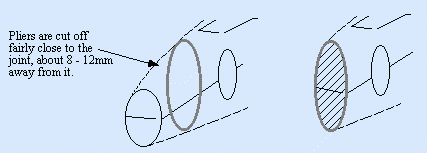
One should use box joint (where one arm of the pliers is inserted through a hole in the other) as they are far superior in strength and stability to side joint pliers. Most pliers will be soft enough to saw into and file. The pliers are cut off flush fairly close (8-12 mm) to the joint as greater pressure is developed closer to the joint (the fulcrum) of the pliers.
A groove is burred into one flat jaw of the pliers using an appropriate burr (a standard burr from the dentist is great). The groove is sunk in to the half-way point of the burr. The diameter of the groove is the same as that of the prong. The distance into the jaws is usually less than 3 mm. The end of the groove functions a stop to the prong wire sliding into the jaws when using the pliers.
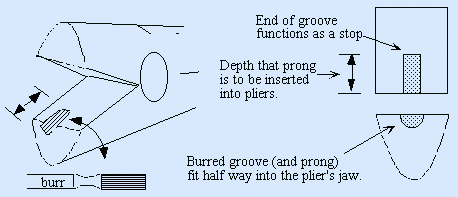
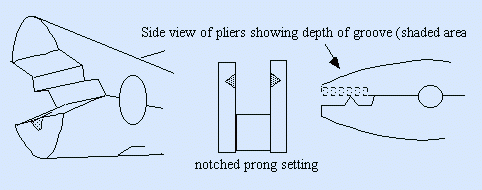
The other side of the pliers are filed in such a way that a notching ridge runs across the jaw at the correct height to make a notch in the prong when the prong is inserted in the groove. The end of the groove functions as a stop to keep the position of the notch uniform on the prongs. The area of the jaw filed away to leave the notching ridge is filed to a depth of at least one half the prong depth (if not more).
The prong is inserted into the pliers until it stops, the pliers are firmly squeezed together thus notching the prong. These are especially good for stud earrings and similar settings which are hard to hold. The plier jaws are rounded off and tapered towards the groove as on page 38. [Cheap Thrills in the Tool Shop]
Related Articles

Half-Ground Round Bur

Creating and Sharpening Gravers

Bud Bur Tool

Customized Turntable Tool Rack
The All-In-One Jewelry Making Solution At Your Fingertips
When you join the Ganoksin community, you get the tools you need to take your work to the next level.