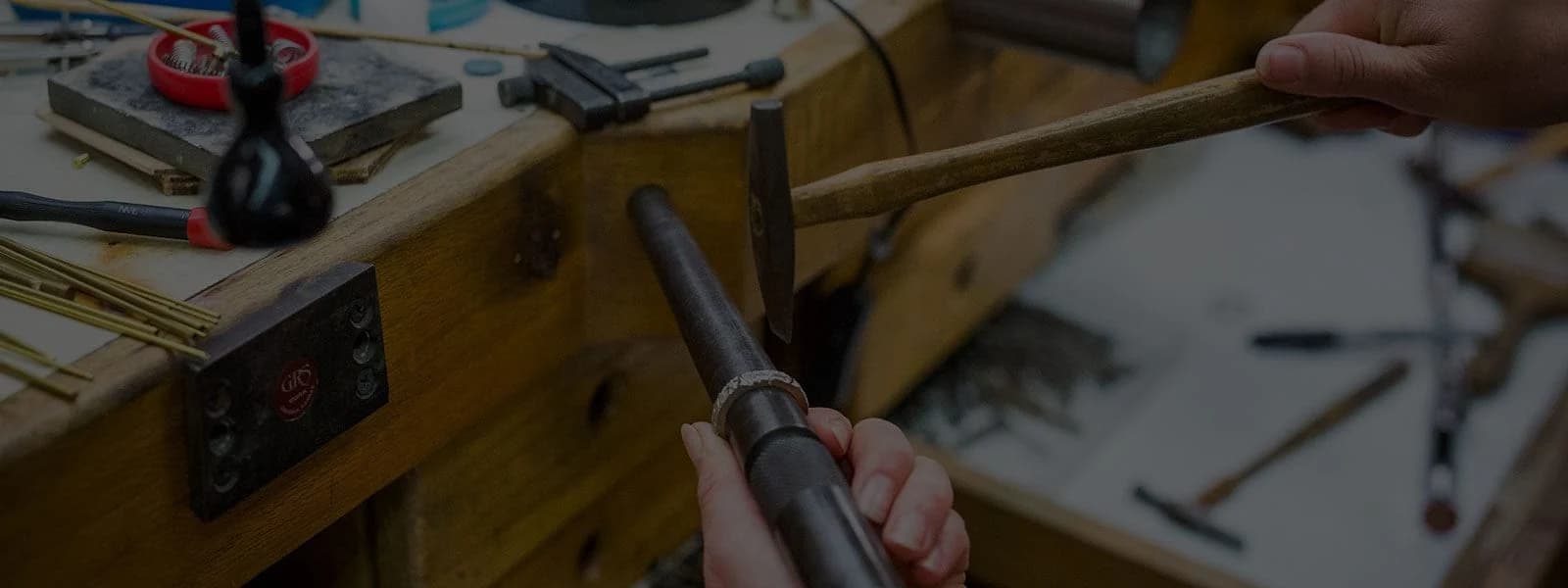
Producing Semi-Fabricated Platinum Products
It is also vital to know the basic forms of semi-fabricated Platinum product that are generally available and how to best use them in completing a jewelry project. This article addresses three forms of semi-fabricated platinum product: sheet, wire and tubing, along with the procedures generally followed to produce these forms and the importance of knowing both the form and the particular characteristics of the form needed to complete a jewelry project.
8 Minute Read

The jewelry industry produces many beautiful items of personal adornment which are the result of imagination, artful design, skilled craftsmanship and often unusual perseverance. The designer must be keenly aware of the characteristics and limitations of the metal used and the craftsman must have the requisite technical knowledge of the metal in order to properly utilize it as the designer envisioned.
Whether a person is a full-time designer or craftsman, or even more so if a person is an occasional designer or bench person, it is also vital to know the basic forms of semi-fabricated product that are generally available and how to best use them in completing a jewelry project.
Herein, I will address three forms of semi-fabricated platinum products: sheet, wire and tubing, along with the procedures generally followed to produce these forms and the importance of knowing both the form and the particular characteristics of the form needed to complete a jewelry project.
In a production facility such as the Johnson Matthey plant, essentially basic forms begin on rollers that are extremely smooth, highly polished and kept exceptionally clean to ensure a bright, as-rolled finish on the sheet and to preclude any contamination during the rolling process. The as-rolled finish may occasionally exhibit slight surface blemishes which are usually inconsequential. If a particularly bright finish is required, some additional rolling and polishing can usually satisfy that requirement. Since this sheet form is often only an interim form, the ultimate finish is usually achieved nearer the end of the manufacturing cycle.
Depending on the final dimensions desired, the metal may need to be annealed at least once to achieve a particular dimension and hardness. A very thin sheet, called foil, is produced by many successive passes between rollers. Slightly different rolling techniques are required when producing foil. Sometimes a very narrow sheet, called strip, perhaps only an inch or less in width, is what findings and the like might be stamped from. A very thin strip is sometimes called ribbon. Neither foil nor ribbons have many applications within the jewelry industry.
Heavy sheet or plate of perhaps 0.125″ thickness, which might be further worked by cutting or re-rolling by a manufacturer or craftsman, might have tolerances of up to +/-100/0 of its thickness and +/-1/8″ in width, while in applications which require very specific dimensions, a thickness tolerance of +/-0.002″ to +/-0.003″ and a width tolerance of +/-0.010″ to +/-0.020″ are generally possible. Your supplier cannot generally respond favorably to an exact dimension, such as +/-0.000″, nor one which neither you nor your supplier can adequately measure.
If your project has special requirements, specify them at the time of an order with drop shot, also called Grain. Drop shot is produced by melting platinum sponge, which is like a powder, with an alloying metal such as iridium, ruthenium, cobalt, etc., in a computer-controlled induction melting device and then pouring the molten metal in a controlled manner into water. In the process of melting the platinum and alloying metal, any residual gases that might have been trapped in the metals will be burned off, thus further purifying the alloy. When the molten metal enters the water it quickly hardens into grains of irregular size and shape. In this case, where the entire output of a 400 troy ounces melt is being re-melted to produce the sheet, the irregularity of size and shape is inconsequential. However, if this alloyed grain were to be used for general casting purposes, it would most likely be screened or sieved to classify it by size. Very small grains sometimes cause problems for casters who melt using a torch, in that they might fly from the crucible when the pressure of the flame hits the metal.
Sheet
In order to create sheet, or plate as it is sometimes called, drop shot is melted and cast into an ingot weighing approximately 400 troy ounces with dimensions of approximately 3.5″ wide by 7.25″ long by 1.5″ thick. This ingot is then run through a breakdown mill, a series of rollers that reduce the shot to a thickness of roughly three-eighths of an inch. The ingot is then run through a finishing mill, once again a series of rollers, in successive passes to reduce it to its desired thickness and width. This rolling process compresses the metal greatly and insures homogeneity, while usually eliminating the pipe, or double metal effect. This pipe is the result of a slight cavity in the ingot which occasionally is not completely compressed into a solid mass during the rolling process, and can actually delaminate into two sections while being further worked. Specify the surface when placing your order. Dimensions, tolerances, hardness (if known, in Vickers Scale) and finish should be specified if important. A realistic delivery schedule should also be agreed upon.
Platinum alloy sheet, even in thin sections, exhibits such unusual strength and rigidity that 'lightweight pave panels may be drilled with the holes almost touching while still maintaining metal integrity. In addition, stones are securely set and protected. Spring alloy sheet is also available for catches and clasps.
Wire
Wire is usually round or square, but other shapes may be produced with special dies. Once again, to produce wire, drop shot is melted and is cast into a wire bar, which might be 2″ square by 12″ long. This casting is either forged with a drop hammer or extruded into a bar. 75″ to 1″ square by 3″ long. An extruder is a massive device that propels metal with great force and considerable speed through a die. Both the forging and extruding processes compress the metal greatly and cause it to work hardens. These bars are then progressively rolled down to about .25″ in diameter and are then progressively pulled through dies of various sizes until the final dimension is reached. Annealing may once again be necessary to achieve a specific hardness and tolerances of +/-0.001″ are possible, if necessary. Particular requirements, if known, should be specified as to dimension, tolerances, tensile strength and elongation.
These parameters may be used to describe other forms as well, but are particularly important in defining the properties of wire. Remember to specify with your supplier exactly what you need at the time your order is placed so that there are no surprises on either side.
Wire in its simplest form is often used to produce beautiful rings, settings, brooches, neck pieces, chains and bracelets. It can also be used to accent, to act as a bridge to add delicacy to a heavier piece. Spring wire is also available for some applications.
Tubing
A third basic form is tubing, which may be produced in several ways, Once again, drop shot is melted and if an extruder is to be used, an appropriately sized billet is cast. The billet is then bored out through its center and at the same time is pushed over a fixed plug mandrel and through a die to create proper dimensions of outside and inside diameter. For medium to large ring sizes, thick-wall tubing (0.040″ to 0.140″), tolerances of 0.005″ are often achievable, while in smaller, thin-wall tubing (0.010″ to 0.025″), 10% tolerances are usual. Tubing may also be drawn from sheet, which is rolled to an appropriate thickness, a disc is cut from the sheet, the disc is progressively cupped and is then drawn through a series of dies which determine the outside diameter while a series of mandrels inside determines the inside diameter and wall thickness. The final tube produced from the drawing process is the result of a number of passes through successively smaller dies and in conjunction with different sized mandrels. Tolerances are similar to those of extruded tubing. Some small-diameter, thin-walled tubing is made by first producing strip of an appropriate thickness and width, then using a drawplate to bring the strip into tubular form with a seam along the entire length of the tube, then welding the seam. The welded seam is practically invisible and the tubing is quite strong. Round, square, and specialty shaped tubing may be produced if dies are available. Tubing can be used to bezel set gemstones and in many other ways. Often, sections of tubing of various lengths are used to produce styled rings, bracelets, neck pieces, brooches and earrings. The tubing itself is often drilled and gems are set in the tubing wall, creating a striking effect.
Conclusion
Suppliers can often produce specialty forms if provided with accurate specifications, sufficient time and an adequate budget. As in most instances, small quantities can be produced, but at a much higher unit cost. The time and effort to set up for a small run differs little, if indeed any, from the time and effort to set up for a large run and a large run obviously offers economies of scale.
Before going to the trouble and expense of ordering specialty items for a particular project, you might wish to consult with a colleague or your supplier, as they might be able to suggest ways of using more standard products which would still allow you to achieve your goals, but in a more cost effective manner.
It is well known that platinum may be used very effectively in combination with yellow gold to make a strong and pleasing fashion statement. This bi-metal jewelry is very important also in that it bridges the gap for many who would choose to move toward platinum, but who are not yet ready for all white jewelry. When creating bi-metal pieces, there are definite techniques which must be used to insure the proper joining and polishing of platinum and gold.
Platinum in its various alloys, forms, shapes and with its specific characteristics, offers the jeweler a wide range of opportunities to practice the jeweler's art. However, to fully utilize platinum as jewelry medium you must educate yourself and gain knowledge as to how to effectively work in platinum. There are a number of publications available to help you gain some of this knowledge.
Get a mentor, if possible. Ask questions. Do research. Get with platinum. Just do it.

Related Articles

Platinum Finishing 1 – Safety
Platinum Durability vs Scratching
Re-tipping Platinum Prongs

Platinum Bench Tricks


The All-In-One Jewelry Making Solution At Your Fingertips
When you join the Ganoksin community, you get the tools you need to take your work to the next level.