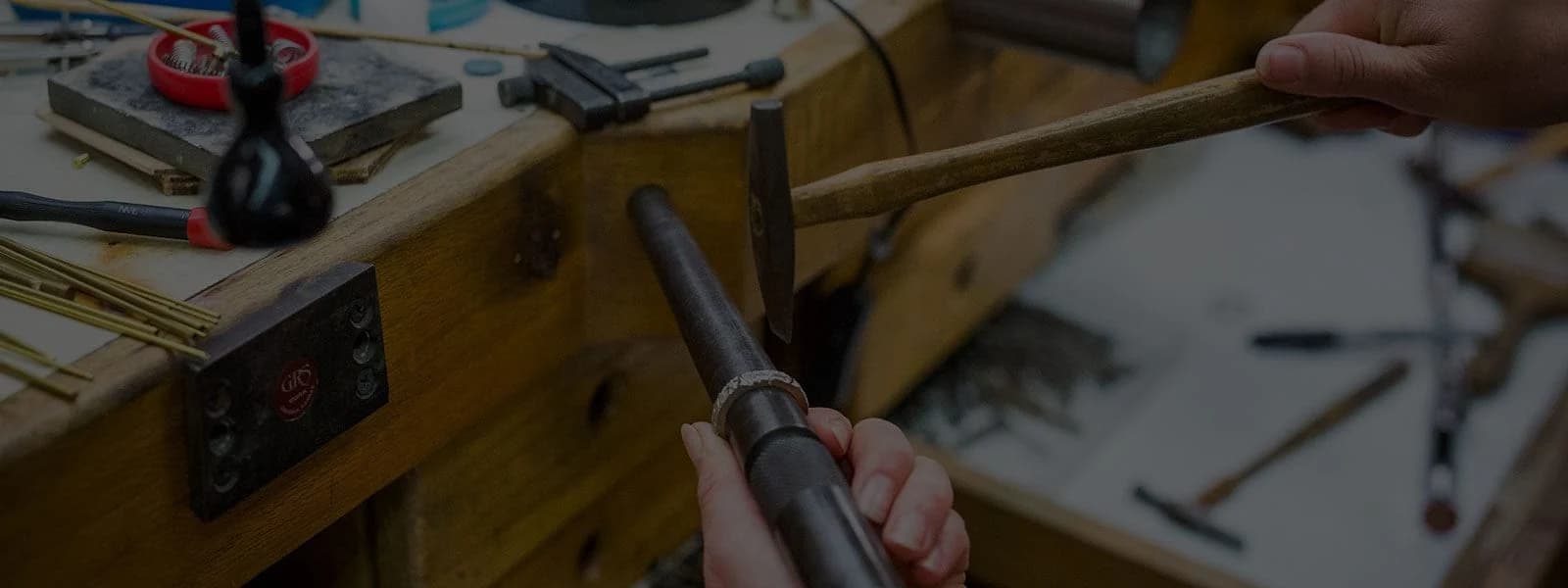
Perfect Finishing Tools and Techniques
Our castings can be flawless, our assembly precise, and our settings secure -- but let any surface go a bit rough, a little uneven and wobbly, and the jewelry is judged to be inferior. Ironically, even the ultimate finish begins to deteriorate as soon as a piece of jewelry leaves the showroom. But to attract a willing buyer at a fair price, a piece needs be in top form when it enters the showroom. The tools, tips, and techniques presented in this article can help manufacturers avoid the harsh criticism that can result when a less-than-perfect finish clouds the public view.
12 Minute Read

Human perception is often based on biased observation, with little understanding of underlying conditions. A classic example of this is the public judgment of airline pilots, who among themselves knowingly acknowledge that any landing that one can walk away from is a good landing.
Unfortunately, they tend to be judged by the flying public on only the smoothness of the landing. Never mind that the pilot may have successfully avoided major weather, compensated for equipment failure, or juggled weight, balance, temperature, and wind to produce a maximally efficient flight - and then negotiated with air traffic control for landing position. If the aircraft jostles just a little as it kisses the earth, the pilot is the goat. A smooth landing makes the pilot a hero.
And so it goes in our world of jewelry manufacturing. Our castings can be flawless, our assembly precise, and our settings secure - but let any surface go a bit rough, a little uneven and wobbly, and the jewelry is judged to be inferior. Ironically, even the ultimate finish begins to deteriorate as soon as a piece of jewelry leaves the showroom. But to attract a willing buyer at a fair price, a piece needs be in top form when it enters the showroom.
The tools, tips, and techniques presented in this article can help manufacturers avoid the harsh criticism that can result when a less-than-perfect finish clouds the public view.
There is No Magic
In the case of finishing, the old adage "you can't make a silk purse out of a sow's ear" is particularly applicable. "Polishing represents the final stage of manufacture and is often seen as an opportunity to hide any surface defects arising from earlier manufacturing steps," writes London-based industry consultant Dr. Christopher Corti in his preface to the Handbook on Finishing in Gold Jewelry Manufacture (published by the World Gold Council). "It is considered a necessary - and expensive - solution to the defect problem… The more progressive manufacturers see finishing as the last step in an integrated manufacturing process to produce a quality item and recognize that care taken in earlier stages can substantially reduce the effort and cost involved in finishing."
With that in mind, I'll assume that your manufacturing defects are at a minimum, and that you have a general understanding of basic finishing and polishing processes. While some of the topics I hope to cover here are simple and basic, this article is not meant to be a beginning instructional tome.
Safety First
Please realize, as in most jewelry manufacturing processes, there are substantial health and safety considerations that should be addressed, including but not limited to the toxicity of polishing dust and compounds, as well as the danger of serious injury resulting from working around rapidly turning polishing lathes. You must research safe practices for your particular workplace and processes, and implement accordingly. This article will not detail all safety considerations regarding finishing or polishing.
Finishing or Polishing
So, what's the difference between finishing and polishing? Although many use the terms interchangeably, they have distinct meanings. Finishing generally refers to the final stage of jewelry manufacture, but it can include most any surface treatment, bright polish, texture, color, or other mechanical or chemical process. Polishing specifically refers to the ultimate or final smoothing of a surface to obtain a high luster or uniform reflectivity.
I have always told my students that every visible surface (even the backside or the underneath) on a jewelry piece should look purposeful, that is, finished…but only some surfaces need be polished. One example of a piece with differential surfaces is this tie tack (above) I recently created for a client. Notice that the lower surface is minimally treated. I left the cast surface intact and just used an enamel preparation brush to bring up a tiny luster. The trees, rim around the agate, and outer rim are high polish.
The Simple Science
Though a high luster polish can be difficult to achieve, the science is not complex. Essentially, most fabricated or cast metal surfaces emerge from the manufacturing process with rough cast surfaces or scratches left from tools. In cross-section under high magnification, these surfaces might resemble a mountain range with tall peaks and deep valleys. These peaks and valleys scatter light striking the surface in many different directions, making the surface non-reflective and dull. As the surface becomes smoother, light tends to be more uniformly reflected. A perfectly smooth surface will achieve an even, high luster.
Tips, Tools, and Techniques
There are a variety of methods, both traditional and recently introduced, that manufacturers large and small can implement in their shops. The following is a sampling of tips, tools, and techniques that can help you achieve a flawless finish.
Hand Sanding
There are several methods of smoothing the initial surface. Abrasive removal is probably the more common approach. This is the time-honored technique of sanding the surface, often by hand, with successively finer grits of abrasive paper or abrasive rubber wheels. When sufficient smoothing is achieved with coarser dry abrasives, further smoothing is accomplished with buffs and abrasive compound. Dr. Valerio Faccenda, an Aosta, Italy-based consultant and author of the previously mentioned Handbook on Finishing, describes hand polishing as not difficult, but as a "sort of creative work…very artistic, very much in the dimension of the goldsmith." Flattening the peaks down to the valley level is very effective, but it can be time- consuming for any material, and especially problematic for expensive precious metals due to the high level of material loss. A precious metal recovery system is an absolute necessity in the practice of abrasive removal.
Hand Sanding Alternative. If the thought of hand sanding every piece makes your hair stand on end, you may want to try a time-saving method that I've used in my shop for years. Wrap wet-or-dry abrasive paper around a tapered felt ring buff and secure it with a rubber band. You can use this system to quickly and easily sand both outer and inner surfaces of rings and outer surfaces of other pieces, rapidly changing paper through two grits.
For silver and gold pieces, I usually start with 220 grit and move to 400. (The use of 220 grit may not be necessary on all milled products.) From 400 grit paper, I advance to Tripoli and then rouge. In lieu of Tripoli, I recently began using the compound Zam, which, de-pending on the design and desired finish, allows me to eliminate the rouge step. Zam effectively removes material while leaving a fairly polished surface. I use this shorter process with repairs, so they leave my shop looking better than when they came in, but not necessarily with an as-new finish.
When finishing platinum, I normally go through the same abrasive removal stages, but then use three polishing compounds - first Tripoli, then Zam, and finally green rouge.
Cleanliness
You must keep abrasive compounds separate from each other and clean the jewelry between each stage of abrasive removal and compound buffing. For example, if a rouge wheel becomes contaminated with Tripoli, it is no longer a rouge wheel; even small bits of the coarser Tripoli compound will prevent the object from achieving the next stage of finish. In larger facilities where this is more likely to occur, it's a good idea to designate separate areas for each stage of abrasive removal. However, in any size shop, the simple method of using separate bins for different compounds is effective.
3M FX Polishing Wheels
Newer products that aid in abrasive removal can speed up the process and provide more consistent surface evolution through the stages of polishing. One such product is the 3M FX Polishing Wheels. These wheels come in a variety of diameters, ranging from 4 inches to 12 inches, and in successive grits of 240, 320, 600, 800, 1,500, and 3,000. The wheels contain a silicon carbide mineral with brightness enhancers combined with a "conformable" resin system that works well with curved surfaces. They offer a very controllable and consistent process. Since the wheels operate without additional compound, they eliminate the need for frequent charging.
Goldsmith Charles Lewton-Brain of Calgary, Alberta, Canada, has reported success with these relatively new wheels. He adds that the burnishing action they offer can even fill pits while abrading and smoothing a surface. This may make them particularly useful with platinum and the more malleable gold alloys.
My limited experience with three grits of these wheels confirms these claims - I used 240, 800, and 1,500 grits to pre-polish a batch of repairs with excellent results. The pieces required only a quick final polish.
I should note that, as you push a jewelry piece into the rotating wheel to access the conformability, there can be considerable heat build-up. But since these wheels can be run wet, it is easy to set up a water dip to cool the jewelry pieces as you work.
In addition, the wheels require a plastic adaptor for operation on a common tapered polishing lathe spindle. During use, you have to change out a single adaptor for each wheel, or purchase a separate adaptor for each wheel. Either way, it's a bit more time or money spent. 3M reports that it is working on developing a solution to this minor inconvenience for the jeweler.
Genie
There are at least two things every goldsmith or bench jeweler wishes for during abrasive removal: a faster and cooler process. Goldsmith and lapidary Charles Bennett of Carson, California, recently showed me a technique he developed over years of working with bench and lapidary tools. He uses lapidary equipment to cool down, speed up, and make even more precise the all-important pre-polish phase of finishing.
Bennett's method employs a lapidary unit with a water-bath spritzer called The Genie, which is available from Diamond Pacific Tool Corp. in Barstow, California. He primarily uses the 280, 600, and 1,200 grit Nova wheels of the Genie to prepare the surfaces of cast or fabricated gold pieces, but reports that for cleaning up sprue and gate connections, there is nothing faster than the 80 grit hard diamond wheel of the Genie.
The Genie also has a flat-lap option, which results in perfectly sanded, absolutely flat surfaces. Additionally, all of the abrasive surfaces save the two coarser grits (80 and 120) are built on a cushioned surface, making the Nova wheels conformable to the piece being worked. (This was essential for the product's initial intended use - the successful cabbing of gem materials.)
There is a considerable initial cash outlay for a shop that does not already have lapidary equipment in place, but for custom shops that have the equipment sitting around for inlay or the occasion-al need to trim a gemstone, I would say it's worth a try. This was the case for my own shop; the equipment was just sitting there with only occasional lapidary use until I tried this technique. I've found the lack of heat build-up with the Genie to be a big time saver, and the results are exceptional.
Finishing Small Areas
All of the techniques described above are well-suited to broader surfaces, but what about the tiny spaces around prongs or small design areas? Fortunately, we have progressed beyond scotch stones and compound-laden dental floss in this area of polishing. There are a variety of newer products, including Radial Bristle Discs from 3M, that are excellent at conforming to any shaped surface for abrasive removal. I also find silicone polishing points and wheels to be incredibly effective in reaching and providing a final polish to otherwise inaccessible areas. These are available from many suppliers in pre-formed shapes, from flat discs to knife-edges to bullet points. One of my favorites is a polishing pin that works with a mandrel. The polishing pin is a diamond-impregnated resin in the shape of a flexible 3 mm by 22 mm round rod, the operational end of which can be shaped on a carbide wheel to reach into very tiny areas.
I might point out that it takes some control to keep a broad surface uniform with the tiny knife-edge of some of these silicone discs. Even on small areas, such as prongs, the discs can divot into the metal to produce a non-uniform surface if not used with a mindful touch and kept in constant movement.
My solution to this problem is to use the silicone discs sparingly and to revert to an old standby for final polish - the compound-charged natural bristle brush. I like the even contour achieved by a soft-bristled natural brush charged with polishing compound. I often use this tool in my flex-shaft to achieve the ultimate results in small area finishing. A quick final touch with the rouge buff, and the result, in my opinion, is nearly unbeatable.
Heat Treating
I would be remiss if I did not mention heat treatment - the process of hardening an alloy by heating it to change its microstructure - as a key element in the finishing process. (To read a complete discussion of heat treating metals, see "The Heat Is On," February 2005 AJM.) Since precious metal heat treatment is accomplished at a lower temperature that most gemstones can tolerate, it's good practice to take a piece through setting and pre-polish, and heat-treat just prior to final polish. This will ensure that the process can be accomplished in the least amount of time, guarantee the best possible finish, and preserve the finish for the longest possible time - an attribute for which your clients will thank you.
Flat Lap
Generally a hard felt buff that can be charged with your compound of choice, the flat lap produces even, perfectly flat polished surfaces. Special flat-lap machines are available, but I've found that all you need to achieve an ultra-bright finish is a tapered polishing arbor. Most flat laps are split, allowing the user to actually see (to some extent) the surface being polished during the process. The splits in the lap help a bit with heat build-up, but they do not eliminate the problem entirely. Despite the heat, this tool is invaluable for producing perfectly flat, polished surfaces.
Vibra-Dry+
There's a relatively new media commercially available for any shop wanting an easy-to-achieve, incredibly high polish. Vibra-Dry+ media from Diamond Pacific Tool Corp. is a newly released media that can be used with virtually any jewelry product and produces a finish to 50,000 grit. It even works on gemstone-mounted jewelry to simultaneously polish the metal and gemstones.
Designed for ultrasonic tumblers (the media is not suitable for use in rotary tumblers), Vibra-Dry+ is available in grits from 600 to 50,000. The media comprises granules of corncob and similar organic particles that serve as the base, lubricants and specially formulated polishing abrasives, and burnishing media.
My experience with this method of mechanical (final) finishing is limited, but my initial impression is that it may become the benchmark for an exceedingly high standard of polishing. One huge benefit is the ability to polish chain, which many of my employees refer to as the "weed-eater" process on the lathe. The fact that the media is gentle enough to work with almost any shape and type of material, providing an excellent high polish, is a boon to any jewelry manufacturer.
Be A Hero
Like the airline pilot that manages all the obstacles in equipment, weather, and navigation and just happens to smooth it on the runway, you too can be a hero - but you can do it with consistency. Know your options, find out what finishing and polishing tools and techniques will work best for your operation, and shine on!

In association with

The award-winning Journal is published monthly by MJSA, the trade association for professional jewelry makers, designers, and related suppliers. It offers design ideas, fabrication and production techniques, bench tips, business and marketing insights, and trend and technology updates—the information crucial for business success. “More than other publications, MJSA Journal is oriented toward people like me: those trying to earn a living by designing and making jewelry,” says Jim Binnion of James Binnion Metal Arts.
Click here to read our latest articles
Click here to get a FREE four-month trial subscription.
Related Articles
Modified Split Mandrel for Finishing Round Bezels

Frequently Used Wax Tools

Customized Mini Clamp Tool

Giving New Life to Old Burs
The All-In-One Jewelry Making Solution At Your Fingertips
When you join the Ganoksin community, you get the tools you need to take your work to the next level.