The Patina Studio
It is impossible to pretend that a single description of tools, materials, and equipment will suit all needs. Obviously these elements will depend on the scale of the work you do, the layout of your studio, and the resources at your disposal. A sculptor working in large-scale bronze castings will have different needs from a jeweler.
6 Minute Read

This page entitled "The Patina Studio" is an except from the book "Japanese Patinas" written by Eitoku Sugimori. This is a list of materials and tools you need to have your own Patina Studio.
It is impossible to pretend that a single description of tools, materials, and equipment will suit all needs. Obviously these elements will depend on the scale of the work you do, the layout of your studio, and the resources at your disposal. A sculptor working in large-scale bronze castings will have different needs from a jeweler. Still, the next few pages offer a summary of the sort of equipment and materials that are discussed in this book.
It is important to have your studio as fully prepared as possible before undertaking patination. Not only is it inefficient to run out to the store every time you discover something you need, but it disturbs the concentration that will lead to the desired result. As you will see, most of the procedures described here involve many steps. It is easy to forget what you've done, or to accidentally skip a step if you are distracted. One way to make the process go smoothly is to gather and layout your supplies in advance.
Studio Supplies
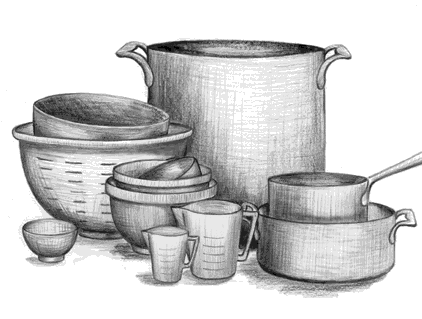
To prepare the studio for patinas, collect a wide assortment of pots and pans. The size you need will depend on the kind of work you do, but you'll want a wide range at your disposal. Plastic tubs and buckets are useful, as are deli containers. In all cases, these vessels will be permanently retired from use in the kitchen.
A strainer or colander is useful for rinsing work under running water, and for immersing objects into a warm patina bath. The advantage of plastic is that there is little chance of scratching the work or the patina layer. It is good to have several different size strainers on hand.
|  |
Household Materials
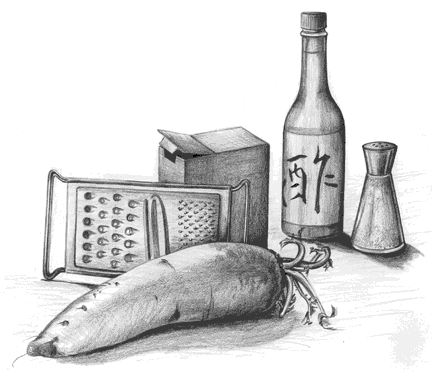
Many of the chemicals we use can be found right around the house. These are exactly what they appear to be-the familiar kitchen supplies you buy in the grocery store. Besides being easy to obtain, these are also inexpensive. Buy separate supplies for the patina studio, so you won't risk accidentally carrying an unwanted substance back into the kitchen.
|  |
Special Chemicals
Some of the chemicals you'll need can be bought at the local supermarket or pharmacy, but not all. Unfortunately, buying small quantities of chemicals can be difficult. The list of suppliers at the back of this book offers a few companies that specialize in chemicals for artists. In addition, you might consult the local Yellow Pages, (look under Laboratory Supplies).
Sometimes it is possible to purchase supplies from the chemistry department of a university or high school. For most people, only small batches of patina solution are needed, so relatively small amounts can last a long time. Though they are not in the business of reselling chemicals, schools can often be persuaded to part with small quantities.
Rokusho
Rokusho , also called "copper rust," is not a patina solution, but an ingredient that will be used later in various solutions. Rokusho is sold commercially in Japan, but until recently it has not been available in the United States. See the Supplier list at the back of this book for a domestic source.
Some artists might prefer to make this "alternate rokusho." This recipe has been modified from suggestions culled from several resources and adapted for commonplace American ingredients and measurements. Readers are invited to adjust the proportions slightly to develop their own solution.
Alternate Rokusho
- 40 grams copper acetate, Cu(C2H3O2)2
- 14 grams calcium carbonate, CaCO3
- 14 grams sodium hydroxide, NaOH (also called caustic soda, lye, sodium hydrate, and Drano)
- 1 liter water
Mix these ingredients well and allow the solution to sit undisturbed for a week. Pour the liquid through a coffee filter to strain it and catch the particles, which is what you want. This recipe will yield about 30 grams of rokusho. Store the rokusho in a jar to keep it slightly moist until ready for use.
Finishing Supplies
If metal is imperfectly finished or insufficiently cleaned, patinas will not only fail to look good-they often exaggerate imperfections.
The general idea behind finishing is consistent around the world. Metalsmiths use tools and abrasives of progressively finer impact to sequentially smooth down the blemishes that are formed in the construction of a piece. In Japan, we use slightly different tools for this, and these have been mentioned here in order to bring this alternative approach to the West.
The two items that will seem most unusual to American and European metalsmiths are whetstones and charcoal. Europeans might be familiar with Water of Ayr stone, also called Scotchstone, a naturally occurring soft stone that is found in Scotland. Enamelists are certainly familiar with the use of abrasive stones to refine a surface, but this technique is not common in western studios. In Japan, whetstones have been used for centuries and continue in common use today.
For final finishing, we use charcoal, which we buy in large blocks. These are rubbed against the finished metal object, where they quickly wear down to match the shape of the work being polished. The process is a bit messy, but surprisingly effective. Compressed charcoal sold for backyard grills is not appropriate for this, but a grilling charcoal labeled as "natural charcoal" is satisfactory.
- Jar of wax
- Rubber gloves
- Jar of lacquer
- Pine resin
- Charcoal block/stick
- Whetstones
- Sandpaper/sanding stick
- Cloth
Patina Application
It will become clear as you read this book that there are four parts in creating a patina. Each alloy has unique color possibilities, and the wide range of patina recipes offer a rich pallette. The proper preparation of the metalwork is crucial, and that leaves one thing-the application of the patina itself. Here, as in the other factors, there is room for creativity.
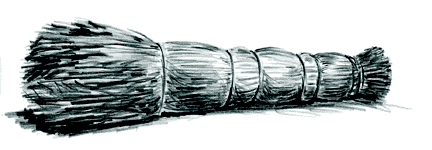 |
| Migo-hake In Japan, patina is sometimes applied with a brush made by tying together a bundle of straw |
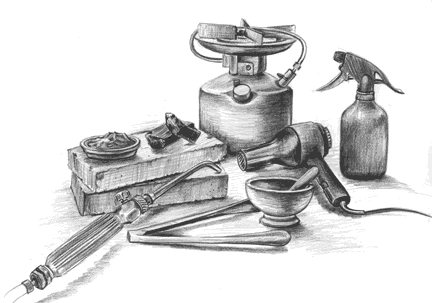
Many patinas are applied by immersion, often while the patina solution is kept hot. In other cases, the work is heated, typically just to the point where it is too hot to touch, then the patina is applied. In Japan we often make a disposable brush for this purpose by tying together a bundle of straw. Not only does this avoid the problem of burning the bristles on a good brush, but the smoke of the burning straw can contribute to the patina.
|  |
Safety
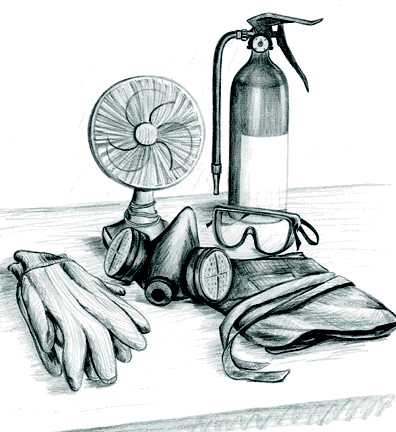
The patinas in this book do not use especially dangerous chemicals, but this is no reason to be careless. Each individual has unique responses to chemicals, including the smoke, vapors, and dusts that are unavoidably part of the patina process. Use your commonsense to remain safe. If you experience headaches, sore eyes, or an unpleasant taste in your mouth, discontinue the patina you are using and see if the problem goes away. Wherever possible, use ventilation to move vapors away from the workspace. Set a fan on one side of the room and open a window on the opposite side. Work outside whenever you can.
Always wear rubber gloves when handling caustic chemicals. Goggles, long sleeve shirts, and aprons are also recommended. Be careful that you do not accidentally carry contaminates into your living space. When using strong chemicals, wear a lab coat or coveralls. This will protect you when you are working, and makes it possible to leave the chemicals in the studio, where they belong.
|  |
It is the job of each artist to learn the potential risks of the chemicals they use. Your first source for this information is the company that sells you the supplies. Tell them what you're doing and ask if there is anything you need to know before getting started. You can also scan the internet and seek advice from your state's Occupational Safety and Health Administration (OSHA).
 |
Purchase your own copy of “Japanese Patinas” today. |
Related Articles

Testing Japanese Patina Solutions

Liver of Sulfur 101

Helen Shirk: Patterns of Growth
Patina Formulas

The All-In-One Jewelry Making Solution At Your Fingertips
When you join the Ganoksin community, you get the tools you need to take your work to the next level.