950 Palladium: Gemstone Setting
Setting gemstones in 950 palladium alloys is a bench jeweler'#39;s dream. Stone setters will agree that the combination of palladium'#39;s malleability, superior strength and the near absence of memory (spring-back) when it is bent or formed all set the foundation for success, regardless of the setting style. But without proper design (structural support, sufficient metal, accurate fit, etc.), planning and execution of workmanship, the unique and positive characteristics of palladium cannot be used to the best advantage. More importantly, ignoring the working characteristics of the metal could lead to problems for the jewelry through normal wear, such as mountings becoming misshapen resulting in loss of gemstones. The following review of gemstone setting specifically in palladium alloys presents some jewelry examples for consideration.
6 Minute Read

Setting gemstones in 950 palladium alloys is a bench jeweler's dream. Stone setters will agree that the combination of palladium's malleability, superior strength and the near absence of memory (spring-back) when it is bent or formed all set the foundation for success, regardless of the setting style.
But without proper design (structural support, sufficient metal, accurate fit, etc.), planning and execution of workmanship, the unique and positive characteristics of palladium cannot be used to the best advantage. More importantly, ignoring the working characteristics of the metal could lead to problems for the jewelry through normal wear, such as mountings becoming misshapen resulting in loss of gemstones. The following review of gemstone setting specifically in palladium alloys presents some jewelry examples for consideration.
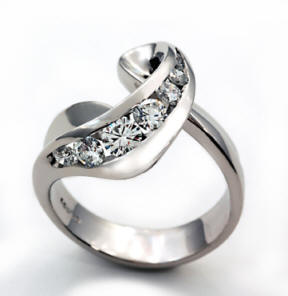
This mounting holds graduated round diamonds ranging in size from 0.01 to 0.33 carats each and was designed by Lainie Mann, Mann Design Group. The channel walls into which the diamonds are set taper in thickness from 1.2mm at the thinnest to 2.2mm at the widest portion. This thickness is proportionately ample, at each point where a stone will be seated and held, so that the palladium will not distort during normal wear.
Design tip: When designing for channel setting, 1) design for the stones you'll be using and measure between walls, 2) keep the channel walls parallel, 3) allow for ample metal for setting on opposite walls, especially shared walls (remember casting and finishing) 4) consider structural stability allowing for supports to your design 5) keep the top of channel walls flat for setting and finishing.
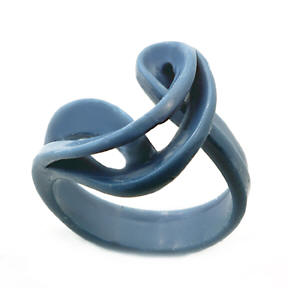 | To further secure and stabilize the curved channel walls, they were joined to the lower bars in the wax model prior to casting. Design tip: Because tapered and curved channels are characteristically less stable than straight channels, this structural reinforcement provides further support for the channel walls, ensuring that the gemstones are secure and preserving the integrity of the design in wear. |
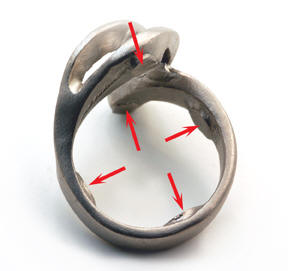 | For casting, 5 runners or feeder sprues were attached to the wax model. The diameter of each was about 3.5mm and their locations are indicated by the red arrows. The casting was done by TechFrom, Portland, OR. Palladium note: Multiple spruing and gating of models to be cast in palladium has significantly reduced or eliminated shrinkage porosity and provided an "exit" for excess gasses absorbed during melting that is given off when the metal is cooling. |
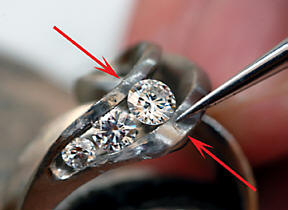 | To create the opposing bearings in the walls of the mounting and to seat the diamonds for channel setting, 3 sizes of 70 Busch Bearing burs were used. The diamonds were set one at a time using a scribing, burring and seating process. In this image, 2 diamonds have been set and the third is being positioned. A small amount of sticky wax is holding the diamond in place while the setter scribes its placement. |
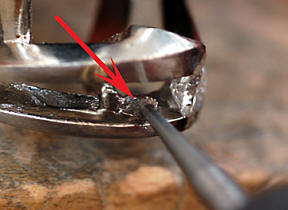 | The wax holding the diamond in place was removed after scribing the position where it will be set and the bearing was created. For the 3.6mm round brilliant diamond, a 70 1.65mm bearing bur was used to create the bearing. The excess metal or flashing created by the tool was removed and the diamond was then pushed in place. This 3-step process was repeated until all of the diamonds were set. |
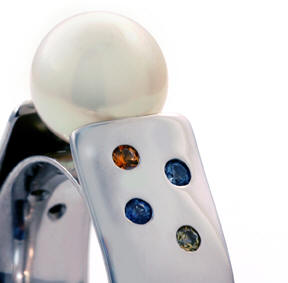 | These multi-colored Montana sapphires are flush (or burnish) set. Palladium is ideal for this purpose given its desirable malleability, which allows for substantial metal to be easily formed around the gemstones. With the strength and superior wear features of palladium, these sapphires are securely set. The sapphires were set by JewelCraft in Erlanger, KY. Design tip: Jewelry design is all about bringing precious metal and gemstones together to create a dazzling, wearable, lasting piece which complements both elements-and more importantly, the wearer. Select the materials to make the whole greater than the sum of its parts. Here, the forever untarnished whiteness of palladium compliments each brilliant colored sapphire and illuminates the overtones of the pearl. The gemstones in turn bring out the soft tactile form of the palladium-the perfect enhancement for all skin tones. |
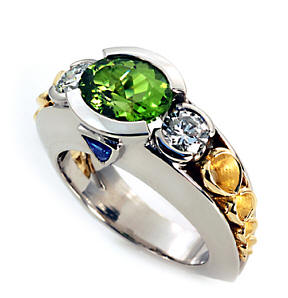 | This 5 stone ring designed by Lainie Mann, Mann Design Group holds an oval peridot center stone flanked by round brilliant diamonds, all set in partial bezels and accented by 2 bezel set trillion-shaped blue sapphires. The setting was done by JewelCraft in Erlanger, KY. The full bezels are 0.65mm in width. The thickness of the partial bezel for the center stone is 1.3mm and 1.1mm on the side diamonds. Both were easy to manipulate in the setting process and provide ample security. Design tip: Partial bezels offer great possibilities in design: the security of bezel setting, maximum 'show' for gemstones (e.g. more light, closer spacing) and the form of the setting is integral to the design style. When creating designs that 'overlap' gemstones in partial bezels (to make the most of their sparkle and color), remember to allow enough metal and 'elbow room' to insure that the settings can be secure. |
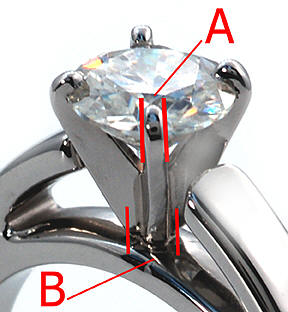 | This mounting and setting features prongs that are only 0.7mm in width (A) that taper to a very narrow base (B). Because the prongs and the base are narrow the setting twisted and distorted when the bearings were being created using a setting bur. The center stone is large so when placed on a flat surface with a small amount of pressure applied from the top, the setting bent to one side. This is undesirable as the prongs should be thicker and the base should have a substantially wider platform. This mounting may fail under the strain of normal wear. |
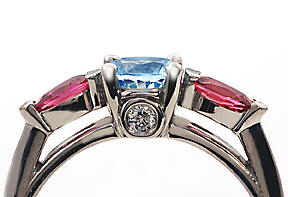 | The prongs for the round brilliant center stone in this lightweight 950 palladium 5-stone mounting by the Mann Design Group are 1.2mm in diameter. It also features a supportive gallery wire just above the small bezels holding the 0.02 round diamonds. This structure provides sufficient support and security for all 5 stones even though this mounting only has a total weight of 3.5 pennyweights. The prong width, bezel and point prong width and the structural support for this low-profile design make this palladium mounting a successful candidate for lasting wear. |
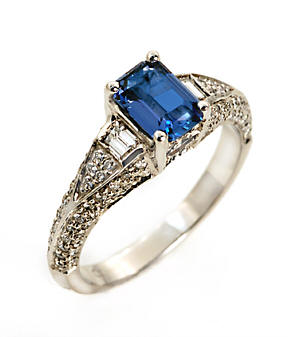 | This mounting by Jim Adair, Adair Jewelers, Missoula, MT features an emerald cut sapphire center stone set in 4 1.25mm round prongs. The prongs are substantially supported below the girdle level of the mounting. The baguette side stones are bezel and channel set with ample wall thickness and the small round brilliants have been pave' set with beads large enough to cover the small diamonds they are securing and to hold up during normal wear. |
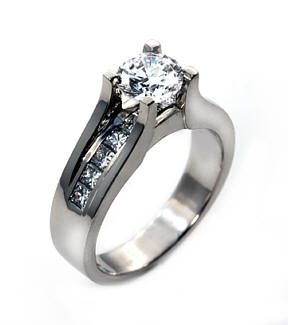 | This ring designed by Venetti, Los Angeles, CA has 4 substantial square-shaped prongs. The prongs taper from 1.4mm square at the top to a wide base and are supported within the overall structure. The small princess cut side diamonds are channel set with substantial metal holding them in place. Given the dimensions of the ring and setting structure, there is no potential for distortion or stone loss through normal wear. Design tip: Palladium provides the perfect precious metal medium for the designing larger and more substantial jewelry which is very comfortable to wear. With a specific gravity of 11.8, palladium expands the range of styles for today's designer. Whether you are a designer, bench jeweler, quality control technician or jewelry buyer, take the time to become familiar with the qualities that mark a well-designed and crafted example of fine palladium jewelry and jewelry components which will provide a desirable, wearable and long lasting piece of jewelry. |
Palladium Jewelry Manufacturing: Frequently Asked Questions:
How is the weight of palladium as compared to platinum and white gold?
Platinum's specific gravity is 20.7 and palladium's is 11.8. This means that palladium is nearly half of the weight by volume under platinum offering a wider range of design possibilities. The overall weight of palladium is similar to the weight of 14- and 18-karat white gold.
Related Articles

950 Palladium: Superior White Color

950 Palladium: Making a 3-Stone Ring

950 Palladium: Manufacturing Methods

950 Palladium: Fabricating Custom Earrings

The All-In-One Jewelry Making Solution At Your Fingertips
When you join the Ganoksin community, you get the tools you need to take your work to the next level.