950 Palladium: Successful Design Considerations
Well designed 950 palladium jewelry plays to the strengths of this unique metal -- the aesthetics of its light, bright, white color, weight and '#39;feel'#39;. It'#39;s a joy to create a beautiful piece of jewelry which delights the wearer, and promises to remain trouble free for years to come. So here'#39;s a tip: Emphasize the positive qualities of this unique metal in your designs. Whether palladium plays a supporting role to diamonds or fancy gemstones, or takes the spotlight in visual form or tactile comfort, employing its best characteristics in your creations will serve you well in saleable jewelry, customer satisfaction and your bottom line.
6 Minute Read

Palladium alloys for jewelry manufacturing contain 95% palladium and 5% other metals. Specific jewelry manufacturing methods like casting, machining, chain making, hand fabricating or other processes sometimes call for differing alloy ingredients. Of the popular alloys currently being used in the U.S. for palladium jewelry the common balance consists of 95% palladium, nearly 5% ruthenium and trace elements of other metals. The inclusion of specific trace elements offer certain benefits to the manufacturing process (e.g. hardness, better fluidity for casting, ease in machining) or lend to better wear of the finished jewelry. Alloys containing 95% palladium share inherent characteristics of the pure metal, such as
- Malleability - palladium is readily capable of being shaped or formed by hammering or pressure.
- Ductility - palladium is capable of being drawn or bent without breaking.
- Hardness - palladium has an as-cast Vickers hardness between 110 and 150 depending upon the alloy. With this hardness range, it is relatively resistant to denting, scratching or bending and wears similarly to platinum.
- Strength - with adequate tolerances, palladium has good strength and will hold shape and form through strain or stress.
Well designed 950 palladium jewelry plays to the strengths of this unique metal-the aesthetics of its light, bright, white color, weight (comparable to 14k gold) and 'feel' as well as palladium's metallurgical assets in setting, fabricating, casting and machining. It's a joy to create a beautiful piece of jewelry which delights the wearer, and promises to remain trouble free for years to come. So here's a tip: Emphasize the positive qualities of this unique metal in your designs. Whether palladium plays a supporting role to diamonds or fancy gemstones, or takes the spotlight in visual form or tactile comfort, employing its best characteristics in your creations will serve you well in saleable jewelry, customer satisfaction and your bottom line.
This article examines 2 basic examples of 950 palladium jewelry. They are both solitaires and both show examples of the best applications of palladium's characteristics.
This example shows a comfort fit shank (inside of the shank is slightly rounded) and a low profile 4-prong setting. The inherent characteristics of palladium and the design of the parts were considered in their selection as explained in the following points:
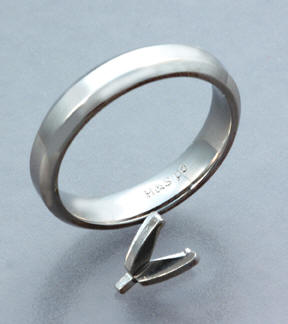 | ![[]](/_next/image/?url=https%3A%2F%2Fwww.ganoksin.com%2Fwp-content%2Fuploads%2F2016%2F06%2Flistblack.gif&w=1920&q=75) The overall thickness of the shank is 1.85mm. This thickness is required and offers the support necessary for the shank to hold its shape through normal wear. Palladium's malleability, while desirable in setting, would allow a thin shank to be easily deformed during normal wear. Customers may be assured that the thicker shank is neither bulky nor heavy, since the specific gravity of palladium is comparable to (an equal mass of) 14 karat gold. The shank has a beveled design. The overall width is 4.10mm and the flat portion at the top of the shank is 2.00mm wide. Palladium has a desirable hardness for jewelry but is softer than the less pure white gold alloys containing nickel. The narrow flat area at the top of this shank will show less wear than a plain flat shank with the same overall width of 4.10mm. A low profile setting was chosen with a total height of 5.65mm from the base of the unit to the tops of the prongs prior to setting. Taller profiles for this type of assembly are more vulnerable to deformation such as twisting or bending. The base of the setting measures 3.25mm offering a good amount of surface area for soldering to the ring shank. Narrower widths would have less contact and therefore be less stable and could bend and eventually break during normal wear. The prongs measure 1.00mm in width and 1.25mm at the prong top and broaden to 1.90mm at the base of the prong. The tapering width from bottom to top offers fantastic prong stability for normal wear. Prongs of thinner dimensions when made in 950 palladium alloys present a risk of becoming deformed during normal wear. The overall thickness of the shank is 1.85mm. This thickness is required and offers the support necessary for the shank to hold its shape through normal wear. Palladium's malleability, while desirable in setting, would allow a thin shank to be easily deformed during normal wear. Customers may be assured that the thicker shank is neither bulky nor heavy, since the specific gravity of palladium is comparable to (an equal mass of) 14 karat gold. The shank has a beveled design. The overall width is 4.10mm and the flat portion at the top of the shank is 2.00mm wide. Palladium has a desirable hardness for jewelry but is softer than the less pure white gold alloys containing nickel. The narrow flat area at the top of this shank will show less wear than a plain flat shank with the same overall width of 4.10mm. A low profile setting was chosen with a total height of 5.65mm from the base of the unit to the tops of the prongs prior to setting. Taller profiles for this type of assembly are more vulnerable to deformation such as twisting or bending. The base of the setting measures 3.25mm offering a good amount of surface area for soldering to the ring shank. Narrower widths would have less contact and therefore be less stable and could bend and eventually break during normal wear. The prongs measure 1.00mm in width and 1.25mm at the prong top and broaden to 1.90mm at the base of the prong. The tapering width from bottom to top offers fantastic prong stability for normal wear. Prongs of thinner dimensions when made in 950 palladium alloys present a risk of becoming deformed during normal wear. |
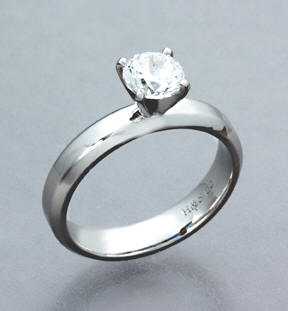 | When the mounting is assembled and set, the combined features of this basic assembly provide a secure setting for the 6.0mm gemstone. |
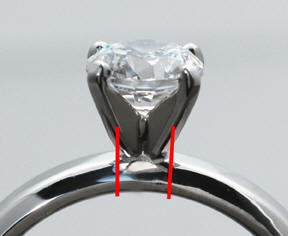 | Important notes: The contact area between the base of the head and the shank measures 3.25mm (indicated by the red lines) offering good strength and stability for the setting. The prongs have sufficient length and thickness, providing good security for the 6.0mm gemstone. |
This example shows a half-round shank and a high profile 4-prong setting. Again, these parts were chosen on the basis of palladium's characteristic strengths and on the merit of their design for the following reasons:
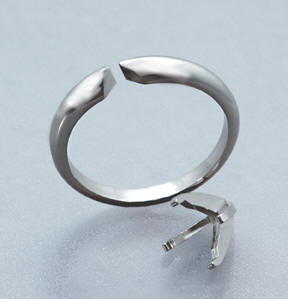 | The overall thickness of the shank tapers from 3.60mm to 2.10mm at the bottom. This thickness offers support for the shank to hold its shape through normal wear. The height tapers from 2.50mm to 1.50mm at the bottom portion. Thinner shank options would not be desirable as they could easily be deformed during normal wear. The setting is high profile with a total height of 8.65mm from the base of the unit to the tops of the prongs prior to setting (3mm taller then the previous example). The prongs measure 1.00mm in width and 1.00mm at the prong top and widen to 2.5mm at the base of the prong. The tapering width from bottom to top offers great prong stability for normal wear. Prongs of thinner dimensions when made in 950 palladium alloys could present a risk of becoming deformed during normal wear. |
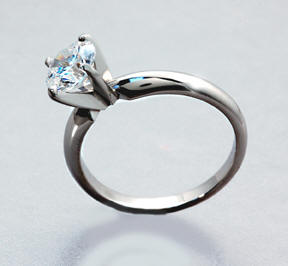 | The method of assembly between this setting and shank differs from the previous example. The top portion of the shank is cut so it precisely interlocks between the prongs providing extra strength and security to the assembly. |
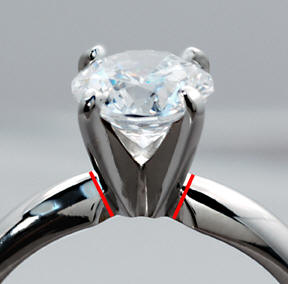 | Important notes: The height of the shank at the point of assembly is 2.50mm. The width and interlocking feature of this assembly provide ample contact area for added strength and security to the high profile setting. The high profile is balanced by proportionately thicker prongs which widen at the base. This design feature greatly decreases the chance of bending and deformation of the malleable palladium prongs during normal wear. |
Be sure to use pre-made components (findings) that are designed and made for palladium. Using dies originally designed for white gold to strike out components for palladium could lead to problems. White gold alloys contain high percentages of nickel and other metals that have different metallurgical characteristics (e.g. low malleability and greater hardness) than 95 percent pure palladium or platinum alloys. Dies designed for white gold specifications may prove to be insufficient for use in palladium jewelry components.
Watch this series of palladium jewelry manufacturing articles for more on palladium jewelry design considerations.
Palladium Jewelry Manufacturing: Frequently Asked Questions:
When palladium is used for jewelry manufacturing, is it as pure as platinum or white gold for the same?
Palladium is a noble metal like platinum and from the platinum group of metals. General purpose palladium alloys are typically mixed with ruthenium (another member of the platinum group of metals, or PGM) and trace elements of other metals. The content of palladium is 95% of the total alloy and referred to as 950Pd. This means that 950 parts of 1,000 are palladium and 50 parts are ruthenium and trace amounts of other metals. When white gold is used for jewelry, it usually occurs as 14- or 18-karat. 14-karat white gold contains only 58.5% gold in the alloy and 18-karat alloys contain 75% gold. Palladium and platinum are superior in purity over white gold alloys.
Related Articles
Laser Platinum Fabrication

950 Palladium: Fabricating Custom Earrings

Design Layout Tip

Making Custom-Designed Earrings Using Welding Technology
The All-In-One Jewelry Making Solution At Your Fingertips
When you join the Ganoksin community, you get the tools you need to take your work to the next level.