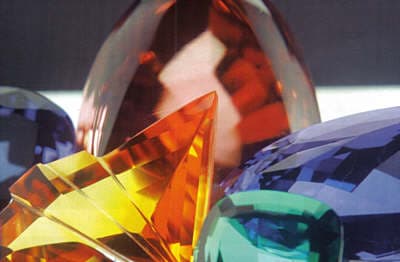
Gemstone Cutting Creates Freedom for Design
Difficult times are often good times for the unusual. The higher the hurdle that must be overcome to make clients decide to buy, the more important are originality and exclusiveness. Proven, well-loved, timeless... This year the trend is toward lasting values. That iss why classic gemstones are particularly in demand. Quality and originality are doing well.
2 Minute Read

Difficult times are often good times for the unusual. The higher the hurdle that must be overcome to make clients decide to buy, the more important are originality and exclusiveness. Proven, well-loved, timeless… This year the trend is toward lasting values. That's why classic gemstones are particularly in demand. Quality and originality are doing well.
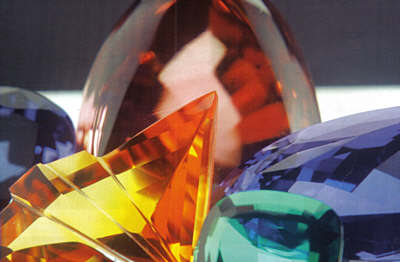 |
| Perfection to the last detail: fine gemstones in various finishes (Ekkehard F. Schneider) |
The cutting and polishing of gemstones are among the rare cases where a natural material first reveals its full beauty as the result of human intervention. However, the proportion, cutting, and polishing of the stone must be in perfect harmony Every rough stone is different, and the cutting must reveal the potential hidden in it. Ekkehard F. Schneider, a supplier of unusual gemstones in Idar-Oberstein, Germany, says that the art is first to recognize the beauty and then to use craftsmanship to reveal it. If either factor is missing, the result will be mediocre.
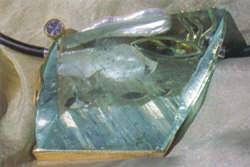 |
| Intergern 2002. Pendant, diamond, roulette cut, 0.950 ct tw/vvsi, aquamarine, fresh-water pearl, beryl, navette cut, 18 carat yellow gold (Hans-Jurgen Druglat) |
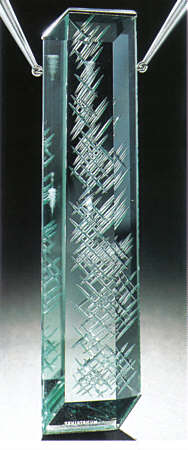 | Necklace "Prisma" Platinum, aquamarine 252.44 ct (Tom Munsteiner) |
Cutters often spend hours studying an unusual rough stone from every angle. Every aspect is important: the shape, the enclosures, color nuances, and the pleochroism - the change in color depending on the axis. The stone then receives its shape and proportion on the cutting wheel before it is cut facet by facet. The final polishing then gives the stone its brilliance.
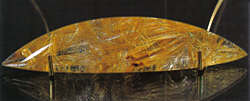 | Necklace 18 carat yellow gold, rutilated quartz, diamonds (Rainer Schuhmann) |
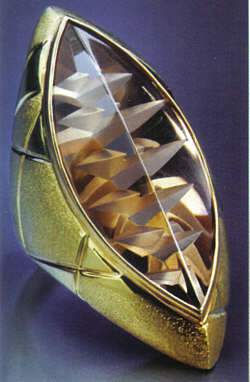 | Ring 18 carat yellow gold, natural citrine 19.2 ct, Unique (Stephen Greenstein) |
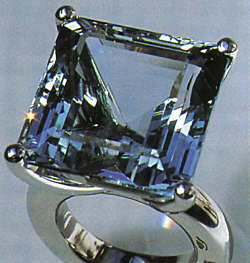 | Princesses ring 18 carat white gold with aquamarine 43.38 ct (Erich Zimmermann) |
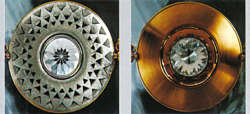 | "Janus" disc pendant with HR-CUT®, HLB 452 C Designed for viewing of both sides of the stone - front side on the left, reverse on the right (Jorg Schreiner) |
The more perfectly a stone is cut, the greater the amount of light that is captured and reflected and the more beautiful the interplay of light and color. The imaginative processes created over the past few years fulfill the prerequisites for extremely unusual jewelry designs, such as the precise patterns in 'Janus Cut' by Groh + Ripp, which is cut on the front and back side of the stone, giving the wearer the fun of displaying either side, depending on the mood.
 | Necklace Silver, amber and leather (Mariusz Gliwinski) |
 | Ring in 18 carat yellow gold With a tourmaline in the spirit diamond cut (Jorg Munsteiner) |
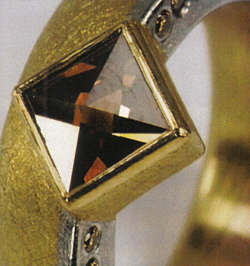 | Ring, 18 carat gold, platinum, diamond Context Cut, Earth Colour EC2-vsi2 1.12 ct Diamonds cognac total 0.37 ct (Michael Zobel) |
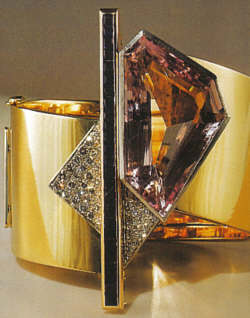 | Armlet, 18 carat yellow-gold with sapphires, brilliant-cut diamonds and pink kunzite. The central piece is removable and can be worn as a brooch |
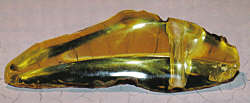 | Amber with a polished drill hole for pendants (Hochstrasser + Co) |
Leaving behind familiar shapes to break new ground requires extensive knowledge of the characteristics of the material and a sure hand with the dramaturgy of refraction. The new facets obtained from the precious stone create freedom for the design and the ability to enchant with the charm of novel optical effects, thereby attracting new customer groups.
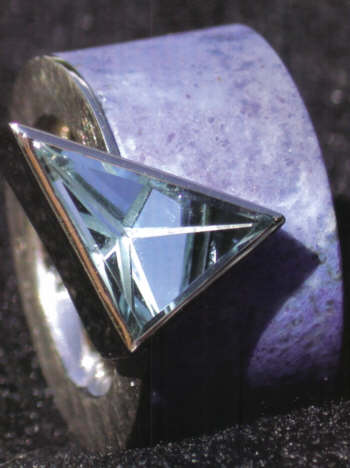 |
| Intergern 2002. Ring Aquamarine, 18 carat white gold (Hans-Jurgen Druglat) |
Related Articles

Playing Favorites with Dallae Kang
Gemstone Name Reference List

CAD/CAM: Creating a Class Ring – Part 1

The Artemis Medallion

The All-In-One Jewelry Making Solution At Your Fingertips
When you join the Ganoksin community, you get the tools you need to take your work to the next level.