Optical Effects in Gemstones
This list introduces some of the terms used in discussing optical effects in gemstones.
6 Minute Read

This list introduces some of the terms used in discussing optical effects in gemstones. read on to learn about optical effects on gemstones.
Lustres
Lustre (or the American spelling Luster) refers to the amount and quality of light reflecting from a gem's surface to the eye. It is partially a subjective measurement but can be helped by comparison with a standard set of gems with known lustres. The hardness of a material, its refractive index and the degree to which it has been polished will have a bearing on the lustre. In general the harder a material is the higher the lustre, the softer it is the lower the lustre. The Americans and the British use slightly different nomenclature for lustres.
The American Liddicoat terms the categories: "metallic, submetallic, adamantine, subadamantine, vitreous, subvitreous, waxy, greasy, silky, dull." He goes on to say: '"The first three reflect the presence of refractive indices over the refractometer scale. Subadamantine suggests an index high on the scale; vitreous, midscale; and subvitreous, low. Waxy and greasy lusters are usually associated with poorly polished surfaces, while silky refers to stones with many needle like inclusions." (Liddicoat, 'Handbook of Gem Identification', pp 216, 1993 ed.)
Britain's Webster says that many gems have a glassy or vitreous lustre. He gives examples and lists the lustre types as: "Metallic: silver, Adamantine: diamond, Subadamantine: demantoid garnet, Resinous adamantine: certain zircons, Vitreous: quartz, Resinous: amber, Silky: fibrous materials such as satin-spar, Pearly: usually seen only on cleavage faces, Waxy: turquoise". (Webster, "Gems: Their Sources, Descriptions and Identification"..pp 670)
John Sinkakas makes a correlation between refractive index and luster (he's American). Refractive index is given first, then the corresponding comment on luster.
- 1.3 - 1.4 - Poor reflections, inclined to be greasy or oily in appearance
- 1.5 - 1./8 - Brightly reflective, like glass
- 1.6 - 1.9 - Resinous in appearance
- 1.9 - 2.5 - Very brightly reflective, adamantine, sometimes appearing as if the mineral is lightly coated with a metal film.
- 2.5 + - Submetallic, bright luster, definitely metallic in appearance
(Sinkakas, John,. "Gemstone and Mineral Data Book", pp 336)
Sheen
Sheen is due to the reflection of light from material below the surface of a gem. Moonstone, spectrolite and other feldspars are examples. Sheen in moonstone is also called schiller or adularescence. Pearls too have sheen as light reflects from below the surface of the pearl.
Interference of Light
When a light ray strikes a surface composed of thin films part is reflected and part refracted into the films. The ray then reflects from film levels below the top surface and reenters the air. As it does so it interferes with; either intensifying or quenching certain wavelengths (colors) in other light rays reflecting from the top of the film. This produces color and light effects like that of oil on water, soap bubbles, Titanium and Niobium coloring, labradorite, tempering colors on steel and so on. In the diagram below a single ray is shown but in reality an infinite number of rays are doing the same thing simultaneously at all points on the surface of the partially reflective top layer or film.

Iridescence
A general term for color effects produced by interference or by diffraction. Color play in opals, mother of pearl etc. are examples.
Play of Color
A term used to describe the colors seen in opal. This is caused by light diffraction from a regular structure of silica spheres in opals.
Diffraction
When light passes over many tiny sharp edges or between many repeated points of differently refracting media an interference like phenomenon occurs; light is spread out into specific colors. You can see this on music CDs and sometimes on mesh between you and a light source. This principle is used in the diffraction grating spectroscope. This is what causes the play of color in opals, light being bent and diffracted as it passes innumerable regular stacked layers of minuscule silica gel spheres.
Opalescence
The milkiness of opals. Sometimes it is used to describe play of color.
Chatoyancy
When a gem material contains many minute fibrous inclusions oriented in one direction and it is cut en cabachon a streak of light or 'eye' can be seen at right angles to the direction of the inclusions. An example used to explain this is the light streak visible on a spool of silk thread or on an old 35 RPM record. Examples include chrysoberyl (cymophane), crocidolite (tigers eye) and quartz. Many gems can exhibit an 'eye' including tourmaline, beryl, nephrite, jadeite etc.
Asterism
Star stones, these are most commonly sapphire and ruby but may include garnet, spinel, diopside and other gems. It is a special type of chatoyancy as the cause is due to many small fibrous inclusions oriented at set angles to each other. Examples are ruby (60o), garnet (70o). These inclusions in the case of corundum are all parallel to the lateral axes of the crystal and at right angles to the vertical crystal axis. When the stone is cut with the top of the cabachon dome oriented with the main crystal axis passing vertically through it and the silk inclusions parallel to the girdle of the stone asterism results. Each set of silk has a streak of light at right angles to it and a star is seen.
Spectroscope
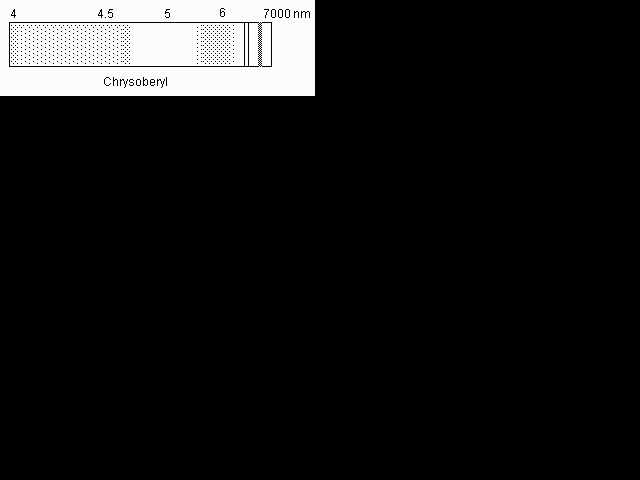
Along with the microscope and refractometer this is a major identification tool in gemology. As light passes through a gem the presence of certain chemicals will cause specific wavelengths of light to be absorbed. Instances also occur where wavelengths are intensified or the stone actually emits light (fluorescence wavelengths - rubies, spinel). When light is spread out by a prism or diffraction grating spectroscope into a wide band these absorbed wavelengths show up a lines or areas of darkness in the spectrum. While the actual wavelength numbers can be used in identification usually only a pattern of lines is used to identify the stone. It can be the fastest way of checking out large numbers of stones, even small ones, especially red gems, as spinel, ruby and tourmaline have distinctive spectra. It can be used to identify synthetic verneuil sapphire, blue synthetic spinel, almandine garnet to name a few. Note that British gemmologists have the red on the left and Americans have it on the right when looking at spectra.
Here is an example of what the absorbtion spectrum pattern of a gem stone might look like through a spectroscope. We are however dealing with an ideal here because in real life the spectrum lines you see are really faint, fuzzy, hard to see things. The most realistic drawings available can be found in Liddicoats 'Handbook of Gem Identification'. Red is on the right in the diagram below - because I like the American drawings the best.
Suggested Reading:
- 'Gem Testing' by Anderson and Webster,
'Handbook of Gem Identification' by Richard Liddicoat.
The latter has the best group of drawings available on what spectra look like, very fuzzy, hard to see at times. - Anderson, B.W. Gem Testing. London: Butterworths, 1980.
- Liddicoat, Richard T., Jr. "Handbook of Gem Identification". 12th ed. Santa Monica: Gemological Institute of America, 1993.
- Sinkakas, John,. "Gemstone and Mineral Data Book: A Compilation of Data, Recipes, Formulas and Instructions for the Mineralogist, Gemologist, Lapidary, Jeweler, Craftsman and Collector". Prescott, AZ: Geosciences Press, 1988.
- Webster, Robert. "Gems: Their Sources, Descriptions and Identification". Fourth ed. Rev. B.W. Anderson. London: Butterworths, 1983.
Related Articles

Step by Step Guide to Single Row Pave Settings

Handling Colored Stones at the Bench Part 4

Fish Tail Setting

Fracture Healing / Filling of Möng Hsu ruby

The All-In-One Jewelry Making Solution At Your Fingertips
When you join the Ganoksin community, you get the tools you need to take your work to the next level.