Noise and its Effects
Noise is so common that we don't tend to think of it in terms of exposure in the same way that we would, for example, with a chemical such as benzene. Yet the treatment of hearing damage is considered to be one of the growth industries as we.
15 Minute Read

Noise is so common that we don't tend to think of it in terms of exposure in the same way that we would, for example, with a chemical such as benzene. Yet the treatment of hearing damage is considered to be one of the growth industries as we enter the new century, as the "baby boomers" age. I personally know several people in their forties who have to use hearing aids. And with increasing age even more hearing can go.
For people who have been able to hear all their lives it is not a pleasant thing to be cut off from the world by deafness-it can be one of the loneliest things in the world for someone who goes deaf later in life and has trouble compensating. Not all hearing damage is due to workplace exposure, and in fact much damage comes from music played far too loudly, and other recreational activities. One of the medical books I consulted had the most marvelous electron microscope pictures of the cilia, these little grass-like stalks that receive sound and let us hear.
Noise damage destroys the cilia and eventually the loss of hearing that results is permanent. The incredibly graphic look of those pretty little cilia permanently blasted into ribbons and shattered stumps by sound really made an impact on me. If you experience tinnitus, a ringing or a similar sensation in the ears then you probably have impaired hearing. Tinnitis is variously described as 'ringing', a rushing or hissing sound or even a musical type of noise (Tver and Anderson 144).
About that recreational music level. I used to know a bar owner. We asked him to lower the volume one night. He explained that it was deliberately kept too loud because when a customer is uncomfortable and unable to hear conversation they drink more-and the bar makes lots more money. This understanding among bar owners was borne out some years later when a band I know was playing in a bar. I asked them to turn the music down and they explained they couldn't because the bar had the volume control wired directly to the bartender and he alone controlled the volume.
When we go out to a club we always take ear plugs, and I've seen ear plugs for sale on a bartop in Idaho-which says something important about what kind of damage we are doing to ourselves with music. And rock musicians have bought all this hook, line, and sinker, so that many now play their music far too loudly as a matter of course, not understanding that doing so is just a reflection of the capitalism of bar owners and does not, in fact, enhance their music. And their audiences accept this state of affairs. If you applied workplace noise guidelines to the average club, music act or bar, they would be shut down immediately or have to hand out hearing protection at the door. I remember seeing a James Taylor special on television and noticing the man had hearing aids in both ears. Other well-known rock musicians have impaired hearing from exposure to their own music
Jeff Guard, Group Safety Manager at ConAgra Malt Americas notes that, "Here in the southern province of Washington State (in the workplace), Walkman® personal radios are banned, mainly for two reasons. 1) You cannot hear alarms, warnings and/or other personnel. 2) They introduce noise directly into your ears, usually over an 85 decibel level" (Guard, Jeff, Health and Safety list, "Re:"). That 85 decibel level is the point where health and safety experts begin to really worry about permanent hearing damage. It is worth noting that the way that decibels are measured means that one multiplies (not adds) the intensity of the noise, so that, for example, "80 dB is ten times the intensity of 70 dB" (Quinn et al 10).
Other recreational exposures to noise can contribute to hearing loss in the workplace. It has been shown that people exposed to shooting noises (military, competition shooting or hunting) show significant hearing loss compared with those not exposed to shooting (Pekkarinen 545).
A rather rough guideline that I've heard is that you need hearing protection if you have to raise your voice to be heard by someone less than two feet away, or if you have to raise your voice to be heard in the workshop. Also, if your ears are ringing after work, you definitely need hearing protection. I've heard more than one person say their ears were ringing after going to a rock concert.
Electric hand tools produce sounds in the 85-100 dB range, and sound in workshops with machinery generally is between 90-100 dB (both are damaging levels). It should be noted that even if there are intermittent noises during the work day which are over 85 dB, then there is a risk of hearing damage, so if you can't do anything about unexpected occasional very loud sounds, equipment screeching, hammering etc. in the workshop, you should consider wearing hearing protection at all times (Century 27). The best solution, however, is to eliminate the cause of the too-loud sound by changing the procedure, or to change your exposure to it.
In the mid-1970s, sixteen million workers in the U.S. exhibited permanent hearing loss (Quinn et al 10). In Australia a survey of 5000 workers in all trades showed one third had hearing loss. A study of over 700 steel workers in Italy showed that 100% of them had hearing loss. In England in the 1970s the loudspeaker level in movie theaters was set higher in the industrialized north than in the south in response to the higher number of hard-of-hearing patrons (Kinnersly 45).
If you ever go to a blacksmiths' conference, the joke (or perhaps not a joke because it is so serious) is that they all have to shout at each other because they are so hard of hearing, and it is true that I've never met so many hard-of-hearing people in one place as at a large blacksmiths' conference. The sound of drop forging can lead to a rapid loss of hearing (Waldron 161). Ramazzini writes that coppersmiths lose their hearing and eventually become completely deaf (as well as being hump-backed, like gold leaf makers, from stooping bent over their work) (438).
The things about noise that cause damage include loudness, pitch, length of time exposed, the environment, your age, previous hearing or ear troubles, simultaneous chemical exposures, how far the noise is from you and where the noise is coming from relative to you.
Besides deafness, noise can cause nervousness and stress in people, really bad headaches and more. The body's "stress reaction," releasing adrenaline and so on, "occurs continuously in the presence of noise" (Stellman and Daum 79). Stress, in turn, can lead to coronary heart disease, ulcers, migraines, asthma and other problems. Sound types that produce the greatest stress include "a lack of predictability, lack of meaningfulness, high volume and intermittent and/or disharmonious nature" (Benowitz 476). Note that both low frequency sounds and ultrasound can produce symptoms in people exposed to them. Ultrasonic cleaning equipment can produce headaches, dizziness and nausea in some people (Kinnersly 60).
Noise can be a major contributor to fatigue, and fatigue is a common cause of accidents (Fraser 22). Other problems linked with exposure to noise include difficulties in focusing your eyes, backaches, sore muscles, heart trouble, stomach disorders, and depression (Quinn et al 10). Heart disease and blood vessel disorders are associated with exposure to high levels of noise (Stellman and Daum 33). Studies of Italian workers exposed to large amounts of noise and vibration showed significant deterioration of their digestive tracts (Stellman and Daum 105). Vibration is often associated with jobs that involve noise.
It has been shown that workers in a noisy environment make more mistakes than the same workers when the background noise has been reduced (Kinnersly 64).
There are lots of examples where people have been injured because noise has masked a hazard, or where wearing hearing protection has stopped a person from telling where a sound is coming from and they have then stepped into trouble. Hearing protection causes many wearers to confuse a sound from in front with one from behind and vice versa (Hétu et al 503). Noise (and wearing hearing protection as a result) can mask warning shouts from others, and it is important to remember this when you are wearing hearing protection.
If you can find and eliminate sources of noise you will do yourself some good. Maintain your equipment so things don't rattle. You can use acoustical tile, muffling cabinets (this is often done with dust collection and ventilation systems to quiet their powerful motors), add sound insulation to machine guards, move noisy machines away from people, put felt or rubber pads under noisy equipment, install sound barriers and so on to reduce the level of general noise that you have going on in the workshop.
Jewelry factory suggestions include avoiding air-powered ejectors, starting to use mechanical ejectors on production presses, using hydraulic presses instead of drop presses, lowering speed and workloads, using plastic gears, using backflowing blades on fans, welding machine parts instead of riveting, muffling the machines and chutes for parts being produced, going to newer machinery. "It is your right to work in a jewelry plant that won't damage your hearing" (Quinn et al 11, 12).
An example of a damping device used with a tool is a slice of rubber car inner tube with a grommet on it which is attached to the stump under the anvil. When you are using the anvil, stretch the tube up and pull it over the anvil horn, so that it presses tightly onto it. This will lower the noise level somewhat. Some blacksmiths will place a powerful magnet against the side of an anvil for the same reason.
There is some evidence that the effects of noise exposure on hearing are made worse if you are exposed to certain chemicals (Fechters 609-621). Solvent exposure in particular has been linked with hearing loss. Solvents used in the jewelry workshop or factory that add to hearing loss include trichloroethylene and the much more common toluene (Johnson and Nyéln 623-640).
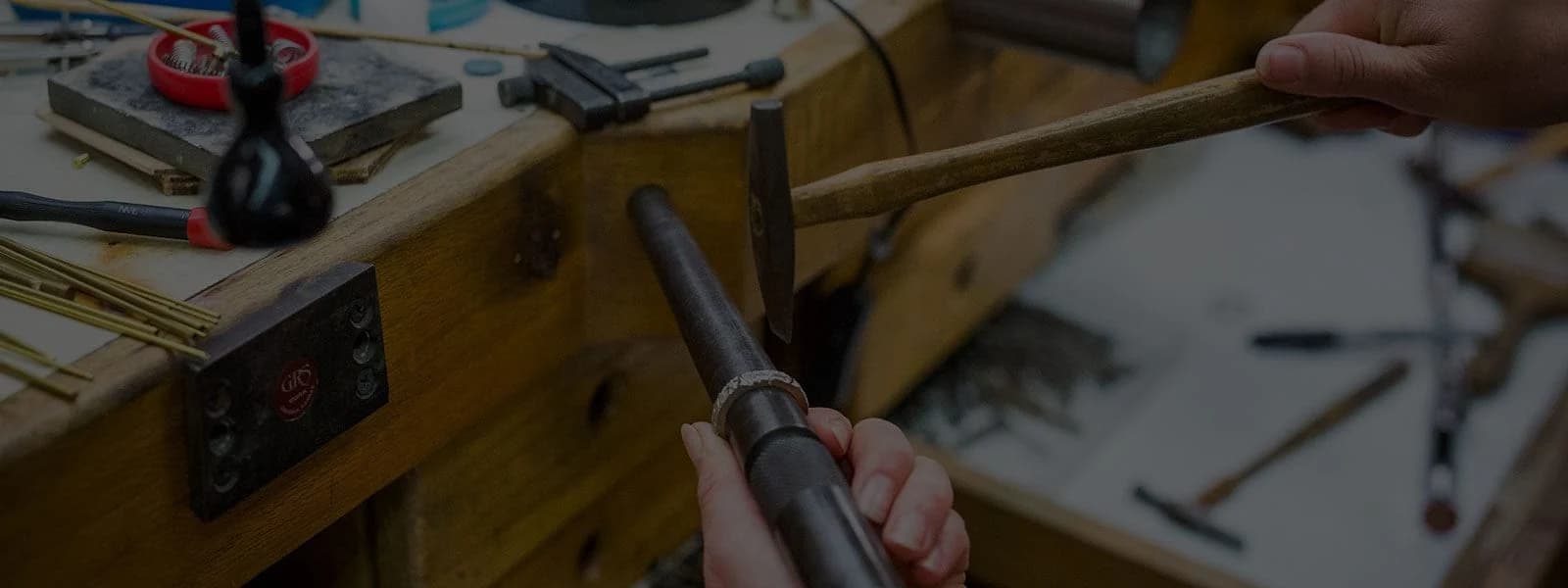
The worst noises in terms of damage include high-pitched, loud and irregular ones (Beyer et al. 55). Those kinds of noises are often found in a jewelry workshop where we are working metals, examples including hammering, using burs, grinders and abrasive tools among other activities. You know the kind of screeching, high-pitched noises I mean. Such pure tones are more dangerous than lower ones (Kinnersly 59).
You must have hearing protection available in the jewelry workshop. Ear muffs are good, but plugs cut more sound out generally (if properly positioned), are lighter and easy to wear. It can be difficult to put the plugs in so they work to their best advantage, while ear muffs are easier to position correctly to reduce sound to their maximum ability (Century 27). Individually molded ear plugs work very well for people using them, they cost around $200.00 to have made and are a standard item ordered by professional musicians, so you can make arrangements to have them fitted through music shops (and rock musicians think it is OK to inflict sound levels on their fans that they themselves wouldn't listen to?).
In factory situations, ear muffs and plugs can become hazardous if greases or chemicals get on them and so contact your ears or ear canal. Muffs are less easy to contaminate, but may be difficult to use if you wear glasses. There are ear muff/face shield combinations that may be useful at times.
Factories may prefer hearing protection to changing machinery configurations because muffs and plugs are a less expensive solution in the short term. In general, jewelry factory workers prefer engineering controls (changing the machines and procedures) to using muffs and plugs. Plugs may also allow the damaging high frequencies through more than muffs (Quinn et al 11). That means that it is best to eliminate the sound source as much as possible rather than using hearing protection. Rather like respirators, the need to use hearing protection should be a warning that the procedure is too loud to begin with and should be dampened if possible.
In general, hearing protection is seen as a last resort to deal with noise (Stellman and Daum 113). Let's say that again: if you have to use hearing protection, then there is something wrong with the procedure, your working conditions and environment.
If using plugs, in general the highest protection is from individually molded silicone rubber (15-34 dB), followed by mass-produced rubber plugs (18-25 dB). Ear muffs cut more sound the heavier they are (light=25 dB, medium=35 dB, heavy=40 dB) (Stellman and Daum 112). Electronic ear muffs are available for factory situations where there are loud noises which are repeated frequently in the mid and lower ranges. These hearing protectors have a microchip in them, analyze the incoming sound and generate an opposite sound wave that cancels the incoming sound almost completely.
Just for reference, here are some estimations of noise amounts for different kinds of equipment. Remember that 90 decibels is ten times louder than 80 decibels.
| 10 decibels | Rustle of a leaf |
| 30 decibels | A whisper |
| 40 decibels | Quiet office, quiet conversation, quiet library |
| 50 decibels | Quiet street, ordinary home, moderate rainfall |
| 60 decibels | Normal conversation at a 3-foot distance |
| 70 decibels | Busy street, large workshop, seagulls and crows |
| 75 decibels | Vacuum cleaner |
| 80 decibels | Hearing damage begins, electric shaver, baby screaming |
| 80-89 decibels | Annealing furnace, grinding, lathe, machining tools, electric tools, spraying sealers and finishes, welding, wood finishing. |
| 90 decibels | Barking dog, electric blender |
| 90-99 decibels | Electric tools, boring, hammer drill, fabricating steel, foundry operations, woodshop and metal shop power tools, grinders, hammers (drop forge), lathes, air-powered tools and air blasts, sawing, acetylene welding equipment, shapers, power shears, welders, machine wire drawing, dirt bike. |
| 100-109 decibels | Chipping castings, circular saw, pedestal grinders, pneumatic hammers, large machines, planers, punch presses, metal cutting saws, cutoff saws, some tumbling equipment, chain saw. |
| 110-119 decibels | Air-powered industrial tools, heavy-duty metal working and cutting machinery, power hammer on thin metal, woodworking machinery, sandblasting machine. |
| 120 decibels | Jack hammer, amplified rock music. |
| 120-129 decibels | Engine, airplane propeller, pneumatic riveting equipment, fireworks. Over 130 decibels come things like a jet engine taking off. A shotgun blast close up is 140 decibels. Over 150 decibels sound at the same frequencies as speech can even burn the skin. |
(Stellman and Daum 97; Kinnersly 50, Tver 215, Virginia Merrill Bloedel) | |
It is a good idea to have your hearing tested now and then. With age there is a loss of the ability to hear high frequencies, just as vision is affected with age. The degree to which this hearing loss (called presbycusis) occurs varies considerably with the individual (Tver and Anderson 215).
Vibration and noise are often linked conditions. Vibration can cause injuries very similar to those caused by noise, and can also result in special damage to the hands and other jointed areas. Vibration has been shown to hasten and cause the onset of arthritis, back problems, gout and heart disease, and can damage vision with long exposures (Quinn et al 8).
You can experience vibration when using power tools of various kinds, and when using heavy machinery. Hammering can be considered in some ways similar to vibration; there are repeated shocks occurring to the hands and arms. Holding items on the polishing wheel constitutes vibration. A well-known injury in the production jeweler's world is "whitefinger," where numbness and a white look to the fingers can occur, progressively getting worse until the whole hand is involved, painful and not fully usable. Professional polishers, or people who do a lot of jewelry polishing, most frequently experience
whitefinger (Stellman and Daum 108; Kinnersly 67). If you have to do a lot of polishing in your work, consider changing your finish or procedures to reduce your time at the polishing wheel. The job is not good for you, and the ventilation needs to be working well to protect you. You could, for instance, obtain pre-polished metal for some projects, immediately protect a metal's surface with glue-on paper before beginning to work it, use firescale retardants like Pripps flux upon every heating, seek to avoid scratches to reduce the polishing required in your workplace. You can switch to tumbling for certain applications to reduce the polishing time on certain pieces.
There are four main kinds of damage that can result from vibration. The hands and wrists develop bone loss in the form of small holes that show up on x-rays. This is not supposed to make them more fragile, however. The muscles and nerves of the hands can be injured by vibration, resulting in loss of use in the hand, or, rarely, the tendons contract and thicken, making the hand weak and restricted in movement. The joints can develop osteo-arthritis; this is common in the elderly, but it ensues earlier in people exposed to vibration (Stellman and Daum 108).
Finally, there is "whitefinger," mentioned above, where the circulation of the hands has been damaged. It is very disabling. Progressive numbness leads to permanent disability. It happens most often to workers who grip vibrating tools tightly when working, as well as to production polishers. In general, pneumatic hammer type tools are responsible for many such injuries (Stellman and Daum 109).
Symptoms include (from best to worst), intermittent tingling, intermittent numbness, blanching of fingertips with or without tingling or numbness, blanching of entire fingers in winter, blanching on most fingers both in summer and winter (Waldron 165)-and really bad pain can be involved too. Whitefinger can end in rare, severe cases with a finger becoming gangrenous and having to be amputated (Stellman and Daum 108). There is no medical cure for whitefinger (Kinnersly 67). Set things up so that you don't experience repeated vibration, or if you do, see if you can dampen it as much as possible. If your fingers tingle or the tips go white when using a vibrating tool it is time to consider vibration a problem.
Note that some of the special "vibration absorbing" gloves that are available from safety suppliers (with gel-filled pads on the palm) have been found to contribute to carpal tunnel syndrome because they change the gripping position of the hand
Related Articles
A Pain In The Neck
Dusts in the Jewelry Workshop
Patination Safety Considerations
Sand Casting Safety Notes


The All-In-One Jewelry Making Solution At Your Fingertips
When you join the Ganoksin community, you get the tools you need to take your work to the next level.