Leila Tai – Plique-a-jour Delight
Leila Tai of New York City will be the first person to tell you that in order to take on the ancient technique of plique--jour enameling, it helps to be a little crazy. But looking at the delicately shimmering scrollwork that brings color and life to her Spanish Garden bracelet, theres no doubt that there is a definite method to this jewelers creative madness.
2 Minute Read

Leila Tai of New York City will be the first person to tell you that in order to take on the ancient technique of plique-à-jour enameling, it helps to be a little crazy. But looking at the delicately shimmering scrollwork that brings color and life to her Spanish Garden bracelet, there's no doubt that there is a definite method to this jeweler's creative madness.
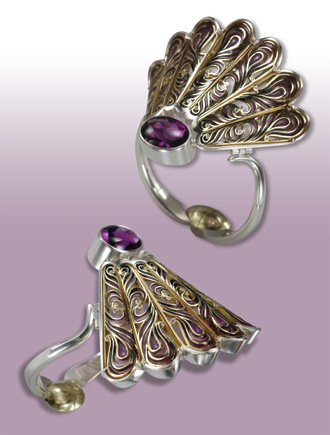
Because that adhesion can be hampered by oxidation, Tai uses metal that is either relatively close to pure, or alloys that are low in copper content. "When I started I was using 22k gold," she says. "It's not totally pure, but the copper in it is so minimal the oxidation disappears after several firings. When you have oxidation in the metal, the glass pulls away from it and stops the piece from having nice, close contact."Unlike its cousin cloisonné, where the enamels are placed on top of a base and fired, a completed plique-à-jour piece is open on both sides, the enamel suspended within the metal framework like a beautiful piece of stained glass. To create the design, Tai places washed and cleaned glass powder into gold frames with tools ranging from tiny brushes to dental picks. The results rely on how the melting glass and the metal react in the kiln, and how the two adhere. Fired to 1,500F/815C, both elements expand and contract at different rates, making the process very much a mixture of art and science.
Creating a plique-à-jour piece requires several rounds of firing. "Especially when you're filling every single area," Tai explains. "The first firing is never perfect because you have to keep filling the holes with more glass."
In this bracelet, a sterling silver fan component encases seven enameled tapered partitions of 18k green gold-Tai's current alloy of choice, a blend of 75 percent gold and 25 percent pure silver. Tai fabricated the gold elements and had the silver fan component cast by her collaborator, New York City-based metalsmith David Butler. (He also hand-forged the wrist section of the bracelet.) Tai enameled the partitions, set each section with four 0.01 carat diamonds, and then turned over the task of assembling the top section of the bracelet to Butler.
"In the wax for the frame, I [had] created an undercut for the tip of each partition," Butler explains. "Near the wide end, I left a lump of wax that [when cast] becomes a kind of prong. Because of that preparation, the actual setting of the gold sections went like a breeze."
While the plique-à-jour technique is extremely time consuming-in this piece, for example, Tai created only two sections per eight-hour workday-Tai has recently found that she can skip one typical step, saving time without sacrificing aesthetics.
"When I started, I would complete the piece by lapping the enamels to a shiny finish," she says. On her "Wings of Color" collection of enameled insects, lapping a single butterfly wing could take up to three hours. "With this piece, I decided not to lap them and just leave the natural finish that comes out of the firing. It brings out the playfulness of the filigree and scrollwork."

In association with

The award-winning Journal is published monthly by MJSA, the trade association for professional jewelry makers, designers, and related suppliers. It offers design ideas, fabrication and production techniques, bench tips, business and marketing insights, and trend and technology updates—the information crucial for business success. “More than other publications, MJSA Journal is oriented toward people like me: those trying to earn a living by designing and making jewelry,” says Jim Binnion of James Binnion Metal Arts.
Click here to read our latest articles
Click here to get a FREE four-month trial subscription.
Related Articles

The Enamelwork of Jamie Bennett

Charles Loloma: Spirit of the New

Mary Lee Hu: The Purpose and Persistence of Wire

Elsa Freund on Elsaramic Jewelry

The All-In-One Jewelry Making Solution At Your Fingertips
When you join the Ganoksin community, you get the tools you need to take your work to the next level.