The Kinds of Hammers
Hammers are an essential part of silversmithing and goldsmithing. While one can buy hammers ready made one can also do a lot with home-made versions and adaptations. Ordinary hammer heads may be reshaped providing they have not been cast. Reshaping.
5 Minute Read

Hammers are an essential part of silversmithing and goldsmithing. While one can buy hammers ready made one can also do a lot with home-made versions and adaptations.
Ordinary hammer heads may be reshaped providing they have not been cast. Reshaping is a good way of getting a few new shapes inexpensively, as used ones are fine. Upset (hit them like riveting to thicken the striking surface) them while red hot. Note that if they are cast iron when hit while red hot they will explode all over the room. Goggles and leg protection while doing this are a must as always when hammering hot materials. A 'sandy' looking surface and parting lines indicate a cast head. If ground all over it indicates but does not prove a drop forged one.
Tack hammers are often very cheap at flea markets but have only one usable face, the flat one. If one takes a ball bearing as for the home made dapping tools, grinds a flat spot onto it to relieve any potential pent up stress in it and brazes it onto the split end of the tack hammer one has a reasonable forming hammer easily and with little cost. As with dapping tools use a lot of white paste flux. When I've done this I have packed the hammer handle near the head and the eye of the head with soaking wet rags and used a hot torch. This allows one to braze the ball on without having to take the head off the handle and re-seat it later. To finish sand and polish with Fabulustre®.
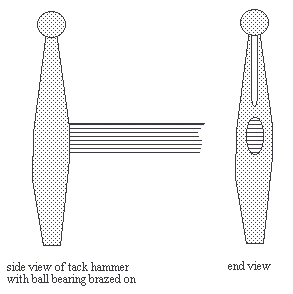
Small hammers may be made from drill rod or small pieces of high-carbon steel. The hole should be oval and taper slightly towards the front to allow proper wedging. The hole may be made by drilling twice close together and filing out the intervening metal. Remember to clamp the head securely while drilling.
Old hammers, particularly ball peen hammers from the flea market can have their faces reshaped by removal with grinding wheels to make raising and forging peens or be carved into with separating discs or chisels and so become large stamps on a stick to cover large surface areas quickly with textures.
Car body-bumping hammers are useful when finished off a bit. They are however often soft and dent easily. It is possible with some work to case harden the ends. There are also quality tool suppliers for serious car body builders and repair people which are good potential planishing and forming hammers for about 25.00 or so. See Eastwood for such tools. Eastwood Company, 580 Lancaster Avenue, Box 3014, Malvern, PA, 19355, 1-800-345-1178: Delrin® hammers, metal and body working tools.
For forging and fold-forming work a old-fashioned welders chip hammer which has two driving peens at right angles to each other is very useful. Sometimes one can find flea market versions or inexpensive Chinese versions which work well. One rounds off the ends of each peen to make them useful.

A turned spindle from a chair makes a good handle for a hammer in a pinch though an oval cross section on a hammer handle is better than a round one.
One can buy round leather dog chews in different diameters at the pet store, cut them in half, drill through them and mount an appropriate sized hammer handle in them to make very inexpensive good quality leather mallets, particularly in the small sizes. Look for one that is solid all the way through as some will have cavities in them.
A number of nice wooden hammers may be fashioned from old croquet mallets. Sometimes an old wooden meat tenderizing wooden hammer is adaptable.
Paper mallets have become hard to find and a rare item even in flea markets. They are my favorite mallet because they do not mark the metal as even a leather mallet will yet they have enough solidity to move the metal.
If you know someone who has access to a log rolling tool for making combustible logs from old newspapers one may be able to make paper mallets by rolling the newspapers very tightly, possibly slightly dampened with some watery white glue and letting them dry out, cutting them to length, drilling a hole for the hammer handle and then making the mallets from the cut sections.
Horn hammers are rather pleasant to use and very good ones may be made from water buffalo horn. Moose antlers and other antlers work but tend to disintegrate. Nylon and Delrin® are excellent substitutes but may be more expensive to make. I have also seen a Delrin® mallet suddenly chip and shatter when used and a piece of it fly past someone's head so safety glasses are in order when using such materials. It is a good idea anyway to wear eye protection at all times in the studio. Knife making magazines often carry advertisements for companies that specialize in materials like these.
Hammer handles are often worth reshaping or making to fit your hand. The comfort and control gained is worth the time spent doing this. This is particularly so with chasing hammers where the head is tipped to about 8o so one does not have to lift one's arm high to use the hammer and the hammer is actually held mostly with two fingers so it flops easily like a see saw and is balanced. This is so one does not have to move ones wrist much when using the chasing hammer.
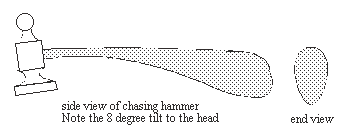
As with stakes a set of silversmithing hammers cast in 'semi-steel' can be obtained from Casting Specialties Inc. One has to finish them oneself and also put the handles on which come with them. I usually suggest that one connect with a local high school shop and offer to teach a workshop or lecture in exchange for the students finishing off your stakes for you. It is a day and a half of grinding and finishing with an angle grinder to do the whole set.
Casting Specialties, W 51 N 545 Struck Lane, Cedarburg, WIS 53012, (414-377-4361): Cast semi steel hammer set; unfinished (94.00), also set of T stakes, 8 for $130 and vertical set at $102.
Pitch can also be used to hammer and shape into. I've seen Renaissance Wax® (very similar to bees wax) used as a pitch substitute to very good effect with much less clean up problem at the end. The same goes for hot glue. If you use lead to hammer into use a rubber sheild like a latex glove over the lead to avoid contamination. Wood and wooden stumps are excellent for all kinds of metal forming with hammers.
Related Articles

Creating and Sharpening Gravers

Sheet Metal Tool Modification

How to Make Prong Notching Pliers

Turning Burrs Into Stonesetting Tools
The All-In-One Jewelry Making Solution At Your Fingertips
When you join the Ganoksin community, you get the tools you need to take your work to the next level.