Goldsmithing Granulation Technique
The revival of granulation in our century has been accompanied by many wrong ideas and misunderstandings, many stemming from the incorrect notion that the secrets of a mysterious process were long lost. To better understand granulation, we should therefore start by examining the myths and laying them to rest.
9 Minute Read

The ancient technique called granulation is a specialized version of fusing in which tiny spheres "granules" are attached to a piece with such a delicate fillet that they appear to be simply set into place. The result is a rich yet delicate pattern of great beauty.
The revival of granulation in our century has been accompanied by many wrong ideas and misunderstandings, many stemming from the incorrect notion that the secrets of a mysterious process were long lost. To better understand granulation, we should therefore start by examining the myths and laying them to rest.
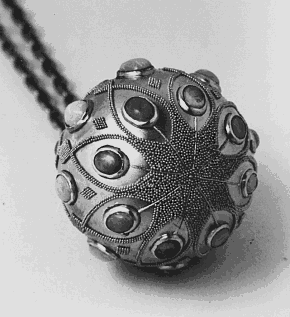 |
| Gold sphare pendant with linear areas of granulation |
Historical Soldering Procedures
From ancient times right up to the Middle Ages, two different procedures were used depending on the requirements of a particular piece. One used an alloy with a slightly lower melting point than the work piece to fill seams; this of course is hard soldering as we practice it today.
The other method used a eutectic solder created at the location and at the moment of diffusion, in the process we have come to call granulation. This method was used to attach the dividing struts in Egyptian cloisonn? inlays, to join the wire ornaments in German disk fibulas, and to attach bezels and filigree onto book covers in the Middle Ages.
To achieve the localized diffusion of granulation, a copper compound is applied to the base, then an organic substance is added to it. The carbon in this compound will act as a reducing agent, joining with oxygen and drawing it away in the form of carbon dioxide. This organic substance often does double duty, serving simultaneously as a glue to hold pieces temporarily and as a flux. The units to be joined (which might be granules, but can in fact be any shape) are set into place and the work is dried. Heat is applied gently, traditionally with a charcoal fire, until the piece reaches a precise temperature. The copper compound, acted upon by the glue and flux, forms a low-melting alloy exactly at the point of contact. This eutectic alloy diffuses between the two units, base and ornament, and welds them together
In most of the many centuries this process has been used, goldsmiths knew only as much as their eyes and instincts could show them. With modern measuring devices we are now able to confirm the temperature differences that make this possible.
- On fine silver (melting point 960.5oC, 1760oF) the process yields a silver/copper eutectic alloy with a solidus temperature of 779oC, 1434oF.
- On fine gold (melting point 1063oC, 1945oF) the resulting gold/copper alloy (Au 820) has a melting point of 889oC, 1632oF.
- Copper in small amounts also alters the melting points of high karat gold/silver alloys. Etruscan pieces made of alloys in the range of 2/3 gold and 1/3silver (melting point 1060oC, 1940oF) can be joined with the granulation process because the eutectic alloy drops to a melting point of 860oC, 1580oF.
With all this going for it, we might wonder why eutectic joining went out of fashion. To save money, alloys were made of a lower value, reducing the proportion of gold in order to create a more affordable alloy. These lower alloys do not react the same way as the richer blends, so the "eutectic magic" of granulation could no longer be used. For example, in silver alloys like sterling, the eutectic temperature remains unchanged at 779oC, 1434oF. In lower karat gold/silver/copper alloys, the introduction of small amounts of copper at a joint has almost no effect. With the introduction of alloys of lower gold content, eutectic soldering was forgotten and replaced by the use of the hard solders. When work was no longer done in high karat alloys, eutectic diffusion was displaced from the technical vocabularies and then the design repertoire of goldsmiths.
This was to change early in the twentieth century when archeological discoveries of the work of antiquity (particularly the outstanding masterpieces of the Etruscans) wakened an interest in granulation. This surge of interest led to a hectic and often misguided attempt to "rediscover" this lost art, though in fact eutectic diffusion has always been practiced by some metalworkers somewhere, often in very basic folk art traditions. Research has shown that granulation was never really "lost" and was accurately described by Pliny, Herodotus, Theophilus and others.
Metals
Pure gold and silver can be used for granulation, as can alloys with high proportions of pure metal. For gold, alloys over Au 750 are recommended; for silver, though sterling (Ag 925) can be used, mixtures with a higher percentage of silver are recommended. Gold and silver can be mixed, as can different alloys. It is possible, for example, to fuse gold granules onto silver sheet, or to use golds of different karats in the same piece.
Making the Granules
Roll a sheet of metal as thin as possible and use scissors to cut parallel lines, making a fringe. Cut across this at a right angle to create tiny squares (pallions) as is done when cutting solder. Alternately, it is also possible to snip a fine wire into short pieces. For extremely fine granules, catch the dust made with a coarse file.
In order to prevent the pieces from melting into each other in the next step, the small pieces are moistened and stirred into powdered charcoal with a miniature whisk. This will coat each piece with a fine layer of powder. Sprinkle a half inch layer of charcoal powder into a crucible then distribute the gold pieces over it. Add another layer of charcoal powder and sprinkle in more chips, continuing until the crucible is full.
Set the assembly into a kiln and heat it until the crucible glows red. Use a spoon to lift out a small sampling, which is dropped in a container of water. If the granules have formed spheres, the heating is done and the rest of the batch can be retrieved. The contents of the crucible are poured into a container, rinsed and then dried.
It is also possible to simply set the gold pieces on a charcoal block and heat them with a torch, a method that is particularly useful when only a few granules are being made. A disadvantage with this method is that the spheres tend to have a small flat facet, especially in the larger granules.
To sort granules by size, make a graduated series of sieves using either commercially obtained screens or disks drilled with holes of different sizes. There are several approaches to this; many use a tube to rank the sieves in sequence, enabling the granules to be sorted and stored in each section according to size.
Eutectic Soldering of the Granules
Any of the following copper compounds can be used to create eutectic solders.
- Malachite, basic copper carbonate CuCO3 . Cu(OH)2. Pliny records that in ancient times this stone was pulverized and used for soldering.
- Copper (II) oxide CuO. This material can be derived, as it was in antiquity, be saving and grinding the scale that forms on copper during annealing.
- Copper (II) hydroxide Cu(OH)?, which is transformed into black copper (II) oxide upon heating with an alkaline base.
- Copper (II) chloride CuCl2 * H2O. In earlier times, this was obtained by annealing a piece of copper sheet painted with salt.
- Copper sulfate CuSO4 * 5 H2O.
Make a solution that includes one of the copper compounds above along with a glue (gum tragacanth is preferred) and a hard soldering flux, in roughly equal proportions. This solution is painted onto the cleaned surface and the granules are set into position, typically with a fine-pointed brush. To avoid a boiling action that would dislodge the granules, the piece is slowly dried, for instance under a lamp.
The work is then heated with a reducing flame to a temperature at which the copper is released from its compound. This is ideally done by heating from beneath the piece. As the work is heated the organic glue will turn black then lighten and disappear. At the precise moment the eutectic temperature is reached, the trace amount of copper at the site of each point of contact will go into the alloy and diffuse into the granule and the base, making a metallic bond at that point. This is the decisive moment! If a timid goldsmith stops too soon, the bond is not sufficiently strong and some of the granules will fall off. If the heat is allowed to linger, the higher temperature will start to melt the pieces together, destroying the delicacy that makes granulation so beautiful.
If granules fall off, it is possible to clean the metal and repeat the process, but it's always better to have all the granules adhere in the first firing.
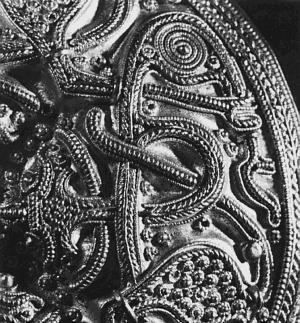 |
| Soldering of filegree wire and granulation on brooch - detail (Cultural Historical Museum, Stralsund) |
Fusing the Granules in Place
This method is used with particularly fine granulation. No metallic bonding material is used; instead, the surface is painted with diluted flux. After their original heating, the granules in this case are not pickled, leaving them with a slight coating of oxide. They are set into position with a tiny bit of flux that acts as a glue. The piece is then heated to just that point at which the surface shines like a mirror; that is, where it reaches its liquidus temperature. At that moment the granules will fuse to the surface, their form being held intact by the oxide coating. Every goldsmith has seen this effect when a pallion of solder draws up into a ball instead of flowing into a seam.
Siegfried Meyer of Freiberg has been experimenting with granulation in Au 858 (14k). Granules are made as described above. The thickness of the sheet used as a base should be the same thickness as the size of the granules. Lines are scribed lightly into the sheet to keep the balls from rolling off, then the sheet is sanded with a fine paper and degreased. The soldering/gluing solution is made of 1 part gum tragacanth and 4 parts ground borax. This mixture is applied to the sheet with a small watercolor brush, which is then used to position the granules.
The gold sheet is set onto a steel plate about 2 mm thick (12 gauge B&S) that conforms to the contours of the piece and is a little larger on all sides. The piece is allowed to dry for several hours to insure that all moisture has evaporated away. When the piece is dry the section of steel that projects around the piece is heated with a torch, allowing the heat to creep beneath the piece. When the gold is glowing red, the flame, (which should be large and bushy) is played over the top of the gold, which will "blink" and shine like a mirror at the moment of diffusion. The temperature is sustained for a few seconds, then the torch is removed. The time and temperature are critical - difficult to describe in words and impossible to learn except through experimentation.
Granulation Design
Having mastered the technique of bonding granules to a base, the larger questions of design come into play. Pieces from the historical record offer many dazzling examples but each goldsmith will need to develop his or her personal style. As a granulation master once said, "If granulation were such a simple thing that any clod could easily get the spheres onto a sheet, the technique would only be a senseless game!"
The design possibilities include using granules across an entire surface, to outline specific shapes, to create geometric patterns, and to build up minuscule pyramids of spheres.
Because the technique has gathered an air of mystery, attention is usually focused on mastery of the process, which is incorrect. Granulation is primarily a matter of design - the vision and talent needed to paint across a golden sheet with tiny spheres.
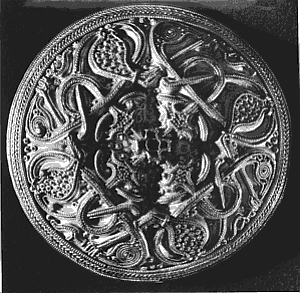 |
| Soldering of filegree wire and granulation on brooch - overview (Cultural Historical Museum, Stralsund) |
Excerpts from the book:
The Theory and Practice of Goldsmithing
By Prof. Dr. Erhard Brepohl
Translated by Charles Lewton Brain
Edited by Tim McCreight
Brynmorgen Press
ISBN 0 9615984 9 2
Get your own copy of The Theory and Practice of Goldsmithing
Related Articles

Copper Granulation Technique

Granulation Using Fusion Welding
Fine Silver Granulation – Part 1

Alloying Gold for Granulation


The All-In-One Jewelry Making Solution At Your Fingertips
When you join the Ganoksin community, you get the tools you need to take your work to the next level.