Enameling Applications and Preparation
For more than two thousand years, goldsmiths have fused glass onto their work for color enrichment. Wonderful enameled work can be found from many ancient cultures, providing familiar icons of the technical skill and aesthetic sensibilities of their makers.
21 Minute Read

For more than two thousand years, goldsmiths have fused glass onto their work for color enrichment. Wonderful enameled work can be found from many ancient cultures, providing familiar icons of the technical skill and aesthetic sensibilities of their makers.
In our own century enameling has benefited from scientific and industrial research and because of this it has grown from being just one element of the goldsmith's art to a position of prominence on its own. One need only think of enameled housewares, architectural trim and utilitarian objects to understand the importance of enameling in our society.
For a complete description to enameling the reader is referred to books specifically on that topic such as Kunsthandwerkliches Emaillieren by Erhard Brepohl, third edition, VEB Fachbuchverlag, Leipzig, 1983. But even those who do not intend to incorporate enamels in their work as a primary element should have an understanding of the historical importance of enameling and a general idea of the process. It is for those people that the following pages are included here.
Enameling is a simple process that uses very little specialized equipment. The electric kiln in which the metal is brought up to temperature is the single most expensive piece of equipment, and even this has the advantage of lending itself to several other uses in the studio. Of far more importance and requiring greater skill is the preparation of a piece preliminary to enameling. Without intelligent design and proper goldsmithing work, enameled pieces are simply colored bits of metal.
Enamel Applications
Cloisonné
In this popular process, thin flattened wires, usually of fine silver, are bent into specific shapes and set on edge to create a pattern. The wires appear as silver lines in the finished piece and further serve to create small compartments (in French, cloisons) to contain the enamel. The strips are sometimes soldered into position, but more commonly they are anchored into a layer of clear enamel called flux until the finish layer of enamel can secure them. The cloisons are filled, fired and refilled as necessary, then ground flush after firing to create a flat surface.
Champlevé
Depressions are cut into thick metal plate by engraving, chiseling, etching, turning, filing or burring; these areas are then filled with enamel powder that is fired to fuse it into place. Though less common, it is possible to make the recesses by soldering together pierced layers in the process known as overlay.
Sunken Enamel
This process is a combination of champlevé and cloisonné. A relatively thin sheet of precious metal is formed into a recess. Cloisonné wires are bent according to the design and placed into this area, then filled with enamel powder and fired in the usual way. This is also called false champlevé.
Plique-à-jour Enamel
In this rather specialized technique, enamel is made to fill openings that are exposed on both sides, causing it to resemble a stained glass window. The structure is cut from sheet, fabricated from wire or cast, then given a temporary backing of foil or placed on mica to contain the enamel powder during firing. Once the chambers are filled the backing is removed and the surfaces are ground flush. Like stained glass windows, such work becomes particularly striking when light falls through it.
Basse Taille Enamel
In this process recesses are made by engraving, milling or cutting with chisels. The depth and textures of the recesses are given careful attention, then the piece is filled with transparent enamel. The relative depths will be revealed through varying shades of color, just as the water in a pool or lake will appear differently as the bottom slopes away. Deeper spots appear darker because of the thicker enamel, the raised ones brighter because they lie close to the surface of the enamel.
Enameling en Rond Bosse (3D Enameling)
This term refers to the use of enamel to cover metal sculpture on all sides. It can be a solid cast miniature sculpture or a hollow one formed from sheet metal.
Limoges Enamel
In the 15th and 16th centuries, an enameling technique was taken to a high degree of refinement in the city of Limoges, France. Since that time the process has taken the name of the city. In the Limoges process a base of black enamel is fired over an object. White enamel is then painted over the base, creating a range of grays and whites depending on their thickness. and fired to create an image. A variation called grisaille starts with a layer of black enamel to be covered with powdered white enamel. The white is drawn aside with a brush to reveal the black line.
Enamel Painting
Portrait miniatures are painted in the same way a potter paints on porcelain. Metal oxide colors are applied to a base coat of white opaque enamel. These are laid down with a fine brush and can equal the precision and detail of oil paint. After the enamels are fused they are covered with transparent enamel called the fondant.
Overview of Enameling Technique in Goldsmithing | |
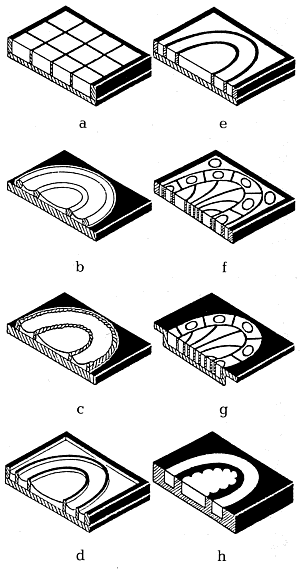 | a) Flat wires are bent, Placed on edge and soldered. Small strips are glued and cloisons formed. b) Wire-enameling contours are formed by bent and soldered round wire; colored enamel is fused in by the recesses. c) Filgree enameling-walls are formed by twisted filigree wire, procedure otherwise similar to wire enameling. d) Enameling using straight cloisonne wire which is bent and soldered; enamel is fused into the depressions. e) Cloisonne enameling similar to d) but cloisons are filled to the top and stoned flat. f)Plique-à-jour-bent and mounted cloisonne wire, the holes filled and fused with enamel, stoned flat. g) Recessed enameling on a thin base sheet which has been depressed, cloisonne wire is arranged and the cells filled with enamel h) Base taille recesses in a thick sheet are made and filled with enamel which is fused and stoned fused. |
Materials and Equipment
Enamels
Enamels are purchased either as powders or lumps that are ground to particles as needed. They consist principally of frit, oxides and, in some cases, opacifiers. Frit makes up the body of the enamel and consist of quartz, feldspar, boric acid, soda, potash, and lead oxide. Color is achieved through the addition of metal oxides; other ingredients might be added to create special effects.
Enamels are available from specialized distributors; a glance at a catalog will dazzle the beginning enamelist with the wide range of colors available. The number needed will of course depend on the work being done, but it is wise for a first time enamelist to limit his or her selection to about ten colors. This will guaranty an understanding of these enamels and provide a foundation upon which additional colors may be acquired. The enamels should be stored in wide-mouthed clear glass jars.
Because the color of the enamel powder is different from the effect when fired, it is necessary to create a sample of each color, preferably showing what it will look like in several different applications. Clean a piece of copper about 6 x 15 cm (3 x 6 inches) and apply vertical strips of equal width of white, ivory and transparent high firing flux. Also include a band of flux into which you have fused a panel of fine silver foil.
Apply each of your colors across these stripes at right angles. This will show the effect of each color on these various backgrounds. Keep the test panel handy for reference as you select enamels for particular projects, and make new test panels as your selection of enamels increases.
Kiln
Enameling can be done in a flame and was in ancient times done on a hearth, but nowadays it is considered standard practice to work in an electric kiln. You will need a unit that can achieve and sustain temperatures of 1000°C (1830°F). A kiln with a small chamber is suitable for most jewelry work; but of course larger units will be needed for other applications. The kiln should be fitted with a thermostat, a device that will regulate temperatures to sustain a constant level. Accuracy is important, but it does not need to be as precise (or expensive) as those used in scientific laboratories.
Firing Supports
Objects being enameled must be supported off the floor of the kiln while the enamel is melting. This is achieved by resting the work in a metal structure called a trivet. These are available in a variety of shapes and can be made of steel, stainless, titanium, or several other exotic alloys. The requirements of a firing support is that it withstand heat without shrinking, that it not create oxides (they might pop off and contaminate the enamel), that it make only limited contact with the workpiece. Asbestos should not be used because of health and safety concerns.
The point of contact where the piece touches the support will not have a smooth coating of enamel, so these points should be minimized and arranged to fall in places where they will not ruin the design. Figure 10.5 shows a simple but reliable support that achieves this goal, but keep in mind that conventional supports might need to be altered for specific pieces.
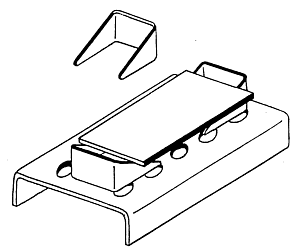 |
| 10.5- Simple setup with enamel piece for firing in the kilin |
The Workplace
Cleanliness is critical to successful enameling. Dirt, dust, grease, and impurities of any kind will affect enamels, and can turn a rich transparent into a cloudy film or render a brilliant hue as a muddy tone. The area used for grinding and polishing must be removed from the place where the enamel is applied, with proper ventilation in place to keep airborne dust away. A goldsmith who sweeps his tools to one side with the thought of applying the enameling at his bench has clearly not understood the importance of this warning.
It is best to designate a specific work area for enameling. A clean, well-lit, waterproof tabletop is ideal. Tools will include a clean cloth, several watercolor brushes, and a dish of clean water. Wires are bent with delicate pliers and placed with tweezers. A porcelain mortar and pestle is used to grind glass lumps into a powder, a process that will ideally be done at a sink. Powders are poured into porcelain or plastic containers from which they are applied to the work. Gum tragacanth powder is mixed with water to make a paste that is used to adhere cloisonné wires to their base. Small sieves are used to dust the powder onto the metal.
Supports are needed for firing and a long handled fork or similar tool is used to place the work into the kiln and withdraw it when done. The area around the kiln should be equipped with firebrick or a similar surface that will provide a place to set the hot work. You will need heat-resistant gloves and apron, and dark glasses to protect your eyes when looking into the glowing chamber. Finishing work requires silicon carbide stones and rods and the usual range of abrasive papers.
Metals for Enameling
Because enameling requires a minimum temperature of 800°C (1470°F), the metal base may be made of high karat gold, fine silver, copper, and brass alloys that have a maximum of 5% zinc. Gold expands only slightly when heated, a factor that helps secure the glass layer to the metal base. In addition, the rich color of golds provide a suitable visual environment for colored glass. It is hardly a coincidence that we are able to find so many beautiful examples of enameling on gold in our museums.
Fine silver is a good base for enamels, but alloys of less than 950 Ag purity are not recommended, particularly for transparent enamels where the oxides will cause cloudiness. Sterling, at 925 Ag is not recommended. When applying enamels to silver it is helpful to roughen the surface. This improved mechanical grip will help secure the enamels to the metal.
Copper is especially good for enameling, not only because of its low cost, but its rates of expansion and shrinkage and high melting point also make it reliable for virtually every enamel. Of course copper forms oxides easily and because of this colors will not be as bright, especially with transparent enamels.
Brass alloys with less than 5% zinc make excellent surfaces for enameling. They have the advantages of copper and in addition offer a somewhat higher tensile strength. Brasses with higher zinc contents are absolutely unsuitable for enameling because the fired enamels pop off as the metal cools.
Champlevé
Recesses that will contain the enamel are cut into relatively thick sheet with gravers, chisels or mechanical equipment. The technique is particularly suited to transparent enamels because differing depths show up as darker shades of color. This aspect of champlevé cannot be used well on copper since transparent enamels cannot tolerate the oxides given off by that metal. Recesses can be etched, a process in which mechanical effort is replaced with chemical corrosion. The bottom surface of the recess is roughened to increase the grip of the enamel on the metal. The walls of the cut should be vertical or may lean slightly outward. Undercutting, which would be preferred in the case of metal inlay should be avoided here because it will create stress cracking. When fabricating a layered piece for enameling, the metal partitions that separate each section can easily be made of different and variable width, a distinguishing feature that instantly identifies this process as different from cloisonné (figure 10.8).
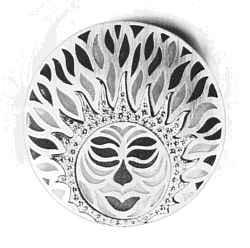 |
| 10.8- Plique a jour - Yellow and white gold. piereced out sections with no base, filled with enamel. (Ralf Bender, Hanahu) |
Cloisonné
Because cloisonné wires are thin, it is important to build the work within a stout metal frame to ensure its strength. Remember that not only must the enamel be supported in its final state, but before then it must withstand the stress of firing and of being ground flush. This frame is soldered to a piece of sheet metal with IT solder and should be thick enough to resist warping in firing and cooling.
Perhaps more than other enameling techniques, cloisonné may be thought of as a graphic process because of the importance of lines. Each piece of wire is a line, and like a pencil drawing, each can add to the character of the piece. Place the drawing under glass or plastic to protect it while working. It is typical to draw the design carefully and at the correct size on paper, and to bend wires directly upon the drawing to insure their accuracy.
Though it is occasionally necessary to use a single straight piece of wire, it is far more common to break the design into units that can be bent in such a way that they will stand up by themselves. Consider setting a "V" into position as contrasted with setting two single lengths of wire and you'll perceive the point.
It is typical (though not mandatory) to start by coating the sheet metal with a layer of clear flux, a material that is in essence a colorless enamel. Wires are then glued into place on top of this with gum tragacanth, a temporary support that will keep them from being pushed out of place as the enamel powder is laid into place with a brush. When the piece is fired the fused glass will bond to the lower layer and to the wires and hold everything together
Metal Preparation
Enamel can only stick to metal that has been cleaned and degreased. Sometimes it is possible heat the metal in the enameling kiln to a temperature at which grease residues burn off, but care must be taken that you do not reach a temperature at which oxides are formed.
Preparing the Enamel
The best enamels are sold as gravel shaped lumps that need to be ground up in preparation for use. The first step in this is to use a steel mortar and pestle arrangement like the one shown in figure 10.10. In this case the pestle makes a snug fit into the cylinder which prevents the pieces from sliding away. Though not absolutely necessary, this device provides quick reduction of large pieces and prevents undue wear and tear on a more delicate mortar.
The small pieces are transferred to a porcelain mortar and pestle where they are ground into a finer powder. Add a small amount of water to keep the grains from jumping out of the bowl. If your water supply is laden with chemicals use bottled or distilled water. Opaque enamels are ground to a fine powder, but transparents will produce their brightest color if left slightly larger.
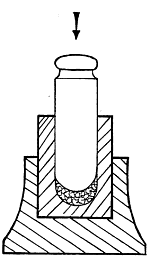 |
| 10.10- Mortar and pestle (Cress Section) |
After grinding, the enamel powder is washed by placing it in a shallow dish and swirling it in clean water. Pour off the cloudy water and add fresh, repeating the process several times. In the case of opaques you may quit after a couple of rinsings, but transparents require that they be rinsed until the runoff water is clear. Though the author's experience has been fine with tap water, enamelists working in other environments might find it necessary to use distilled or bottled water to prevent mineral contamination of the enamels.
The cleaned enamel is transferred to small glass dishes that are in turn marked with the number of the color. These are kept under a bell jar during the course of the work day to minimize their drying out and to protect them from dust. Powders left over at the end of the session are put back in a jar and mixed with a generous supply of water to keep them fresh. When starting up next time the water is poured off and the enamel is rinsed a few times.
Applying the Enamel
Glass shrinks as it cools, which means that a panel having enamel on only one side will curl up when is it taken from the kiln. To prevent this and equalize stresses throughout the piece it is vital to apply enamel to both sides of a work. The reverse side, called counter-enamel, is often nothing more than an unpatterned layer of a single color but its importance cannot be understated. Applying the counter enamel is the first step to be undertaken.
After cleaning and roughening the metal, paint on a thin layer of gum tragacanth. It is also possible to add some gum tragacanth powder in with the enamel. Sprinkle this onto the sheet in an even distribution by using a brass sieve. Put enamel into the spoonlike tool and shake it several inches above the plate. Allow the enamel to dry, invert it carefully and set it into a firing support, and apply enamels with a brush into the cloisons.
Pick up a dollop of damp enamel with a moistened brush and deposit it onto the prepared workpiece. The degree of dampness depends upon the kind of work being done. If the enamel is too wet it will run out of place and can mix with previously applied colors. If it is too dry it will not flow into the chambers.
In the case of cloisonné and champlevé it is usually best to build up the enamel in several layers because some enamels become milky if applied too thickly all at once. The full height is typically achieved with two to four firings.
Firing the Enamel
As mentioned above, the enamel powder is mixed with water to help it flow into the cavity that is meant to contain it. Once the powdered glass is in place, however, the water becomes unnecessary and so must be allowed to evaporate away. Place the work on top of the enameling kiln, which by this time is preheating in preparation for use. In most cases this will only take a few minutes.
If some of the enamel drops off during drying or as the piece is being set into the kiln, do not apply fresh wet enamel. It will appear cloudy. Instead either fill the area with dry powder, repair the loss in the next firing, or remove all the enamel from that section and refill it with fresh damp powder.
When the kiln has reached the intended temperature, the firing support that holds the work is set into the kiln. Manufacturers will often provide information with their colors about ideal firing temperatures and while these should be heeded, no amount of reading or planning can take the place of intuitive understanding of what constitutes a correct firing. Each situation depends to some degree on the thickness and size of the metal object, the other enamels present, the thickness of the enamel, the accuracy of the kiln and other subjective factors.
Generally, there are three phases in the fusing operation. First, the enamel powder sinters into a pasty mass. If you could touch it (don't - it's hot!) it seems like it would be crumbly. This then melts into a sticky mass, still uneven on its surface. The mass usually looks red at this point. With continued heat the enamel mass will glow a bright red and even itself out to a smooth level surface. This indicates that the piece is ready to be removed. Avoid overheating because this might change the color of the enamel.
The work is removed and set onto a firebrick or similar heat proof surface near the kiln. If the piece has warped it should be flattened immediately, while still red hot. Lift the work from the firing support and set it onto a steel surface plate. Press down on it with a stiff spatula - a mason's trowel is useful.
Finishing Enamel
Grinding
It is traditional, particularly in the case of champlevé and cloisonné to finish the piece to a flush surface. This accentuates the graphic nature of the design and allows the wires to show well. This is done with bars and rods of silicon carbide in a process called stoning.
After the firing is complete and the work has cooled to room temperature, it is set on a board in or across a sink in such a way that a trickle of water can be run constantly across it. A stone of the appropriate shape is rubbed with firm pressure back and forth across the piece until the surface is completely flush. While it is possible to achieve this with a wet sander, in most studio situations enamels continue to be stoned by hand.
Washing
After grinding the enamel surface has many pores, the result of air bubbles in the molten glass. In the stoning process these bubbles are cut open and remain in the surface as tiny pits. Remnants of the abrasives become stuck in these openings and can mar the finished piece as gray flecks if they are not removed. Scrub the finished work aggressively with a glass brush under running water, then follow this with another scrubbing with soap and a toothbrush. Examine the surface with a loupe to insure that all traces of debris have been flushed away. Large pits are cleaned with a needle, filled with fresh enamel and refired.
Flash Firing
If the piece is to have a matte finish, stoning is the last process. When the enamel is intended to be shiny, the work is returned to the kiln for one last firing after the surface has been ground flat and cleaned. The kiln is brought up to a high temperature and the piece set into it for a few seconds, just long enough that the surface will melt and become smooth. The hotter the kiln at this point, the brighter the resulting colors, but care must be taken to insure that the work is not overheated.
Polishing
The metal around an enameled area can be polished with the usual compounds as long as you are careful to avoid keeping the buff too long at any one spot. The compounds will not wear down the glass, so prolonged exposure risks creating an uneven surface as metal is removed. This is generally easy to avoid. A light touch with the buff should be enough to bring the metal to a bright shine.
Table 10.1 shows some possibilities for errors when enameling.
| Problem | Cause | Remedy |
| Metal parts melted | Kilin was too hot | reduce the kilin temprature |
| Cloisone wire sinks in the enamel | wire is alloying with solder | use less solder |
| White become spotted with green | enamel is reacting with copper | use a thicker layer of enamel |
| White becomes spotted with yellow | enamel is reacting with silver | avoid contact with silver |
| Black spots on the enamel | Iron dust or filings may have fallen on the enamel | clean the elements and kilin chamber |
| Fray spots on the enamel | could be residue of polishing compounds | clean the work throughly after stoning or polishing |
| Porous enamel | the enamel might have been over heated; use of inappropriate metal as a base for the enamel | reduce the kilin temprature; use a different metal |
| Discoloring film on the enamel | enamel was insuffiently cleaned | clean the enamel more throughly |
| Bubbles in the enamel | enamel has been contaminated | clean the enamel more throughly |
| Cloudy spots and edges | water might have run in to the try enamel powder | moisten the enamel uniformly |
| enamel shows cracks | uneven heat expantion of adjacent enameled areas; uneven heating between enamel and metal; wrong thickness of metal; not enough counter-enamel | Change to enamels with similar properties; use more counter-enamel |
| clear enamel becomes cloudy | too finely ground; not sufficiently cleaned; spread too thick, kilin temprature too high | use frit that is more coarsely ground; wash well; fire at a more moderate temprature |
| metal warps | incorrect firing base; insufficient counter-enamel | select a different metal as the base; use more counter-enamel |
Related Articles
Layering Over Sgraffitoed Liquid

Enameling Care and Considerations

The Enamelwork of Jamie Bennett

Enameled Spiral Beads


The All-In-One Jewelry Making Solution At Your Fingertips
When you join the Ganoksin community, you get the tools you need to take your work to the next level.