Recent Electroforming Developments
Electroforming is an old, established technology and, in its original form, it was a bit cumbersome to use. However, as with other jewelry technologies, it has made great strides over the last decade and is now a much easier and quicker process. In this article, I shall focus on gold, but other precious metals can also be electroformed successfully.
10 Minute Read

For a jewelry designer, the link between design and technology is not always obvious. As a technologist, I have often thought about how they are connected. It is actually quite complex, but one thing is certain: A specific technology can offer exciting opportunities for the creative designer. It can enable the designer to achieve designs that would be impossible or difficult by traditional means. This is particularly true for electroforming, a process technology that is often under-utilized and underestimated in modern jewelry design.
Electroforming is an old, established technology and, in its original form, it was a bit cumbersome to use. However, as with other jewelry technologies, it has made great strides over the last decade and is now a much easier and quicker process. In this article, I shall focus on gold, but other precious metals can also be electroformed successfully.
What is Electroforming?
First, we need to define what electroforming is: It is simply electroplating a complex, three-dimensional shape (called a mandrel, model, or pattern). In the case of jewelry design, the mandrel is plated with a thick layer of gold that follows the shape and surface details of the mandrel. This mandrel is later removed to leave a hollow gold object—the piece of jewelry. The operation is performed in an electroforming bath, which is essentially a modified electroplating bath, using specially formulated gold electrolytes (plating solutions). Thus, it is very similar to electroplating in terms of equipment and process.
As with all process technologies, there are advantages and disadvantages to the use of electroforming, which make it suitable for particular types of jewelry design. The advantages include:
- Jewelry can be made in pure 24 karat gold as well as karat golds ranging from 8k to 18k.
- Thin, hollow items in complex, three-dimensional shapes are possible.
- A variety of designs can be produced, including large modern shapes with low weight and uniform wall thickness.
- Large or small numbers of each design can be produced eco- nomically.
- Many pieces can be made simultaneously by attaching the mandrels to a plating rack.
- The process does not require expensive tooling for each design.
- It fulfills the requirements for fineness conformance for hall-marking.
- The metal input and consumption is reasonable.
- There is no loss of metal in the process; no scrap is generated.
The main disadvantage with the technique is that it requires special equipment designed for electroforming. Generally, simple electroplating equipment is not adequate for mass production. For electroforming of karat golds, a computer-controlled, automated facility is desirable. Another limitation is that only yellow karat gold is possible: The technology has not yet been developed to plate red or white gold, or high karat gold in the 21k to 22k range.
The Process
In the old form of the process, electroforming was quite complex and lengthy. Gold electroforming baths were operated at 140°F to 176°F (60°C to 80°C), which necessitated the use of mandrels made of low melting point metals. Today, baths can be operated at lower temperatures, typically 104°F to 113°F (40°C to 45°C), permitting the use of wax mandrels. This improvement means the total process is less complex and quicker. A typical production batch of karat gold electroforms can now be completed in 14 hours.
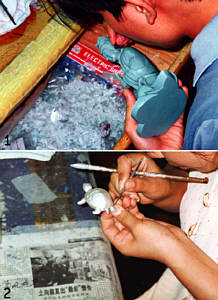
Multiple copies of wax mandrels can be made just as for lost wax (investment) casting: A master model is created, then a rubber mold is made from the master model. The rubber mold is then used to make wax copies with a wax injector. For individual pieces, one can carve a wax model in the traditional manner (Figure 1) or use CAD/CAM technology to create the wax model, which can be used directly as the mandrel. An attachment wire is melted onto the wax, and the wax is coated with a silver- or graphite-based ink to make it electrically conductive. (Figure 2)
When dry, the mandrels are assembled on a rack and immersed in the electroforming bath for plating. When the required thickness has been attained, the plated mandrels are removed and washed. The wax is removed via a small hole by melting. Any residual wax can be dissolved out with a solvent. All that remains is to attach findings by soldering or laser welding, and to do a final polish.
Improvements have also been made in process control. The ability to control the deposited karatage uniformly over the surface of the electroformed piece—on a rack loaded with many items—is vital to ensure consistent weight and karatage conformance to meet fineness/hallmarking standards. The use of computers to monitor current density, bath pH, and gold content of the electroforming bath has enabled operators to maintain a very tight tolerance (± 0.5 karat) in a predictable way, and has taken out the potential error inherent manual control.
in Tables 1, 2, and 3 show some of the characteristics of the various electroforming processes currently in use. The original process for electroforming 10k, 14k, or 18k gold utilizes cyanide-based electrolytes that deposit gold-copper-cadmium alloys, which have a good yellow color. This process is still widely used and is typified by the Artform process by Enthone-Omi, which has offices worldwide. Typical bath processing characteristics are shown in Table 1.
A more recent development, the Aurunaform process by Degussa Electroplating (now O.M. Electroplating), which has offices worldwide, uses a cyanide-based electrolyte to deposit gold-silver alloys that are a pale yellow color. Table 2 shows typical processing parameters.
In both systems, the karatage is controlled by the current density. The properties of electroformed deposits from these baths when producing 18k gold items are shown in Table 3. The gold-copper-cadmium system results in hard brittle deposits, which must be annealed at 930°F/500°C for 15 to 20 minutes to restore ductility. Both systems produce pieces that can be successfully soldered and polish well.
Electroformed 24k Jewelry
Several companies have also developed systems for electroforming 24k gold jewelry, including some cyanide-free systems. These produce gold deposits of various purities, with gold contents ranging from 99 to 99.9 percent. Table 4 gives some data for the O.M. Electroplating and Enthone-Omi systems.
As with the karat gold systems discussed earlier, various metal and wax mandrels can be used, as long as the bath temperature is not high enough to melt the wax mandrels. It is worth noting that electroformed 24k gold is much harder than annealed, wrought, or cast 24k gold, although soldering and other heating operations will soften it .
Properties of Electroformed Jewelry
Typically, electroforming produces deposits 4 to 6 mils/100 to 150 microns (0.1 mm to 0.15 mm) thick. For larger articles, this may increase to 6 to 8 mils/150 to 200 microns (0.15 mm to 0.2 mm). In the case of 24k gold, they may be even thicker, around 10 mils/ 250 microns (0.25 mm).
It is not possible to specify a minimum acceptable deposit thickness because the mechanical strength and stability of a piece of electroformed jewelry will depend on its geometry and surface structure, as well as its inherent tensile strength. For example, a ribbed piece will be stronger than a similar piece with flat surfaces.
As thickness increases, the weight and the amount of gold increases, leading to higher costs. Inevitably, the thickness realized in practice will be decided by the manufacturer and will be a compromise between strength and cost.
| Concentration in electrolyte, g/1 | Au 6-Cu 45-Cd 1-free cyanide 18 |
| Average rate of deposition | 0.5 µm/min. |
| Temperature (STANDARD BATH) | 65-75°C(149-167°F) |
| Temperature (WAXBATH) | 40-45°C (104-113°F) |
Table 1: Bath processing characteristics, Artform process | |
In general, electroformed products only need to be burnished. This is done wet in a vibratory or centrifugal disc (turbo) machine with small porcelain balls. As electroformed deposits are hard, they also tend to be easy to polish on manual polishing wheels and by automated machines, attaining a high polish. Other finishes, such as a satin or matte, can be produced by the usual techniques, such as sand blasting. (Electroforming pure gold at high current densities will result in a textured surface. This effect is often utilized in Asia for statuettes and similar figures.) Because the pieces are thin and hollow, however, care must be taken to avoid damaging them by applying too much pressure.
| Concentration in electrolyte, g/1 | Au 15-Ag 5-KCN 10 |
| pH | 10.2 |
| Bath temperature | 45°C (113°F) |
| Current density | 1.2 - 1.8 A/dm2 |
| Current efficiency | 100 mg/A min, approx. 100% |
| Deposition rate | 0.9 µm/min approx. |
Table 2: Process parameters for the 18k bath, Auruna 568 EF-18 | |
As in investment casting, proper finishing technique begins at the earliest stages, with the master model, and progresses through the rubber mold making and mandrel production stages. A good quality surface on the master model will yield a better surface on the electroform, saving much unnecessary effort during final polishing.
Designing for Electroforming
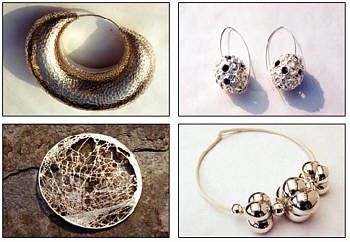
Electroforming offers unique opportunities for creative designers. Some jewelry manufacturers, such as Charles Garnier in Paris and Carla Corp. in East Providence, Rhode Island, have built a reputation for quality electroformed jewelry. For thin, hollow, lightweight, voluminous, and complex three-dimensional shapes, electroforming is unsurpassed. It can allow designs to be realized at affordable prices that are not possible by other techniques.
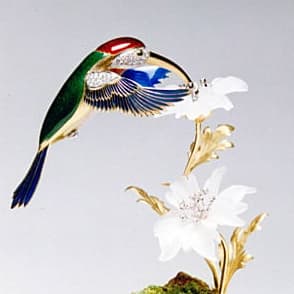
Electroforming offers a new technique for the creation of unique jewelry by the individual craft designer, as well. Among its many uses, electroforming can replicate natural objects—leaves, flowers, shells, nuts, and cobwebs, for example—as well as create interesting shapes from manmade objects. Typical applications for electroformed jewelry include earrings, pendants, brooches, chains and necklaces, charms, clasps, and bangles, as well as decorative artifacts and statues.
| Properties | Artform | Auruna 568 EF -18 |
| Composition | Au 76.5% - Cu 16% - Cd 7.5% | Not Available |
| Average karatage of batch & tolerance | Not available | 18.5 ±0.5 kt |
| Color | Yellow | Pale yellow |
| Density, g/cm3 | 15.5 g/cm3 | 15.9 g/cm3 |
| Hardness, as deposited | HV 420-430 | HV 220 |
| Hardness after annealing | HV 220-250 | Not Available |
| Ductility | Moderate, but good after annaling | Good |
| Surface appearance | Bright | Bright |
Table 3: Properties of electroformed 18k gold by the Artform process and the Auruna 568 EF-18 gold-silver bath | ||
There are a number of points to be considered when designing for electro- forming, including the following:
- Surface detail is reduced as thickness increases. Electroforming builds up from the model surface: The internal surface is in contact with the mandrel and replicates the surface detail.
- For the same reason, the dimensions of the electroformed piece will be larger than those of the mandrel.
- Just as in investment casting, any defects on the mandrel will be reproduced.
- The mandrels must be electrically connected to the rack.
- Because of deposition patterns, there are good and bad shapes or geometries for electroforming if uniform wall thicknesses are desired.
- In order to remove core materials, one or two holes must be drilled or designed in the electroformed piece. These can be subsequently soldered closed, if necessary.
- It is possible to set gemstones prior to electroforming, either by setting them into the wax model or by using a two-stage technique, in which the piece is partially electroformed, the stone put in place, and the electroforming completed.
- Signs and fineness marks can be molded into the finished piece by engraving the master model.
- The gold-copper-cadmium deposits have low melting temperatures, and soldering findings may require an "easy" grade solder.
| Bath Parameters | Aurura 3401 EF-24 | Enthone DIDO 24 |
| Electrolyte gold content, g/1 | 8 | 10-20 |
| pH | 5.5-5.9 | 7.2 |
| Bath temperature | 45°C/113°F | 65°C/149°F |
| Current density | 0.5 A/dm2 | 0.5 A/dm2 |
| Current efficiency | 90% | Not available |
| Deposition rate | 0.24µm/min | 0.33 µm/min (17h for 250 µm) |
| Properties | ||
| Deposit fineness | 99.9% gold | 99% gold+copper |
| Density, g/cm3 . | 19 approx | 19 approx. |
| Color | deep yellow | deep yellow |
| Hardness | HV 250 | HV 300 (220) |
| Recommended thickness | 250 µm | Not available |
| Maximum thickness | Several hundred microns | Several hundred microns |
| Stability | Good | Good |
| Solderability | Good | Good |
| Polishability | Good | Good |
Table 4: Electroforming systems for 24k gold jewelry | ||
Electroforming can also be combined with other techniques, such as stamping, lost wax casting, and enameling, for even greater design possibilities. Color can be added by electroplating the electroform in selected areas with metals such as copper, silver, platinum, or rhodium. In this context, the use of gold clays, such as Precious Metal Clay (PMC) and Art Clay, with electroforming also raises exciting possibilities and could enable interesting color combinations to be produced in gold.
Electroforming should be visualized as a unique process and not simply an alternative to other processes, such as stamping or lost wax casting. Each technique has its strengths from a design standpoint. The possibilities for creativity using electroforming technology are unique and endless.

In association with

The award-winning Journal is published monthly by MJSA, the trade association for professional jewelry makers, designers, and related suppliers. It offers design ideas, fabrication and production techniques, bench tips, business and marketing insights, and trend and technology updates—the information crucial for business success. “More than other publications, MJSA Journal is oriented toward people like me: those trying to earn a living by designing and making jewelry,” says Jim Binnion of James Binnion Metal Arts.
Click here to read our latest articles
Click here to get a FREE four-month trial subscription.
Related Articles

The Work of June Schwarcz

Electroplating Jewellery

American Holloware Changing Criteria

Resists and Electroplating to Create Patterns

The All-In-One Jewelry Making Solution At Your Fingertips
When you join the Ganoksin community, you get the tools you need to take your work to the next level.