Cuttlefish Casting Method
Cuttlefish casting is a quick and fairly accurate casting method. Its applications are limited only by the thickness and overall dimensions of the shell. It is difficult to achieve fine details on the surface of the casting, but this is offset by the richly complex texture that is a natural by-product of this method.
6 Minute Read

Cuttlefish casting is a quick and fairly accurate casting method. Its applications are limited only by the thickness and overall dimensions of the shell. It is difficult to achieve fine details on the surface of the casting, but this is offset by the richly complex texture that is a natural by-product of this method.
The back plate or cuttlebone of the ordinary squid (genus: sepia) serves as the mold material. The elliptical shell is a bright white, porous material that can be easily indented by pressing a model into it. One side of this material is covered with a thin, hard crust that resembles plastic. Cuttlefish bones for casting can be purchased through jewelry suppliers and pet stores, where they are sold for use in birdcages.
The process of preparing a two-part mold will be described by using a ring as an example.
Model
The model must be made of something solid enough to withstand being firmly pressed into the cuttlefish. Plastic or metal models are ideal. Wood or hard wax models will work if they don't have delicate sections. Traditionally a model might have been made from lead, which is easily hammered and bent into shape. Remember to avoid direct contact with skin when using this potentially dangerous metal. Depending on the shape being made, it is sometimes possible to start with an existing ring and simply modify it to meet the particular needs at hand.
The model is given shape with hammers, files and any other tool necessary. It should be made a little tight (a quarter size too small) to allow for the material that will be removed as the casting is finished. If the model needs to be strengthened in specific places, two part metal epoxy can be added as needed and filed to shape after it has hardened.
It is critical that the model have no undercuts so it can be lifted cleanly out after being pressed into the cuttlefish. Removal will be easier if the inside of the band is slightly rounded rather than being perfectly flat.
The Casting Mold
Select a medium-size shell and cut it in half lengthwise. Flatten the face of the soft side of both of these pieces by rubbing them on coarse sandpaper or against each other. Because this makes considerable dust, it is best to perform this operation over a waste basket. The goal is to create surfaces that are smooth, broad and flat enough that no light is visible between the two pieces when they are held firmly together.
Position the model in the thickest part of the cuttlefish. The model is set onto one side in its proper location along with several small registration keys of steel or brass sheet. The other half of the shell is set in alignment on top of this and the two shells are brought together with a firm even pressure until the two sanded faces make full contact. Be certain the mold is thick enough in the area around the model to provide strength in the mold. The internal registration keys can be augmented by making a couple saw cuts or drawing bold lines with a marker when the two halves are together.
The mold halves are separated and the model removed, using tweezers if this seems prudent. It is important that the mold not be damaged during this process. A funnel-shaped sprue is cut into each side of the mold. This must be wide enough to insure that it will be the last part of the casting to cool; that is, it should be thicker than the thickest part of the ring. Small vents are cut from the model leading upward to allow for the exhaust of air and combustion gases as the molten metal enters the mold.
The finished mold is cleaned with a soft, dry brush, and the parts are reassembled, using the registration angle keys and saw cuts for alignment. The parts are then tied together with binding wire and the mold is dried by being set into a warm spot such as under a lamp. It is now ready for casting.
Some more complicated objects will require molds of three or even more pieces. The following example describes the casting of a ring with a hollow bezel, as illustrated in figure 4.25.
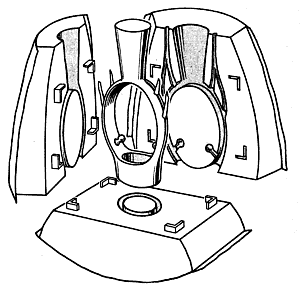 |
Figure 4.25 Three part cuttlefish mold with the rough casting opened up. |
Model for Three-Part Mold
A model like this can be carved from plastic, either sawn from a thick block, or built up by adding epoxy to a plastic ring cut from a length of tubing. Alternately, the model could have been carved from plaster or lead. To make a "blank" of the latter material, bend up a quick ring in sheet brass, considerably wider than the model will need to be. Then use a strip of the same brass to make a silhouette of the intended form, somewhat like a cookie cutter shape. Press these a little way into a charcoal block, then pour molten lead into the form thus created. After it has cooled this form can be reduced to the correct shape with files. Wear rubber gloves to protect your skin from exposure to lead while working. An advantage of a lead model is that the shank can be sawn through at the back and the size adjusted by simply opening out the ring.
The Mold
As described above, a large cuttlefish bone is cut, this time into three pieces. These are again sanded and rubbed until each has a surface that is smooth and perfectly planar. It is important that these surfaces fit tightly against each other or the molten metal will spill out the cracks. The ring model is set onto one panel of the mold so its top element (the hollow bezel) extends above the mold. Registration pins are laid into position and the other half is set onto the model and the two units are pressed together until they meet. The halves of the mold are separated and the model is carefully removed. The pieces are put back together, using the registration pins to insure accurate placement, and the top surface is trued up with sandpaper or a file.
The mold is reopened and the model is set back into place. The head of the ring, which projects out of the mold is pressed vertically into the third piece of cuttlefish, again being certain that the pieces are brought together so tightly that no gaps remain between them. The location of this piece is registered either with saw cuts or bold ink lines, or both. The model is then removed, a pouring gate and air vents are cut as described above, and the interior of the mold is blown clean of any dust. The mold is reassembled and tied securely with binding wire. The assembled mold is shown in figure 4.26.
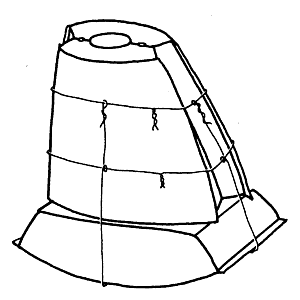 |
| Figure 4.26 Closed three part mold, prepared for casting. |
Casting
In order to promote solid metal free of porosity, a large button is suggested for cuttlefish casting. This will be the result of carving a large gate and remembering to use sufficient metal to fill it. In order to improve the castability of the metal, it's a good idea to add a small amount (about 0.5%) zinc just before pouring the metal. This will lower its melting point, make it less viscous, and decrease the surface tension of the molten mass.
All of these factors will allow the casting to fill more completely and pick up detail better. The metal should be poured into the mold at the lowest possible temperature; if it's too hot the mold will be prematurely burnt up. This can cause a loss of detail in the mold and might also make the cast porous. To prevent this, pour the metal just as a skin starts to form on the charge in the crucible.
Related Articles

Jewelry Designs: Maya Pendant
Precious Metal Clay 101

Wax Model Carving

5 Classic Casting Tips
The All-In-One Jewelry Making Solution At Your Fingertips
When you join the Ganoksin community, you get the tools you need to take your work to the next level.