
Casting Gold to Platinum for the Jewelry Industry
The principle of bi-metal casting is really very simple: A wax model is invested, cast and finished. A secondary wax is created, which is going to become part of this piece. The wax is attached to the first casting, re-invested and the metal is cast on, thus creating a piece that is made with two metals. It is recommended that mechanical fastening devices, such as plugs, tracks etc. be worked into the design. The piece is then finished as usual.
6 Minute Read

This article "Casting Gold to Platinum for the Jewelry Industry" explores platinum casting to be used and developed in the jewelry industry.
Many years ago, when first I was privy to see an actual platinum casting, I was amazed at the meticulous effort, the time and the skill that was required to make such a casting. The model was chosen, a small tree was waxed up, and the whole contraption was set on a thick paper and attached to the bottom of the flask, a heavy stainless steel can. It was then filled with the investment which was created by mixing a binder with the water in the proper proportion and set to dry after all the bubbles were removed.
Well, after a long period of time, the flask then was placed in the kiln and slowly stepped up in temperature over an eight hour period. To make a long story short, we all went home for the night, and the next morning, bright and early, we cast the pieces in the flask, using a torch. At de-vesting, the caster placed the pieces in a hydrofluoric acid bath for cleaning. It was quite an effort and dangerous too. I wondered if there wasn't a better way. It is true, with today's modern induction machines and great casting alloys, casting Platinum has become somewhat less of a challenge, but the traditional investments are still very demanding and require absolute process control. It made me wonder how other industries handle high temperature casting.
After a long search in other industries, using other technologies, I checked with the dental industry, an industry closely related to jewelry making. There I came across a concept which I think will revolutionize the jewelry industry.
The Concept
Imagine an investment powder you could mix, with pre-packaged portions of powder to liquid so you won't make a mistake, that will set totally and completely in 15 minutes, that is so strong that it requires no steel flask but a flexible plastic sleeve that is removed after the mass has set. And imagine further, that this material can be placed into a kiln, at 1700°F for rapid burn-out to cast 20-30 minutes thereafter. And imagine that after the casting is done, the de-vesting would be easy, using water or sand blasting and the metal would have a shiny surface, without the requirements of hydrofluoric add for cleaning. You would think this was some sort of hoax. Well, it isn't. The material I am about to show you has all the properties mentioned above.
Bi-metal Casting
The principle of bi-metal casting is really very simple: A wax model is invested, cast and finished. A secondary wax is created, which is going to become part of this piece. The wax is attached to the first casting, re-invested and the metal is cast on, thus creating a piece that is made with two metals. It is recommended that mechanical fastening devices, such as plugs, tracks etc. be worked into the design. The piece is then finished as usual.
To create a one-of-a-kind piece in a small shop, the wax is typically made by hand. In a manufacturing situation, the wax can be injected onto the piece which is placed inside a mold, made for this purpose. There are many ways to join the wax to the model, all of which require practice and trial and error. Once the best way is found and documented, the technique can be used again and again.
The Project
The flask system used for this project is a 2″x I3/4″ clear plastic flask, designed to hold one ring. This size is ideal for the project in use because it demonstrates the strength of this investment as well as the economy of use.
By using pr-e-packaged portions, there is no waste and the proportions are always right.
For this experiment, we are using a rapid investing dental investment system as is. Meanwhile, through testing and experimenting, the investment has been adapted for jewelry and is now suitable and available to cast silver, gold and platinum.
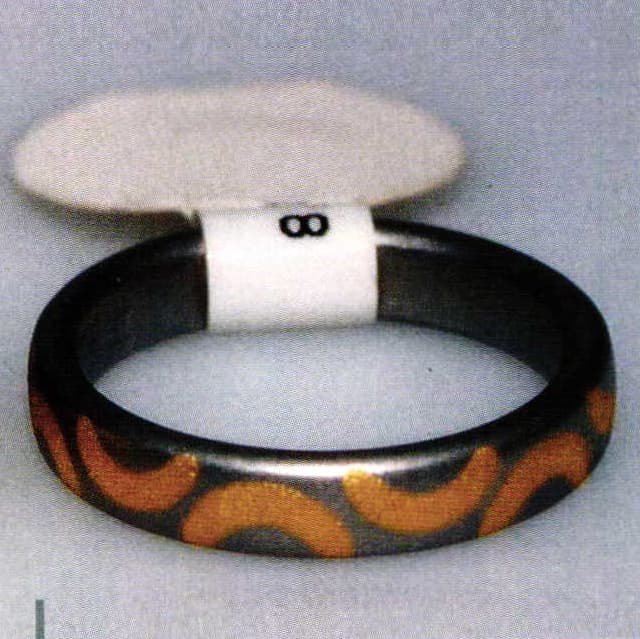
The platinum section has been finished and completely polished to a showroom finish. We are using Pt 900 with an Iridium alloy and the attached wax will be cast with 18K yellow gold.
Using the rapid dental investment and the required expansion fluid, we mix the prepackaged portions together. This fills the flask exactly. The mix is vacuumed in the bowl for 60 seconds and in the flask for an additional 60 seconds. It is important to remember that room temperature is about 72°F. Colder temperature will slow the setting process, warmer temperature will speed it up. The filled flask is then left to set for 15 minutes. During the setting or curing process, the chemical reaction will heat the flask to a temperature of 50°C, which will soften the wax, and in some cases even start to drip out from the sprue as soon as the sprue base is removed. After setting up, we gently remove the flask from the investment. It win stand alone.
The Burn-Out
Without a metal flask or even a plastic flask surrounding it, the dry and set investment, in the flask shape is now placed in a kiln, preheated to 1700°F. The burn-out time is determined by the cubic inches of investment present and in this case is about 30 minutes. During that time the wax will be completely gone, the investment will be bright red in appearance, and hard as can be. At this point we simply turn the kiln off and let the temperature drop to a casting temperature level for 18K gold. We found that 1000°F works best. The cooling takes about 15 minutes and with a total time of one hour since we filled the flask with investment, we are ready for casting. We place the red flask into the casting machine, lock it in and melt the 18K gold with the torch and spin.
Cleaning the Casting
The button shows us that the casting was good. De-vesting was surprisingly easy. The investment held up to its promise of being stronger than most anything on the market. The bond the 18K made on the platinum was good, strong and seamless.
Finishing
Sawing off the button we file, sand and polish the gold portion of the ring. A final buffing colors the platinum and the ring is finished. In this type of an operation it is important that the platinum portion is polished first, as 'one tends to over polish the gold while trying to polish the platinum. It is best to polish the platinum to show room quality before attaching the wax.
Summary
Bi-metal casting is a wonderful way to blend two metals together. Many tricks can be used to accomplish a good bond at the interface. Solder, applied as a thin film to the platinum surface, can be helpful. Holes drilled into the host metal will act as lugs; or small pegs can be attached as we did in this example. The rapid investment method demonstrated made it possible to do the entire bi-metal casting in under two hours, from a wax attached to a platinum host ring to a showroom piece ready for delivery.
I believe that the newly developed rapid investment powders will make a big difference in the way castings are being done, be it on a small scale or a volume manufacturing level. An investment that can cast platinum in under two hours, with a bright shiny surface, eliminating the need for hydrofluoric acid, that has the capability of being used in a vacuum casting machine, is something that until now we could only dream about. Currently I am researching the possibility to modify existing rapid investment powders to be adapted to casting platinum. By adding a slurry to the wax before investing, a smooth surface can be accomplished. The investment powder that we are describing will work for all precious metals and has vacuum cast capability.
See Also:
Important Principles of Casting Safety
Related Articles
Manufacturing Jewelry in Platinum Some Basic Facts
Platinum Casting with Gemstones
Platinum Alloys – Features & Benefits
An Overview of Platinum Casting

The All-In-One Jewelry Making Solution At Your Fingertips
When you join the Ganoksin community, you get the tools you need to take your work to the next level.
