Basic Tubing Catch Fabrication
First one chooses an appropriate metal for the various parts, that is a metal with appropriate structural for it's thickness and stress in use. In this catch there is little stress in use and therefore one can use even as soft metal as sterling for the components. In 14k gold one could.
3 Minute Read

First one chooses an appropriate metal for the various parts, that is a metal with appropriate structural for it's thickness and stress in use. In this catch there is little stress in use and therefore one can use even as soft metal as sterling for the components. In 14k gold one could use thinner material than in silver.
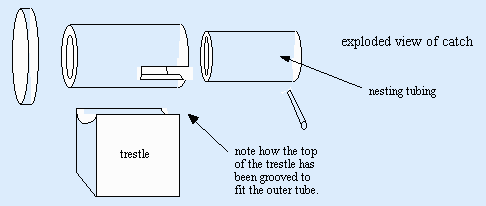
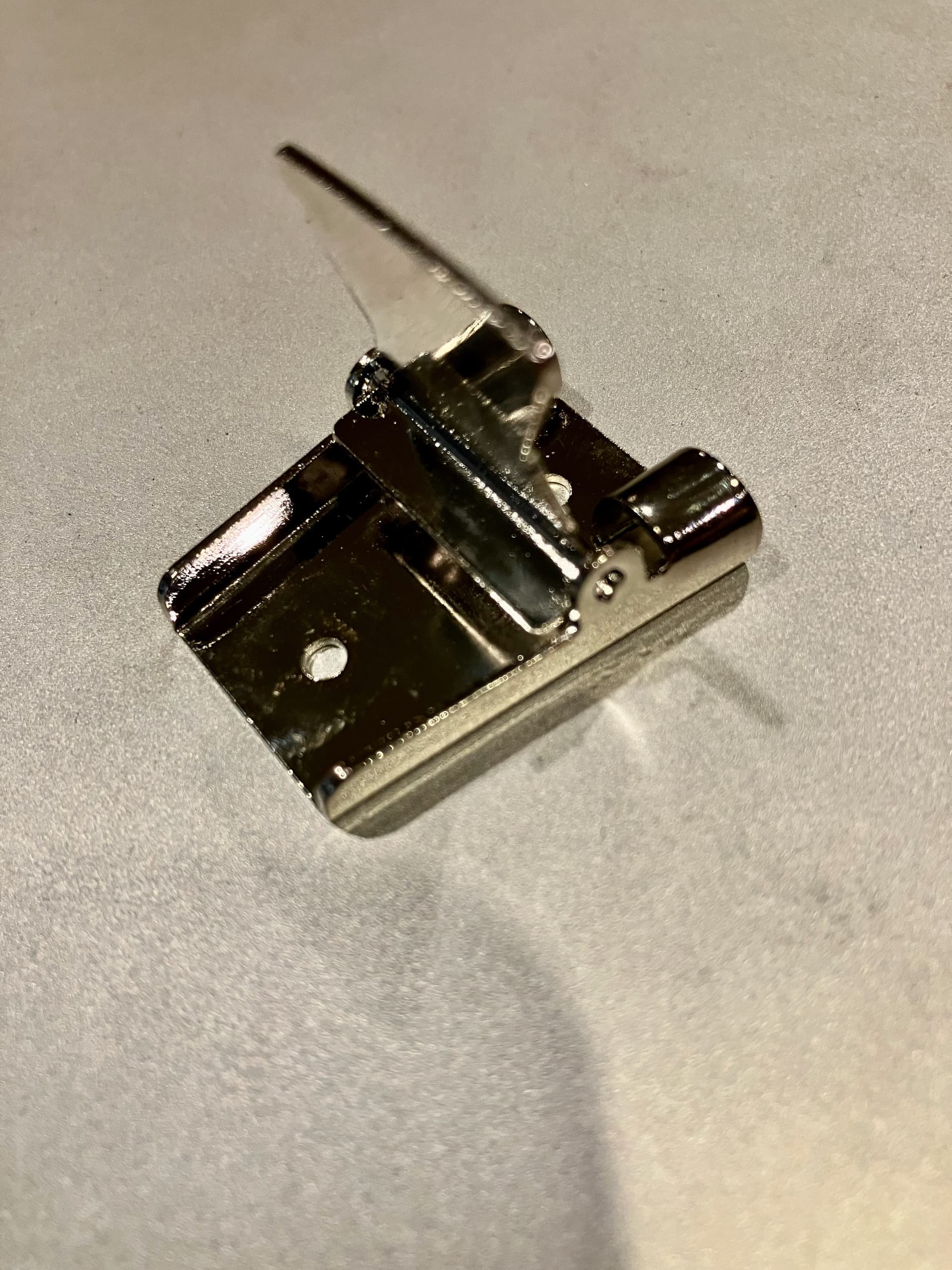
An appropriate thickness for the tube is 0.2-0.4 mm in gold and 0.3-0.5 mm in silver. The upright piece (often called the trestle) is about 1 mm thick. The trestle can be pierced through for decoration.
 | |
 |  |
Procedure:
1) Choose the material type and thicknesses. The inner tube telescopes into the outer tube. The trestle is the desired length and is quite long so that it may serve as a handle. Some people build two catches simultaneously on each end of the strip of metal which will later be cut short to function as the trestle.
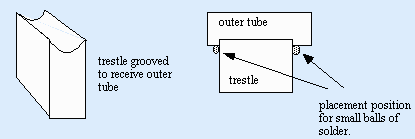
2) The top of the upright is grooved with a chenier file or a separating followed by a round nosed needle file. The outer tube fits into the groove. outside tube is cut somewhat larger than the width of the trestle. As it is cut 'longer than' no actual measurement is made which saves time. Any time a part can be cut 'longer than' without a measuring step the procedure is made more efficient. This is an example of relative fitting. The outer tube is soldered in place with a minimum amount of solder. Preferably one uses small solder balls placed in an area where no residue or 'scar' from overheating can be left. Hard solder is recommended for every joint in the construction of the catch except for the final soldering to the pin.
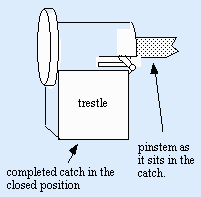
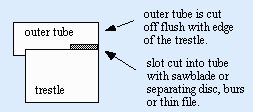
3) The end of the tube on the right side is cut off flush with the edge of trestle. Then a slot is made into the tube where the tube contacts the trestle. The slot is made the same size as the pinstem thickness. It is made between 2 and 3 mm long.
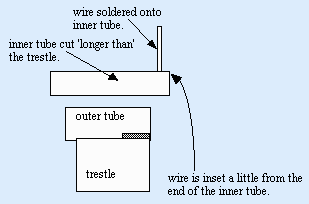
4) Now the inner tube is cut 'longer than' the trestle unit a wire is soldered onto it some distance in from the end, perhaps 1-2 mm in. This too eliminates a measuring step. The wire is cut long enough to function as a handle to it easier to solder in place and to manipulate the inner with. This is another important principle for always leave handles on components as long as possible. The wire chosen is the same diameter as the pinstem and the slot size is determined by the pinstem and the wire. A minute amount of solder is used for the attachment. wire stop is cut off to a short stub (1 mm or so) at the end the construction of the catch.
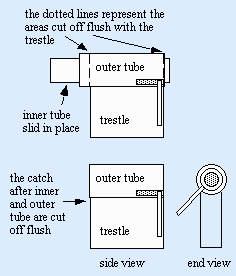
5) The inner tube is slid into the outer tube until the wire positioned just inside the flush end of the outer tube. the inner tube and outer tube are trimmed off together whatever means you prefer - my preference is a separating disc which can be used simultaneously to 'sand' the surfaces being cut just after the cut has been made. Any time one does not have to change tools a procedure is more efficient. Also any time one can combine cutting operations by two things at once which are cut off relative to each other the construction procedure is simplified.
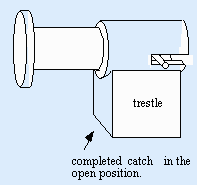
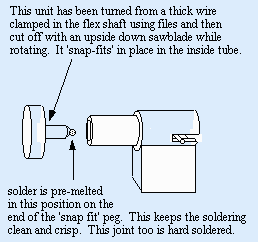
6) At this point one decides what the button or knob looks like with which one draws back the inner tube to allow the pinstem into the slot. One can use a piece of metal balled up on a charcoal block soldered to the inner tube or a slice off a thick wire (think of slicing salami) or even thick jump ring soldered around the very end of the inner tube. personal preference is one shared by many model makers; that one turn a knob along with a 'snap fit' peg from a single piece of thick wire. 'snap fit' peg clicks into place inside the inner tube for accurate fitting easy soldering. The solder is pre-melted on the end of the peg and is drawn to the outside by the heat of the flame in soldering.
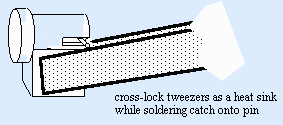
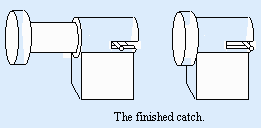
7) The catch is now finished and the trestle is cut off at the required height (remember it was over- long). It is soldered in place on the pin with med- ium solder. Solder is pre-melted on the bottom of the trestle for this last and final step. Some people use white-out or a solder flow retardant but this is not necessary if you heat the pin more than the catch and if you use your cross-lock tweezers as a heat sink.
Related Articles

Working with Jewelry Hinges Made Easy

All About Hidden Hinges

Chain and Bracelet Catches 2

How to Make Earring Posts by Hand


The All-In-One Jewelry Making Solution At Your Fingertips
When you join the Ganoksin community, you get the tools you need to take your work to the next level.