The Jewelry of Barbara Heinrich
Jewelry maker and studio boss Barbara Heinrich keeps business strategies and artistic expression in harmony while creating jewelry designs that strike a chord. When technical mastery meets metal and brilliant stones in her studio, the result is a high-carat opera whose chorus is gold, diamonds hit the high notes, and colored stones are the featured players. When jewelry feels like music, it is unmistakably a Heinrich design.
11 Minute Read

Jewelry maker and studio boss Barbara Heinrich keeps business strategies and artistic expression in harmony while creating jewelry designs that strike a chord.
When goldsmith Barbara Heinrich was five, she collected the pods scattered around the family farm in Heilbronn, Germany, strung them with dyed noodles and broken snail shells, and created her first nature-inspired necklace.
These days, when Heinrich composes a necklace, she sorts through mandarin garnets, eggplant spinels, and purple sapphires. Over 150 colored stones, canoe-shaped to kite-shaped, await framing in gold and platinum "martini" bezels, channel sets, and "pillow" shanks. When technical mastery meets metal and brilliant stones in her studio, the result is a high-carat opera whose chorus is gold, diamonds hit the high notes, and colored stones are the featured players. When jewelry feels like music, it is unmistakably a Heinrich design.
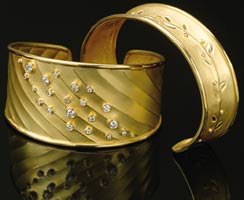 |
| Two of Heinrich's 18K gold hand-fabricated cuff bracelets, one with a chased grapevine design offset by diamonds, the other with chased lines and bezel-set diamonds. |
"Success comes from creating a unique visual language that makes my jewelry instantly recognizable," says Heinrich. "Reward does not come fast in this field; you need to hang in there for a long time. It takes a lot of determination, persistence, and belief in one's self in order to make it. I've wanted to make jewelry from the cradle." As a young girl, Heinrich's dream was to sell her jewelry in the United States. She didn't have a strategy for realizing her dream, but luckily her parents did - they enrolled their daughter in a four-year apprenticeship at Pestalozzi Kinderdorf Wahlwies, on Lake Constance, in southern Germany. Heinrich says, "I picked up a lot of techniques and a few idiosyncrasies."
Art Changes | Life Changes
Apprentices at the school learned and labored in the absolute silence imposed by instructor Rudolph Steiner's holistic philosophy of jewelry making. As Nature was the jeweler's muse, silence was necessary for the peace to speak and direct designs.
"The flow of communication between you, the piece, and the peace should be constant," Heinrich explains. "To this day, when I design a piece, I often don't know how I'll build it. I let the piece tell me," says Heinrich.
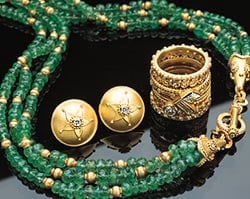 |
| Triple strand faceted emerald bead necklace with 20K gold ball spacers, 18K gold clasp, and 18K gold end caps with granulation and diamonds; Domed earrings, with 0.15 cts of diamonds at the center of each flower and 18K yellow gold granulation. The stackable rings are all done in 18K yellow gold, each with their own assortment of diamonds. |
The next apprenticeship, at the Pforzheim Academy, earned Heinrich an MFA in jewelry and hollowware and two scholarships. The first, to study in London, altered her work, but the second, a $20,000 Rotary scholarship to study at the Rochester Institute of Technology (RIT), altered her life. In 1983, Heinrich filled her knapsack with jewelry tools and set off for Rochester. The RIT years produced a new body of gold work and a second MFA. Heinrich felt she was now technically armed to mine the abundant gallery network and craft show opportunities within range. She met and married Gregory, a chiropractor, and in 1986, set up a studio in their home.
During the previous decade, Heinrich had used wood and anodized aluminum to make avant-garde head jewelry, light jewelry, and performance pieces that featured nude models. Although critically well received, they only reached a small audience of cognoscenti. Heinrich now focused on creating classically proportioned gold jewelry with a contemporary look using traditional techniques. The market responded quickly to the new designs and, in 1989, her business, the Barbara Heinrich Studio, LLC, was added to the house. Although Heinrich now was working 80-hour weeks to produce the line that bore the Studio's oak leaf trademark, she always kept her dates with Gregory for concerts and ballroom dancing. Believing that inspiration came from within, she always took a notebook to concerts, just in case.
"A Grimm's fairytale inspired my early jewelry," Heinrich recalls, recounting the story. "An orphan gives her clothes to a shivering beggar and bread to a starving man. Now herself cold and hungry in the woods, she begins to pray. Suddenly, stars from the Milky Way drop at her feet in a pile of gold dollars. This inspired a series using gold coins with hammered edges. Most of my work comes from being one with the One. My pieces are organic, flowing endlessly from an infinite source."
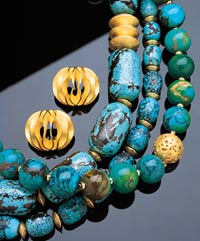 |
Large wave ball earrings of 18K yellow gold, 20 mm; a 17-inch necklace of 16 x 27 mm oblong turquoise beads with 18K yellow gold clasp and spacers; a 16-inch long necklace of 11 mm x 12.5 mm oblong turquoise beads with 18K yellow gold clasp and spacers; a 17-inch necklace of 18.5mm natural Chinese turquoise beads with 18K yellow gold half-round spacers and Milky Way changeable clasp with 12 diamonds, 0.12 ct tw. |
Foreign Exchange
Although inspiration flowed endlessly for Heinrich, energy did not. Working overtime to develop a jewelry line coincided with a growing family, adding new commitments that only expansion and hiring more full-time jewelers could alleviate. Rather than simply hiring jewelers, she invited foreign jewelry students to bring their ideas to the studio and stay a year or three. She would provide the immigration lawyer, give professional training, teach gallery skills, and expose them to the excitement of trade shows. They would provide the synergy and professional dialogue to keep the studio at an international level.
"There are no strings attached. I invite them to just add as much know-how as they can while they're here and then go fly and do something great. I really do believe in the One Good and that if it's good for one, it's good for all. That's pretty much the spirit of the studio. It's neat to see what somebody does with what they've learned. An ex-student from Taiwan now teaches at the university there and designs jewelry for a major company while developing her own work. I'm proud of that whole teaching process because young people really need opportunities and this studio has been a place for that. Currently, we have jewelers from India, Korea, Taiwan, America; and I'm from Germany," laughs Heinrich.
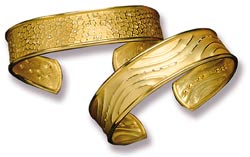 |
| Two 18K gold hand-fabricated cuffs, one with roller-printed snakeskin pattern and diamonds, the other with chased wave line design with diamonds. |
Over the past 15 years, the studio has trained over a dozen foreign jewelers and currently employs a full-time office staff of two, three full-time jewelers, and up to three part-time jewelers. With a solid team in place, Heinrich was soon reaping the rewards of a well-organized business that moved 1,000 new pieces a year out the door and into the display cases of 65 loyal galleries.
"A strong partnership with individual galleries has contributed immensely to our success. Because we understand their specific needs and circumstances, we are able to work together to meet their needs. Sometimes a gallery needs a quick response or consignment issues need discussing. Many galleries love our work, and although our prices range from $200 to $10,000, they can't always afford to buy it. We'll do everything possible to get them started, working with them on a consignment basis for one, two, or three years. Then after they've developed a following, and have done some advertising, we'll ask them to buy some things. If a piece doesn't sell within a year, they can exchange it for a different piece. So slowly, they own some of the inventory and we don't have to finance the entire inventory that's out there. I think it is a very essential thing to develop honest and strong relationships and to really work together to help buyers understand that jewelry is the most intimate of art forms. Objects worn next to the skin become part of the wearer's identity, an outer expression of an inner glow."
Sparks Fly
As for the outer glow of a Heinrich piece, sparks may fly when lava stone, Pacific sponge coral, or Sleeping Beauty turquoise is paired with gold, but the sparkle is unmistakably diamonds. Although Heinrich uses brilliant-cut diamonds like confetti, sprinkling her Embossed Brooch with 49 diamonds, she favors the newly created Spirit CutT diamonds with their boosted radiance that produces 20 percent more light.
Heinrich's jewelry is frequently in the spotlight. Last year's highlight was being featured in Pearls: A Natural History, the touring exhibition launched and organized by New York's American Museum of Natural History. (Heinrich's showpiece was a pierced Milky Way collar featuring 10 round, 10-millimeter Tahitian pearls and .39 carats of diamonds.)
"We got into pearls in a big way. I use black Tahitian and South Sea gray pearls, as well as freshwater pearls to make pink and peach necklaces. I also use Keshi pearls that are not cultured, which means no foreign elements were introduced into the oyster to make the pearl grow. Instead, the pearl is formed around a piece of the oyster's skin, which makes them irregular and lustrous."
"Irregular" and "lustrous" describe Heinrich's playful stackable rings. The distinctive glow of these rings, and all Heinrich jewelry, is the result of multiple labor-intensive finishing steps that begin with pumice, wire brushes, and sandpapers and conclude with hand burnishing and highlighting edges and patterns. These best sellers, which come in 100 styles and feature stones in every available color and setting, are favorites of customers who like creating their own ring combinations. As for the rest of Heinrich's substantial body of work, it is categorized by series, by metal, by stone, by technique, and even by natural phenomenon. The studio's signature Milky Way design is the golden thread that connects past and present jewelry. Tiny pierced and embossed celestial symbols, lightly sprinkled with diamonds, cover cuffs, pendants, brooches, and even the backs of earrings.
"We have by now produced several generations of Milky Way jewelry using different techniques. When we work with a theme we really stay with it for a three-year interval, elaborating it and carrying it further and further. We produce many variations and play around in a big way, combining anything and everything, then take it to another level by adding a new dimension. Necklaces, earrings, rings, and pendants - we don't leave anything out. It's like an obsession but it is methodical at the same time. I think taking a design to another level and developing it is a learned skill that makes our jewelry successful. But a piece can be successful and never sell. For instance, the Interlink necklace, which we have carried for 15 years, didn't sell for three years. I knew it was one of the best pieces made up to that time. It was ahead of its time and now it's one of our classics and sells very well. I knew this piece was a success years before the market proved it.
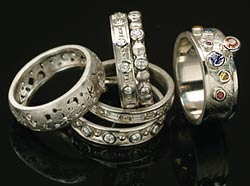 |
| Platinum rings with diamonds and multi-colored sapphires, in various patterns. The ring to the far left is one of Heinrich's signature designs, her Milky Way pattern with moons and stars. |
"When the idea comes across and certain ideas gel and everything in the piece is right - that is success to me. It's also important that the look and the time we put into it is right, new, fresh, and fits in with the gallery and the market. In the end, the sale of a piece is only a part of its success."
Powerful Mix
Heinrich brought a powerful mix of dual-continent training, technical perfection, artistic virtuosity, and business acumen to her jewelry business. This potent formula, along with the built-in guaranteed longevity of the jewelry's classic styling, has launched Heinrich's pieces into the realm of investment jewelry, to become future heirlooms. With each year's growth, Heinrich has had to redefine and evaluate how things are done at the Studio. In 2002, she attended one retail and two wholesale shows and numerous one-person shows at the galleries that represent her. In return, the galleries produced postcards featuring the jewelry, advertised the exhibits, and arranged for reviews in local papers and professional magazines.
"Success came from producing classically designed jewelry and developing a brand name. It means being able to sell most or all of our pieces within a year. Success means being able to offer these pieces to an audience via the gallery system at a price that works for the buyer, the gallery, and for us. I want to be able to pay my employees well, give them benefits and still be able to make a salary. Success means building a studio team, where everyone's abilities create a synergy with a positive dynamic. It also means being able to take off five weeks a year for personal and family time."
In her artist's statement Heinrich says: "I have come to realize that creating jewelry is a spiritual activity for me. It takes intense concentration of a special kind - an inner listening and seeing to conceive these gifts of jewelry in their entirety and purity. It's like going to a secret garden: a place in consciousness where great things of beauty and grace exist. These pieces are gifts that speak to the beauty and nobility present in all people and come from a place where art, beauty, joy, grace, and love are absolute realities."
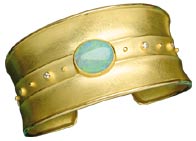 |
| 18K gold hand-fabricated cuff with opal and diamonds. |
At the same time, however, Heinrich has come a long way from the strict silence of her apprenticeship days, surrounding herself with a community of burgeoning artists and encouraging artistic dialog. It's a trade-off, breaking into the isolation and interior world of the artist and reaching out to make connections that are business oriented as well as creative. "As for diversification, I would only recommend it to other artists if they are willing to shift their focus from making jewelry to teaching other professionals and working with a team," Heinrich says. "By being a larger studio, a lot of time is spent on the telephone with galleries and suppliers. Then there's the business side of running a studio, which also involves issues such as managing cash flow, collections, marketing, bookkeeping, and planning shows. For me, it is very gratifying to work in a larger studio setting and still be able to develop new work. I enjoy the challenge of all of these other responsibilities. It is not for everybody, but I recommend it for those who want it."
Related Articles

Metalsmith ’89 Summer: Exhibition Reviews

Projects of Exploration: Performance and Beyond

The Work of Steven Ford and David Forlano

The Search for Modernist Style Jewelry

The All-In-One Jewelry Making Solution At Your Fingertips
When you join the Ganoksin community, you get the tools you need to take your work to the next level.