Argentium Sterling Road Testing
Invented in 1996 by Peter Johns, a professor of silversmithing at Englands Middlesex University, Argentium[R] Sterling Silver, like traditional sterling silver, is at least 92.5 percent pure silver. But unlike traditional sterling, which is 7.5 percent copper, Argentium sterling has a small amount of germanium instead of some of the copper. So how does that change things?.
15 Minute Read

Working with the new Argentium Sterling Silver is similar to working with traditional sterling, but don't assume they're the same, or some key differences may trip you up.
This guide to Argentium® Sterling Silver is a further adaptation and update of a technical article that was first published in SNAG News, the newsletter of the Society of North American Goldsmiths, and later updated for Rio Grande. Argentium® Sterling Silver is a registered trademark.
As soon as I heard of the existence of a firescale-free sterling silver alloy that was being made in sheet form, I couldn't wait to get my hands on it and start playing.
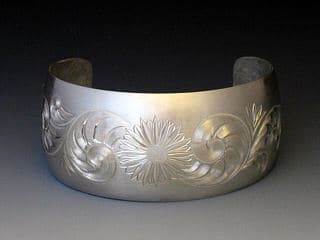
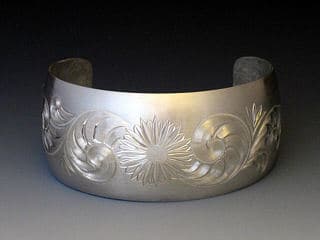
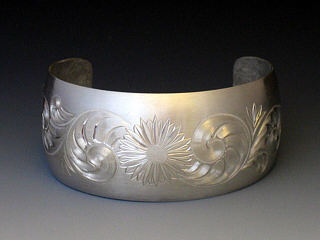
- Jack Cohn of Lee-Joyce designs made this
hand-engraved cuff bracelet of Argentium sterling
5 3/4; x 1 1/4; in. (146 x 32mm)
Invented in 1996 by Peter Johns, a professor of silversmithing at England's Middlesex University, Argentium® Sterling Silver, like traditional sterling silver, is at least 92.5 percent pure silver. But unlike traditional sterling, which is 7.5 percent copper, Argentium sterling has a small amount of germanium instead of some of the copper. So how does that change things?
Argentium sterling has other wonderful qualities beyond its freedom from firescale. It's highly tarnish resistant, it's more malleable and ductile than traditional sterling, it can be precipitation-hardened using a kitchen oven or toaster oven, and it can be easily fused and welded. Argentium sterling findings can be fired into metal clay, and many people who are allergic to traditional sterling silver are able to wear Argentium sterling.
Overall, working with Argentium sterling isn't much different from working with traditional sterling silver. But there are some real differences, so it's best to go in knowing what to expect. The following is a basic guide to working with Argentium sterling in basic metalworking processes.
Annealing
Argentium sterling has a melting point around 60 degrees lower than that of traditional sterling silver. Therefore, it has a lower annealing temperature range of 1050-1150°F (566-621°C).
It also shows a paler glow than traditional sterling does when heated to annealing temperature. The glow can be difficult to see, so I usually anneal in a darkened room to prevent overheating. There are some other ways to tell that the piece has reached annealing temperature. Prepare a piece of brass-brushed Argentium sterling with dabs of paste flux, and make some marks with a permanent marker. Turn off the lights and anneal the piece. Then, turn the lights back on and take a look. As the piece reaches the annealing point, the dabs of flux will be fluid but still a bit bubbly, the ink from most permanent markers will fade, and the metal will turn whitish. Once you know these signs, watch for them when you're annealing in bright light.
In the same way that you wouldn't use a dirty rag to clean a table, avoid using soldering boards that have been used for copper or brass, which create a lot of dirty scale when heated, for Argentium sterling. Use a clean, new soldering board for Argentium sterling and use it only for Argentium sterling.
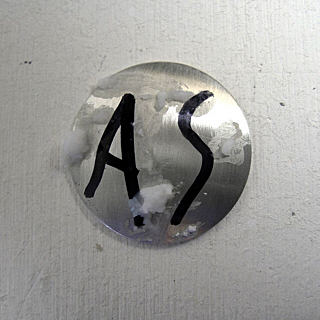 | 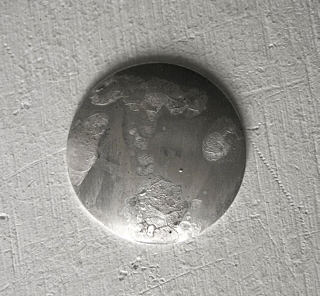 |
| Permanent marker and dabs of paste flux on a disk of Argentium sterling (2) provide signs to watch for so you know when the piece is annealed (3). | |
Quenching
Argentium sterling doesn't cool as quickly as traditional sterling and shouldn't be quenched when it's red-hot. I wait a few seconds before I quench a small piece of metal. I wait longer for a large piece. A soft sizzle when the silver goes into the water is okay; it shouldn't seem like an explosion. Then again, it is true that the sooner Argentium sterling is quenched, the softer it is; so, you might choose between softness and risk of shock cracks or warpage depending on the situation and your personal sense of concern about those factors.
Hardening
Argentium sterling hardens well after a slow air-cool, and quenching is not essential to the hardening process.
Heat the Argentium sterling in an oven or kiln to 580°F (304°C). Begin timing after the oven or kiln and the support for the Argentium sterling have reached the required temperature. Heat for at least 45 minutes (a very large or thick piece may require longer), then air-cool the piece to room temperature. There is no negative effect on the alloy if the metal is left in the oven longer than the minimum time.
Lower temperatures can be used if the heating time is increased. At 428°F (220°C), the minimum temperature required, Argentium sterling needs to be heat-treated for approximately 2 hours. I usually heat-treat my Argentium sterling pieces at the maximum temperature of my kitchen oven, 550°F (288°C), for an hour and a half.
To avoid contamination and to minimize discoloration while heating, make sure the oven is clean to prevent smoke caused by burning food drippings, and place the Argentium sterling on a clean Pyrex dish. Using a metal rack or a metal pan is not recommended.
Any discoloration from the hardening process can be removed easily with pickle; if you want to refresh the shine, I suggest using a Goddard's Long Shine Silver Cloth or Liquid or a brass brush and soapy water.
Don't enclose the Argentium sterling when heat-hardening it — insulation slows down the heating process and prevents oxygen from reaching the metal and creating germanium oxide, which prevents tarnish.
The hardening process won't harm fine silver, sterling silver, gold, or copper alloys used in combination with Argentium sterling. Argentium sterling can be annealed and then rehardened if needed.
Pickling
Use whatever chemical solution you are accustomed to — citric acid, Sparex, sulfuric acid, or sodium bisulfate — for pickling. A separate pickle pot is recommended if you frequently work with copper alloys or if you are in a group-studio situation. I have one pickle pot that I use for all metals, and I haven't had any trouble. However, it's not a bad idea to avoid any cross-contamination; it's possible that contamination in the form of copper deposited on the surface of the Argentium sterling could affect tarnish resistance.
Soldering
In silver jewelry making, a general rule is to heat the whole piece, not just the solder. Argentium sterling, however, doesn't conduct heat as quickly as regular sterling silver does, so it's better to focus the heat on the area of the join after giving the whole piece a general heating.
Although traditional silver solders can be used, I recommend using Argentium sterling solders. Since they contain germanium, they match the color better and tarnish less than regular silver solders. Argentium sterling hard solder melts at about the same temperature as regular silver medium solder, Argentium sterling medium solder melts at about the same temperature as regular easy solder, and Argentium sterling easy solder melts at a temperature similar to traditional extra-easy solder. In my experience, the Argentium sterling solders don't melt completely; it's tempting to try to melt every last bit, but if you do, you'll overheat the piece. Precious-metal manufacturer Stern-Leach is working on new solders that flow better, including an extra-easy Argentium sterling solder.
It may help to use traditional silver solders until you adapt to soldering Argentium sterling. Use medium, easy, and extra easy traditional silver solder to get used to the different torch control needed. When you're comfortable working with the traditional solders, try the Argentium sterling solders.
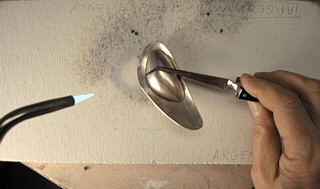
Argentium sterling can be fragile when it's hot, so don't press or push it while heating — instead, use binding wire or pins to hold the metal in position.
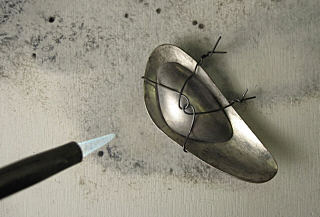 | Argentium sterling can be fragile when heated, so it's best to use binding wire to hold the piece in place while soldering (4) rather than using cross-locking tweezers (5). |
 |
As with any metal, formed Argentium sterling is stronger than flat. When soldering flat sheets of Argentium sterling, make sure they are supported to avoid sagging. The lower the temperature of the solder, the less sagging is a problem. As with any alloy, the thicker the metal is, the easier it is to keep a soldered construction flat.
Flux only the solder join. There's no advantage to fluxing the whole piece, since Argentium sterling's tarnish resistance improves by being exposed to oxygen during soldering and annealing.
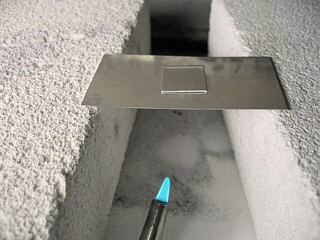 | 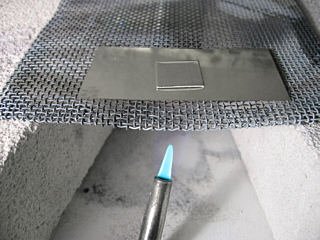 |
| Unsupported, flat pieces of Argentium sterling (6) can sag during soldering; be sure to support the metal (7). | |
Fusing
Because germanium is less conductive than many other metals, Argentium sterling can be easily fused and welded and makes nice, clean joins.
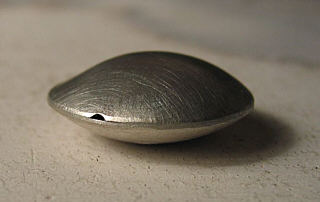 |
| Eid has begun experimenting with complex fusing, such as with this lentil-shaped bead. |
I found it easy to fuse links for an Argentium sterling chain. I used liquid flux on the joins and the small, hot flame of my Smith Little Torch on a heat-reflective soldering pad. I focused the heat on the join, rather than on the whole link. Larry Blackwell, a jeweler who specializes in sterling silver chains, uses Argentium sterling wire and fuses whenever possible, since he finds it faster than soldering.
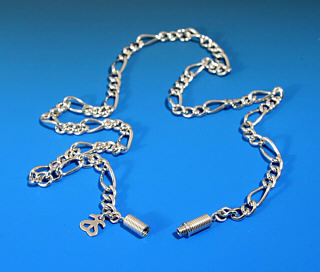 |
| One of Larry Blackwell's Argentium chains with fused links and clasp. |
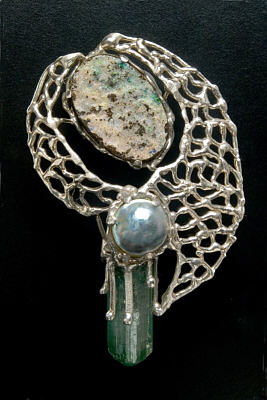 | Fused Argentium sterling brooch by Suzanne Juneau, set with green tourmaline crystal and pearl Photo by David Wortman. |
Granulation
Since Argentium sterling fuses so well, it occurred to me that it might be good for granulation. After I posted this thought on the Orchid list (ganoksin.com), jewelry artist Nancy Howland tried granulating with Argentium sterling.
Howland melted pallions of wire into round granules using a torch over a charcoal block. She cleaned the granules with burnishing powder in porcelain tumbling media. She has also used test granules of Argentium sterling from Stern-Leach and has found no difference in how the granules from the two sources behaved.
"This silver is much, much easier to granulate than fine silver," says Howland. "In a darkened room, I directly torch the granules to a red color and watch for a shiny surface flow on the base. I have yet to have any granules melt together. The Argentium sterling granules show significant resistance to meltdown-collapse, even when overheated. Fine-silver granules readily collapse under similar circumstances. I have also fused fine-silver granules to Argentium sterling using the same techniques as for Argentium sterling granules. Fine-silver granules do not appear to fuse with each other but do firmly attach to the Argentium sterling base. Since the germanium also protects the copper and fine silver in the alloy from tarnishing, it eliminates the need to apply tarnish-removal products — all of which remove some metal and, over time, weaken the somewhat fragile fused connections." Hopefully, granules will be commercially available soon.
Combining with Gold
Gold can be soldered and fused to Argentium sterling and will not be harmed by the hardening process. Aura 22, keum-boo, and gold plating all work with Argentium sterling. The Aura 22 needs a textured surface with a bit of "tooth" to adhere properly. I was able to make keum-boo with both smooth and textured Argentium sterling; the gold foil adheres best to metal that has been annealed and pickled to create a germanium-oxide layer.
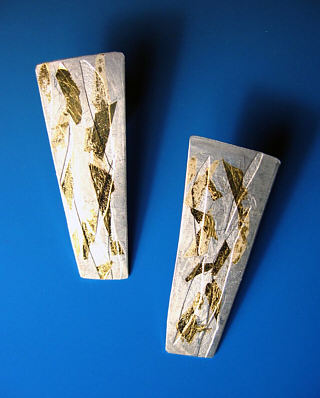 | Eid successfully produced keum-boo with both smooth and textured Argentium sterling and found that the gold foil adhered best to annealed and pickled metal. |
Balling Wire
The ball created by melting an end of Argentium sterling wire is usually smoother than a ball created by melting an end of regular sterling wire. I had some difficulties balling wire at first: sometimes the ball fell off, and sometimes the wire next to the ball got too thin. Here are a few tips for successfully balling wire:
- Clean the wire with a Scotch-Brite pad to remove any oil.
- Use as small and hot a flame as possible, working as quickly as possible, so that the heat doesn't have time to travel up the wire.
- Hold the wire vertically above a heat-reflective surface, and hold the torch flame below the end of the wire so that the flame doesn't affect the wire above the ball.
- Flux is helpful, though not always necessary.
Setting stones
If the stone won't survive heat-hardening, you may choose not to harden the piece. Alterna-tively, you can use a fine-silver setting to set the stone. The fine silver will remain annealed after heat-hardening Argentium sterling. If the stone will survive heat-hardening, you may set the stone in Argentium sterling.
Enameling
In tests at the Goldsmiths' Hall of London, opaque enamels worked well. Transparent enamels appear as a different color than on traditional sterling or fine silver, but no other problems were reported. In some enamel tests, some colors shifted; clear flux enamel applied under the colored enamels stabilized the color. Enamels used on Argentium sterling that was sanded or abraded to remove any germanium-oxide coating showed the best results.
A new 97-percent-silver Argentium sterling alloy is currently being tested for enameling. The first tests worked very well, with no color shifts.
Etching
I successfully etched Argentium sterling with ferric nitrate. I noticed no difference in how it etched compared to traditional sterling.
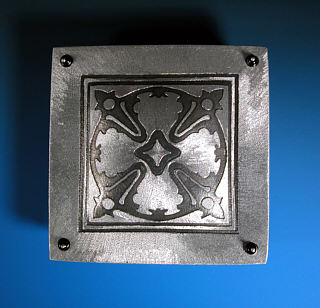 | Eid successfully etched Argentium sterling using ferric nitrate for her Boston Legacy box. |
Reticulation
I have tried to reticulate Argentium sterling by first putting a few pieces of 24- and 18-gauge (0.5 and 1.0mm) Argentium sterling sheet into a kiln for 45 minutes at 1050°F (566°C) to build up a skin of oxides and then applying the torch. I managed to get a few areas of lovely ripples, but nothing consistent enough to encourage me to continue.
Finishing and Tarnish Resistance
Take care that any tool used on Argentium sterling (grinding wheels, files, sandpaper, etc.) doesn't apply residues from other metals to the surface of the Argentium sterling, possibly causing contamination and tarnish. If it isn't possible to have separate polishing buffs, rake the wheels thoroughly to clean them; you can buy a tool made for this or use a clean coarse file or a clean file card. If you do use separate polishing buffs for Argentium sterling, label them and keep them separate from those used for other metals. If you use a brass brush for a soft, satiny finish, always use soapy water as a lubricant to prevent the brass from transferring onto the Argentium sterling.
Just as with traditional sterling silver, ultrasonic solutions should be neutral in pH (a pH of 6-8) for Argentium sterling, since high-alkaline liquids attack sterling alloys and can make the metal look etched or discolored, especially if the ultrasonic cleaner is run over 120°F (49°C). Solutions labeled as neutral are not necessarily so; use your own pH test strips, which are available at pharmacies, aquarium/pet stores, and pool-supply outlets as well as via the Web. Try soaking your piece in the ultrasonic cleaner for a few minutes before turning the machine on; this loosens the polishing compound or dirt so that the metal needs less time in the ultrasonic cleaner.
Argentium sterling's protective germanium-oxide layer forms at room temperature; heating applications, such as soldering and precipita-tion/heat-hardening, accelerate the process. If hardening is not required, or if the work has been abraded or polished after hardening, items can be placed in an oven for 10-20 minutes at 250°F (121°C) to enhance the oxide.
Like any other metal, Argentium sterling can show fingerprints. I have noticed that pieces on which I've used Goddard's Long Shine Silver Cloth or Liquid are more fingerprint resistant. It seems the chemicals in the cloth enhance the nontarnishing properties, though I don't notice any visible difference other than the polishing action. Goddard's Cloth also helps wipe away any surface contaminates or water spots. For optimal tarnish resistance, expose the Argentium sterling to oxygen in a heated environment after the last abrasive process. Goddard's Long Shine Silver Cloth or Liquid can be extra insurance.
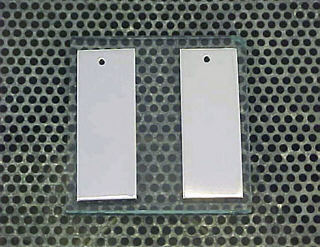 | 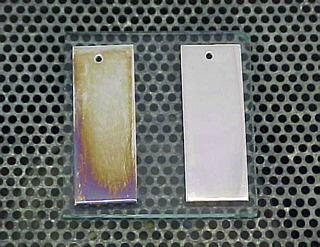 |
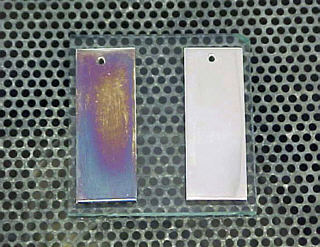 | |
| As a tarnish test, samples of traditional sterling silver (left) and Argentium sterling (right) were exposed to a diluted ammonium polysulfide solution and photographed at 30-minute intervals. | |
Antiquing & Patinas
To darken some of my Argentium sterling pieces, I use a commercial acidic solution, such as Griffith's Silver Black, and apply it with a brush or cotton swab. Liver of sulfur seems to take longer to work on Argentium sterling than on traditional sterling.
Hallmarking & Trademarks
Argentium® Sterling silver is a registered trademark. When marking a piece made with Argentium sterling, the only legal requirement is to stamp it as "925" or "sterling silver," since Argentium sterling is sterling silver. At some point in the future, Argentium sterling suppliers and manufacturers will supply stamps with the Argentium® sterling mark or the artwork necessary to make tags or stamps.
Reclaiming scrap
If you send your scrap to a refiner, it's not necessary, at this time, to keep Argentium sterling scrap separate from traditional sterling scrap. The traditional sterling's properties won't alter until the percentages of the alloys become similar to those of Argentium sterling. If you don't separate your scrap, treat your refined scrap as traditional sterling silver.
Which Metal Is Which?
The only way to tell the difference between traditional sterling silver and Argentium sterling is to use analysis equipment. So, it's important to stay organized if you work with both silvers.
If you can't identify a piece of metal, first sand, scrape, or otherwise abrade the surface to make sure there isn't a fine-silver surface coating. Then heat the metal with a torch, being sure to take the flame off the metal occasionally to expose it to oxygen. If the metal is traditional sterling, it will turn black and stay black. If the metal is Argentium sterling, it may turn black, but as you keep heating, the metal will turn white again.
It can be helpful to test a known piece of each alloy at the same time.
 |
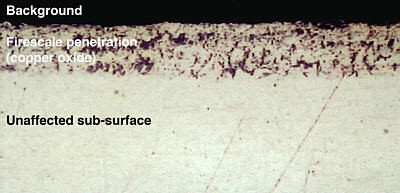 |
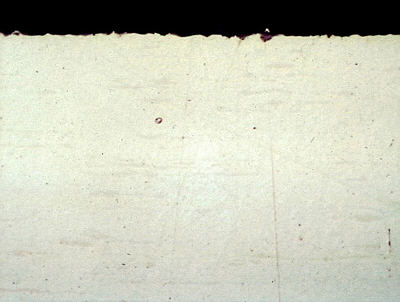
| Microscopic cross-sections of Argentium (1) and traditional sterling (2) heated at 1076°F (580°C) for 1 hour show a marked difference in firescale penetration. |
FAQ: Germanium
 What is germanium? It sounds like a flower!
Germanium (Ge) is an element similar to tin and silicon. (Don't worry, I didn't remember it from science classes, either!)
Why does germanium enable Argentium sterling to be hardened?
The differing crystalline structures of germanium and silver/copper crystal interlock, making the metal harder.
How did germanium come to be alloyed with silver?
A company named Metaleurop, whose primary product was zinc, found that they had a lot of germanium as a by-product of refining zinc ore. In hopes of finding a market for germanium, Metaleurop sent samples and inquiries to people in many different areas of expertise, including Peter Johns at Middlesex University in the United Kingdom.
What is firescale, and how does germanium prevent it?
Annealing or soldering causes traditional sterling silver to form firescale (Cu2O , or cupric oxide). This dark layer is under the surface, and does not come off in pickle. Firescale can be removed by polishing, applying strong acid, or electro-stripping. It can be covered by plating or by depleting the copper from the surface through repeated heating and pickling (often called "bringing up the fine silver").
Germanium prevents oxygen from penetrating the surface of the metal. Since oxygen cannot get inside the metal, Cu2O (firescale) cannot form. Argentium sterling may discolor from soldering or annealing, but the oxide is only on the surface, and it comes off in pickle.

Related Articles

Masterpiece in Metal by Adolphe Himmel

Contemporary Applications of Area Inlay
The Best Jewelry Books: A Comprehensive Reading List For Craftspeople

Optimising Gold Alloys for Manufacturing
The All-In-One Jewelry Making Solution At Your Fingertips
When you join the Ganoksin community, you get the tools you need to take your work to the next level.