Testing ACCU Carve Injection Wax
AJM recently asked two companies, AU Enterprises in Berkley , Michigan , and Racecar Jewelry Co. Inc. in Cranston , Rhode Island , to test out the new ACCU Carve injection wax from KerrLab in Orange , California . Designed for casters and designers who need to rework wax patterns, ACCU Carve is intended to provide carvability in an injection wax, as well as offer low shrinkage, good flow, and low ash content. Using two different methods, the participants put this product to the test. The staff at AU took an experimental approach, reporting on the wax's performance in various categories, while the Racecar staff used the wax to fill a casting order for a class ring. The following are the results of their tests.
7 Minute Read

Editor's Note: AJM recently asked two companies, AU Enterprises in Berkley, Michigan, and Racecar Jewelry Co. Inc. in Cranston , Rhode Island, to test out the new ACCU Carve injection wax from KerrLab in Orange, California. Designed for casters and designers who need to rework wax patterns, ACCU Carve is intended to provide carvability in an injection wax, as well as offer low shrinkage, good flow, and low ash content.
Using two different methods, the participants put this product to the test. The staff at AU took an experimental approach, reporting on the wax's performance in various categories, while the Racecar staff used the wax to fill a casting order for a class ring. The following are the results of their tests.
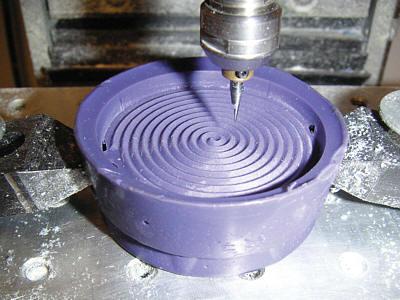 |
| Photo by Linus Drogs |
Test 1 By Linus Drogs, AU Enterprises, Berkley , Michigan
Our objective was to evaluate the physical and mechanical properties of Kerr's ACCU Carve injection wax. To do so, we took a step-by-step approach to a typical casting project and logged our data for each stage of the process, from initial melting of the wax to final casting. The following are the results for each step:
Melting.
ACCU Carve wax has a slightly higher melting temperature than all other Kerr waxes, 174°F (79°C) compared to between 150°F and 160°F (66°C and 71°C). The higher melting temperature provides good workability for applications where it is necessary to add to or adjust wax models. For example, if you take a ring injection with ACCU Carve and find that you need to resize it or retip a prong, you can use a standard injection wax to do the reworking. Because the standard wax has a lower melting temperature than ACCU Carve, you avoid melting the original model during rework.
Furthermore, the higher melting temperature of ACCU Carve ensures that the wax models stay firm during handling. When you rework models made with some of the lower temperature injection waxes, the heat from your hands can soften the wax. Depending on how much hand pressure you use, you can deform the models and leave fingerprints in the wax. The higher temperature of ACCU Carve makes wax models less prone to such defects.
Injecting.
We compared ACCU Carve's wax injection properties to those of other Kerr waxes that we have used. Overall, this wax injects well and has good flow properties.
Because of their higher melting temperature and plastic content, most carvable waxes on the market aren't very fluid, making it difficult to fill mountings of thin to average weight. They usually work better for heavier pieces, such as class rings and belt buckles. Unlike these waxes, ACCU Carve works well for both thin and thick pieces, providing average to above-average fill. Its injection properties are comparable to those of Kerr's Aqua wax.
In terms of detail, ACCU Carve is sharp and above average, but it's not any better than Ruby Red, Kerr's high-detail wax. If you are looking for high-detail and you don't need the carvability, we suggest sticking with Ruby Red.
Other characteristics of note include a great degree of flexibility. Compared to Ruby Red wax, ACCU Carve has a good shelf life. Whereas the Ruby Red can become brittle in just a few days, ACCU Carve stays pliable for much longer. We have models that have sat on the shelf for a month that are still pliable and workable.
Another benefit of ACCU Carve is its dark dye color. The deep purple color is good for inspection, allowing you to examine details and defects that can be difficult to see in lighter waxes. In addition, the dye doesn't bleed or stain the molds like some other waxes do. We've had problems in the past with red wax staining silicon molds; however, we have never tested the long-term negative effects of staining.
Shrinkage.
In general, shrinkage is minimal and comparable to Kerr's other laboratory-grade waxes. Sink (the tendency for large sections of wax to pull in on themselves inside the mold when cooling) is likewise minimal to non-existent, despite the higher injection melting temperature. Sink, which results in a recessed area in the wax, is common on large pieces, such as belt buckles and class rings. But it wasn't a problem with ACCU Carve.
Carvability.
ACCU Carve offers the best carvability we've seen in an injection wax. Besides some minor gumming, which one would expect with an injection wax, it works well with files, carving tools, and even high-speed flex-shaft bits. There's no way it could compare to a standard carving wax because it doesn't have nearly the same plastic content, which prevents gumming.
Milling.
The wax can be milled and used in CAM (computer-aided machining) applications. Our tests show that the material machines better with engraving points than standard end mills.
Casting.
We achieved very good casting properties and smooth surfaces with the wax. It works well with mold releases and has little to no ash residue. It provides a good, clean burnout with less residuals than standard carving wax.
Conclusion.
This is the best carvable injection wax we have ever tested and used.
Test 2 By Daniel Grandi, Racecar Jewelry Co. Inc., Cranston , Rhode Island
Kerr's ACCU Carve wax produces wax models with excellent detail. During the tests conducted in our shop, the wax worked well under standard injection conditions when melted in a wax pot and injected into a rubber mold. It also injected very well in our metal mold injector.
One of the advantages of this wax is its flexibility; it does not become brittle unless it gets very cold. Many hard carving waxes and standard injection waxes are brittle; if you try to bend them to size a ring, they have a tendency to break. This wax is soft and flexible, so you don't have to worry about breaking it unless it gets very cold. For example, if you shoot waxes and leave them overnight in a 50°F (10°C) room, when you try to rework them the next day the waxes will break.
Another benefit of the wax is its easy-to-read color. We work with many different waxes of various colors. In a light yellow wax, it's difficult to see details. But a dark purple wax like ACCU Carve has depth, making the details clearly visible.
The one disadvantage of this wax is that, unlike a hard carving wax, it will clog burs and files. Therefore, you need to use a file cleaning brush on all tools used to carve this wax, which adds time to the process.
The following sample project sums up many of our findings:
School Ring Project
We had an order for a size 8 school ring that we had already made a mold for in a size 10. We had two options for manufacturing the ring: 1. Make a wax pattern for both the size 10 shank and the top of the ring, size the shank, cast the pieces separately, and solder them together. 2. Make a wax pattern for both the size 10 shank and the top of the ring, size the shank, weld the two wax components together, and cast the piece as a whole.
In the past, we have had trouble soldering the cast flat top to the shank, as the two parts of the ring are not a matched set. Therefore, we decided to do most of the work in wax. By using the ACCU Carve wax, we predicted that we could shoot the wax and modify the pattern with ease.
- We started by injecting the shank using a heat-cured silicone mold. We then injected the top of the ring into a metal mold using a high-pressure injector (shown here). Both pieces filled well.
- A benefit of ACCU Carve is its ability to be injected into metal molds, which can't be done with all injection waxes. With this machine, the wax needs to inject out almost like a paste, which requires much lower temperatures and high pressure. Al-though ACCU Carve has a melting temperature of 174°F (79°C), you can bring down the temperature to as low as 150°F (66°C) for injecting metal molds. This enables you to create wax models with extremely fine detail, such as the ring top for this class ring. If you use hot wax in the same machine, the wax sinks and the detail is lost.
- . We cut down the shank to the correct size, from a size 10 to a size 8, and welded it closed using a wax pen. As previously stated, this would be difficult to do with some standard injection waxes because of their brittleness; ACCU Carve is flexible enough for sizing.
- Using a side-cutting bur (you can also use a wax file), we cleaned up the weld mark on the inside of the wax shank. The wax responded well to cutting; however, it did clog the bur.
- We then welded the top of the ring into the top of the shank. This was done using a temperature-controlled wax pen. It welded easily.
- With the top welded in place, you can see the fine detail achieved in the metal mold injection.
- We filed off the excess wax from the top of the ring.
- We cast the silver ring successfully-and eliminated the need for a tricky soldering operation. In addition, since we did not have to use solder on the ring, it will be easier to size in the future.

In association with

The award-winning Journal is published monthly by MJSA, the trade association for professional jewelry makers, designers, and related suppliers. It offers design ideas, fabrication and production techniques, bench tips, business and marketing insights, and trend and technology updates—the information crucial for business success. “More than other publications, MJSA Journal is oriented toward people like me: those trying to earn a living by designing and making jewelry,” says Jim Binnion of James Binnion Metal Arts.
Click here to read our latest articles
Click here to get a FREE four-month trial subscription.
Related Articles

Identifying and Preventing Wax Defects

Popular Textural Wax Patterns

Foredom Milling Assembly for Wax Components

Manufacturing a Free-Form Pendant

The All-In-One Jewelry Making Solution At Your Fingertips
When you join the Ganoksin community, you get the tools you need to take your work to the next level.