Tweezers Tips and Tricks
Tweezers are a constant in a jeweler's life, particularly in these safety conscious times. Tweezer use can help reduce your contact with nasty dermatitis causing chemicals. For example, when used for handling objects in solutions such as pickle, soap, and cleansers, tweezers limit potential damage to your skin.
2 Minute Read

Tweezers are a constant in a jeweler's life, particularly in these safety conscious times. Tweezer use can help reduce your contact with nasty dermatitis causing chemicals. For example, when used for handling objects in solutions such as pickle, soap, and cleansers, tweezers limit potential damage to your skin.
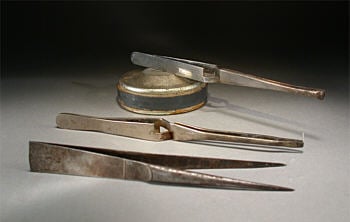
Tweezers are also one of the more easily adaptable tools at the bench. For example, they can be altered to hold together stone setting components, or heads and rings, while soldering. Here are a few of my favorite tweezers and modifications:
Normal hand-held tweezers for soldering are most useful if they consist of 8 inches of good, solid metal. My favorite pair are stainless steel bench tweezers from Germany. It might be noted that the Indian style soldering tweezeris excellent; it has a heavy, thick end to grip during use so your fingers don't get hot.
One of my favorite tweezer tricks is done using a wide-jawed self-locking tweezer-the type that is normally chrome plated. You can alter this tool to pick up earring posts from a flat surface at a 90o angle. There is no skill required to snap the posts into place in the tweezer jaws, making production soldering of earrings much faster and more efficient.
To create this tool, open the ends of the tweezers and file a groove into each side of the jaw with a triangular needle file. Start close to the end of the tweezer. The grooves must be in the same location on both sides so they line up with each other. Also, the grooves should not be too deep-no more than 0.5 mm, and even that is probably a bit too deep.
Once the grooves are made, file the outside of the jaws. Form a beveled front end that slopes down toward the very top edge of the grooves. With the ends filed at such an angle, they can smoothly grasp an earring post lying on a flat surface and guide it into the groove in the tweezer ends. You can then use the post to pick up a solder chip, melt the solder onto the post, and solder it to the earring back.
Numerous grooves, slots, and holes can be made in tweezers to hold various assemblies together while soldering. If the tweezers are made of titanium, or if titanium ends are attached to self-locking tweezers, they cannot be soldered onto the piece you are working on, and thus make a superb soldering jig. (Note: If you are working with platinum, use tungsten welding rods to make tweezer ends, as other metals can contaminate platinum at high temperatures.)
To use these types of tweezers as soldering jigs, position them on a large, strong magnet on your soldering bench: Just clamp the backs of the tweezers to the magnet at a useful angle.
I found the perfect magnet for this purpose inside an old stereo speaker unit. Just drill out the mounting spots attaching the magnet to the frame (while wearing safety equipment), and you have a great platform for your tweezers.
Related Articles

Frequently Used Wax Tools

3M Bur and Polish Wheels

Steps for Graver Preparation

Conversion of Dental Tools Into Wax Engraving Tools


The All-In-One Jewelry Making Solution At Your Fingertips
When you join the Ganoksin community, you get the tools you need to take your work to the next level.