Enhancing the Stone – An Update on Diamond Treatment
A summary of the most common treatment techniques used on diamonds, how they are identified by trained gemologists, and what potential problems they present to manufacturers, retailers, and bench jewelers.
8 Minute Read

As long as there have been gemstones, there have been attempts to improve their appearance. With the advent of numerous new technologies available to diamond merchants, those efforts have become increasingly sophisticated and harder to detect. Most of the treatments discussed in this article have been around for a decade or more. Others, such as high-pressure high-temperature treatment, appeared on the market only recently. But no matter what the treatment, technology doesn't stand still, and even familiar treatments offer new, improved versions.
The following is a summary of the most common treatment techniques used on diamonds, how they are identified by trained gemologists, and what potential problems they present to manufacturers, retailers, and bench jewelers.
High-Pressure, High-Temperature (HPHT)
What is it?
In this treatment, diamonds are subjected to high temperatures (1,9000C to 2,1000C/3,4520F to 3,8120F) and high pressures (6 gigapascals), using diamond synthesizing equipment. The heat and pressure simulate conditions during a diamond's formation in the Earth, and can cause alterations in the diamond's structure and appearance. Whether a color change takes place, and what the change may be, depends on the diamond that is selected for treatment. Some diamonds become colorless, while others change to yellow, greenish-yellow, yellowish-green, blue, or pink. HPHT is used primarily on higher-clarity diamonds, since inclusions can turn dark or cause fractures during the treatment process.
Variations
Although some gemological laboratories have been aware of this treatment since the mid 1990s, the process was introduced to the jewelry trade in 1999 by General Electric and Lazare Kaplan International, which created a subsidiary called Pegasus Overseas Ltd. (now Bellataire Diamonds) to market the treated gems. Since then, several other companies have begun offering HPHT treatment services to the trade, including Novatek of Provo, Utah, and Phoenix Crystal Corp. of Ann Arbor, Michigan. Each company uses its own proprietary process.
How common is it?
The HPHT decolorization process is effective in only a small number of diamonds, making the treatment relatively rare in the diamond market as a whole. However, among certain populations of colored diamonds, such as yellow-green diamonds, the percentages that have been subjected to the HPHT treatment may be significant.
How is it identified?
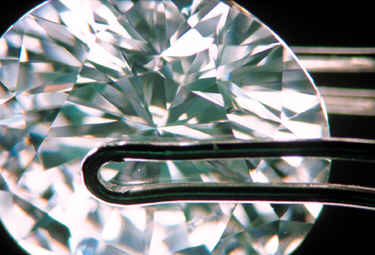
Conclusive identification of HPHT treated diamonds requires low-temperature visible and photoluminescence spectroscopy, techniques normally available only in gemological laboratories. Some visible signs that a colored diamond warrants further investigation include high saturation and darker tones of color; noticeable banded internal graining (in a colorless diamond); the presence of graphitized "feathers"; and altered inclusions with surrounding radial fractures. HPHT treated colored diamonds can also show distinctive fluorescence reactions to long- and short-wave ultraviolet radiation.
To simplify detection of HPHT treated diamonds, several treaters include a laser inscription on the girdle of the stone for easy identification. However, GIA reports seeing several that have no identifying inscription. In addition, not all treaters are using such identification methods.
Potential problems
The primary concern with the HPHT treatment is misrepresentation, since treated diamonds can be difficult to detect. Misrepresentation and/or non-disclosure of these treated diamonds could also affect natural diamond prices. The HPHT treatment is considered permanent, and there is no evidence that the treatment makes the stone any more susceptible to damage during routine repair operations.
New developments: Initially, General Electric and Lazare Kaplan utilized HPHT treatment to remove color from brown type IIa diamonds, resulting in colorless or near-colorless gems. Further work has produced certain type I and type II diamonds in a wide variety of colors, including yellow, yellow-green, pink, and blue.
Clarity Enhancement
What is it?
A high refractive index glass is introduced into surface-reaching feathers to reduce their visibility. The treatment is most effective on very thin cracks, since the filling material is more visible in cavities, laser drill holes, or other gaps.
Variations
Several different companies offer clarity enhancement services, each using their own proprietary filling material. However, all filling materials are detected in the same way.
How common is it?
First marketed in the U.S. by the Yehuda Diamond Co. in 1988, clarity enhancement is one of the more common diamond treatments. Thousands of carats of diamonds are treated each year by several different companies, including Yehuda, Oved Diamond Co. in New York City, and Leshem Diamond Co. in Taos, New Mexico.
How is it identified?
A "flash effect" can be seen when observing the diamond nearly parallel to the plane of the filled fracture. The flash effect usually appears blue against a bright background, and yellow or orange against a dark background. It does not include a full spectrum of color, but is normally just the two colors. This optical effect can best be seen with 10x magnification under a focused beam of intense light.
Potential problems
The filler is stable under normal wear conditions, but it may be damaged by high heat or acids, which are normally used during repair processes. If the filler is removed or damaged, the feathers will become more visible. Such damage can be avoided by removing clarity enhanced diamonds before repair work is done near the diamond. If damage does occur, many clarity enhancement companies will re-treat the diamond at no charge.
New developments
In 2000, the Oved Diamond Co. introduced a clarity enhanced stone they claimed was more durable and less likely to be damaged if exposed to heat, such as during repair work. A study of the stones conducted by GIA and published in the Summer 2000 issue of Gems & Gemology suggested that the new filling was indeed less vulnerable, but determined it could still be damaged by direct heat. The authors of the study recommended that all filled stones continue to be removed prior to repair work to avoid damage.
Laser Drilling
What is it?
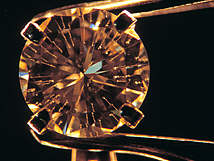
In the traditional method, a laser is used to burn a tiny channel in the diamond until it reaches a dark inclusion. These inclusions may be vaporized by the laser, or the resulting channel is used as a conduit for introducing an acid, which bleaches the inclusion. The resulting white inclusion is generally considered more acceptable than a dark inclusion.
Variations
Laser drilling is also sometimes used to provide a conduit to non-surface reaching feathers, so clarity enhancement techniques can be used.
How common is it?
Laser drilling is one of the more common treatments seen in diamonds. Although GIA estimates that laser drilled stones represent only a modest percentage of diamonds in the market, they are common enough that such stones are seen daily in the GIA Gem Trade Laboratory.
How is it identified?
Laser drilling is normally detected by observing drill holes during microscopic examination under darkfield, brightfield, and/or fiber-optic illumination.
Potential problems
Laser drilling is permanent, and normally causes no damage other than the drill hole itself. However, new techniques that create or extend feathers produce new structures within the stone, which, like natural feathers, may be sources of internal tension and breakage.
New developments
In recent years, new laser techniques have resulted in features that appear as white, irregular, wormhole-like lines, or larger areas with numerous small feathers in a step-like progression to the surface, instead of a straight, round drill hole. In addition, many of these lines are completely internal; only the feathers reach all the way to the surface. These internal laser drilling channels are more difficult to see than traditional straight drill holes, and are more easily mistaken as natural features in the diamond. Microscopic examination is necessary to identify these laser drilled stones.
Irradiation
What is it?
Diamonds are exposed to a source of radiation to improve or introduce color.
Variations
Artificial irradiation is typically performed on cut stones, although rough diamonds may also be irradiated. This treatment (in some cases followed by heat treatment) is used to produce blue, green, pink, yellow, greenish-yellow, brownish-orange, and black colors.
How common is it?
Artificial irradiation has been used commercially since the 1950s to produce colored diamonds, and it's still fairly common. However, HPHT treatment seems to be surpassing irradiation as the favored color treatment for diamonds.
How is it identified?
Some natural and treated colored diamonds get their color from radiation exposure: Natural-color diamonds are subjected to irradiation while still in the Earth, while treated diamonds are irradiated in the laboratory. This makes conclusively identifying the source of a diamond's color challenging in some cases. Radiation treatment may produce subtle color zoning and distinctive ultraviolet fluorescence reactions. Additional information is obtained from visible and infrared spectroscopy. These tests can only be performed with sophisticated equipment, however, which is normally only found in gemological laboratories. As a result, and because natural-color diamonds frequently sell for premium prices, these stones usually should be sent to a gem lab for conclusive testing.
Potential problems
Irradiated diamonds are normally stable to ordinary wear. However, some artificially irradiated and natural-color diamonds, particularly green diamonds, may change color if subjected to the heat of a jeweler's torch. This color change is permanent. As a result, it is recommended that jewelers remove colored diamonds before undertaking repairs.
New developments
Artificial irradiation has been used for almost 100 years to produce colored diamonds. Historically, gemstone irradiation was carried out in a cyclotron or nuclear reactor, or by using radioactive salts. Today most treatment involves the use of a linear accelerator.
Coatings
What is it?
Diamonds are sometimes coated with various substances to produce a fancy color, or to make a pale yellow or brown diamond look more colorless. Coatings are thought to range from fingernail polish to optical materials similar to those used on camera lenses.
Variations
The coating may cover the entire diamond, or only a portion of it. For example, a transparent bluish coating around the girdle of a very light yellow diamond may make the stone appear two to four color grades better than its true grade.
How common is it?
Coated stones are rarely seen by gem laboratories, although instances of fraud involving coated diamonds do occasionally occur.
How is it identified?
Coatings are easily identified by gem labs and by trained gemologists in the field. Magnification under a variety of lighting conditions, especially diffused light, will often reveal the coated surface. Coatings may also be scratched or dissolved in alcohol, which normally would not affect a natural diamond.
Potential problems
Coatings can wear off during normal wear, so reputable diamond dealers generally avoid this treatment. As a result, coated diamonds are often seen misrepresented to unsuspecting buyers as being untreated.
New developments
Although gem laboratories can identify that a diamond has been treated, they normally cannot identify what the coating is. Therefore, it is difficult to identify when a new coating is introduced into the market.

In association with

The award-winning Journal is published monthly by MJSA, the trade association for professional jewelry makers, designers, and related suppliers. It offers design ideas, fabrication and production techniques, bench tips, business and marketing insights, and trend and technology updates—the information crucial for business success. “More than other publications, MJSA Journal is oriented toward people like me: those trying to earn a living by designing and making jewelry,” says Jim Binnion of James Binnion Metal Arts.
Click here to read our latest articles
Click here to get a FREE four-month trial subscription.
Related Articles

The Treatment of Gemstones
Detecting Golden Pearl Color Enhancement

Handling Colored Stones at the Bench Part 4

A Crowning Achievement Part 2

The All-In-One Jewelry Making Solution At Your Fingertips
When you join the Ganoksin community, you get the tools you need to take your work to the next level.