Handmade Acetate Spectacle Frames
describe here some broad practical steps in making an acetate spectacle frame by hand. For a brief comparison let's consider the way acetate frames are often made. In the spectacle industry the typical factory set-up involves dozens of pre-set routing and heat-forming/embedding machines to produce each frame design. Designs must be guarranteed of commercila success to pay for this huge set-up cost, and must fit into the parameters of the machinery. Making by hand has all the attributes and advantages that a factory cannot afford: greatest flexibility of design, quickest speed of reaction to customer/market requirements, and total uniqueness. The downside is that handmade frames take time to make, the runs are small, and the maker must be skilful. Sound familiar? Let's press on undaunted anyway; the rewards are fulfilling.
5 Minute Read

I describe here some broad practical steps in making an acetate spectacle frame by hand. For a brief comparison let's consider the way acetate frames are often made. In the spectacle industry the typical factory set-up involves dozens of pre-set routing and heat-forming/embedding machines to produce each frame design.
Designs must be guaranteed of commercial success to pay for this huge set-up cost, and must fit into the parameters of the machinery. Making by hand has all the attributes and advantages that a factory cannot afford: greatest flexibility of design, quickest speed of reaction to customer/market requirements, and total uniqueness.
The downside is that handmade frames take time to make, the runs are small, and the maker must be skilful. Sound familiar? Let's press on undaunted anyway; the rewards are fulfilling.
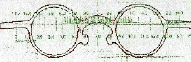 |  |
| The basic drawing, and a photo of a finished acetate frame. | |
I'm assuming prior knowledge of where and how the frame is to basically sit on the head to allow the frame-held lenses to be propped in front of the eyes in a relatively comfortable manner. Frames can have nose-pads, temple-tips, hinges. Or they can have none of those. As a designer you might like to question and redesign these. But ultimately if a frame is to be worn for a time comfort will be a major design factor. If any of you are spectacle wearers, you'll understand about daily comfort.
But then again you may be making a frame for short-term use, and will be satisfied with minimal features for fitting the frame.
Another assumption I'm making here is about suppliers of acetate sheet and hinges and other useful spectacle parts. I may in the future be called upon to write a Suppliers listing. My own suppliers are necessarily local, so it may well be that if some of you were to contribute to a pool of spectacle/optical suppliers information I could collate a full listing that would be useful world-wide.
Acetate for spectacles
Cellulose acetate comes in sheets of various thicknesses - 3.5mm to 6mm or more. The type we used on the spectacle-making workshops here in January '96 was donated by a small New Zealand factory. It is made by a manufacturer in Italy and is produced by them in a variety of transparent, opaque and variagated designs. This from the manufacturer's information pamphlet: "Cellulose acetate has a good resistance to water, low concentrations of acids, bases, and inorganic salts, parraffinic hydrocarbons, high m.w. alcohols, oils and fats. In contact with boiling water some whitening can arise. Soluble in ketones and esters. Soluble in ketones and esters. Strong acids and bases, pure or concentrated oxidising salts, can cause chemical degradation. …
As regards the continuous use in contact with skin, typical in the use of spectacle frames, it is possible to note the following: there have been cases of contact dermatitis, generally coused by excessive pressure with consequent mechanical abrasion; these cases are not frequent and are of limited seriousness, which normally recede of their own accord often simply by re-adjusting the frame. The substitution of the frame with one of different composition is rarely necessary. None of the components of this acetate sheet is a source of frequent or significant irritations to the skin at least under normal conditions of use. As in the case of any plastics material or metal, we cannot exclude an exceptional reaction, which could necessitate the substitution of the type of material."
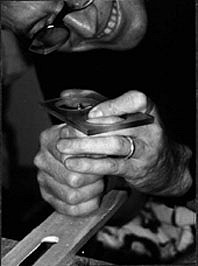 | Vee-routing the lens groove in acetate sheet - instructor Brian Adam. Spectacle-making Workshop, Baltimore MD, June 1996 |
Hand-making method
Here I'll describe a fairly traditional hand-making technique where the acetate sheet is cut, shaped, heat-formed, and solvent-welded. By 'traditional hand-making technique' I mean a series of steps that most "object-makers" would be quite familiar with - jewellers, modellers, sculptors, etc. This acetate sheet I speak of may also be two or more different-coloured sheets fuse-laminated together: solvent-fusing sheets together without trapping air bubbles is very difficult, so I recommend restricting your first attempts at laminating to small sheet areas.
Cut your shape from the acetate sheet
Use a jewellery saw with a wax-cutting blade
Weld together any joints
You might be building up layers, making corners, adding nose pads, adding contrasting colours. Wet the parts with acetone solvent and hold with light pressure for 20 seconds and leave for 24 hours to cure
Heat-form
Curve parts to fit the face - little 'bumps' for the bridge of the nose, corners, shaping to suit the lens curve. At 110°C - 130°C (230°F - 260°F) the 'plastic memory' is overcome and reset to a new shape. Otherwise the acetate will try to return to its original shape (ie the shape that was previously set at over 110°C) Heat source: 50/50 water/glycerol, moving air, or hotplate
Cut the lens groove 90° - 110°. Rout with a vee-cutter, preferably with a limiting device attached, to ensure the vee is cut about 2mm from the front face - I have used a fairly standard 90° hart burr with some success.
File and sand With enough time the solvent-joins will be as solid as the sheet base. Use carving and engraving tools and a succession of rasps, files, emery paper to get the surface you want
Finish
Buff polish (slowly), tumble polish, or solvent-polish
Fit hinges
Make your own from acetate and fuse them on, or fabricate from another material and rivet, or heat-embed your own or standard-supply parts
Sunglass lenses: cut the lenses
I use hard resin opthalmic lenses (98% UV blocking), 'plano' (no correction). I cut with a jewellery saw (3/0 blade), file and sand an edge bevel
Dye those lenses
Dip in water-soluble lens-dyes, or hot fabric-dyes
Pop the lenses in
The lenses should be ever so slightly oversize. The frame is first softened (to about 70 - 90°C) by hot air, water, or a tub of hot salt
Frame adjustments
Adjustments for different heads are usually made by bending or filing. Bending: the acetate should be heated to at least 110°C to make a permanent change to the plastic memory. Filing: adjustments are made by filing small amounts from the temple/sidepiece at the point of the hinge-stop so that the hinge opens out wider.
Can these hand made frames accept your prescription lenses?
If the eye-rim has a reasonably deep and straight vee groove cut in it for a lens then almost any type of prescription lens may be fitted by a dispensing optometrist that is willing to hand-cut the lenses.
Related Articles

Scoring and Bending
Making a Crown Using Welding Technology

Chain and Bracelet Catches 2

Working with Jewelry Hinges Made Easy

The All-In-One Jewelry Making Solution At Your Fingertips
When you join the Ganoksin community, you get the tools you need to take your work to the next level.