Corundum: Rubies and Sapphires
Rubies and sapphires are the same mineral: corundum, with different trace minerals creating a wide variety of color. Rubies and sapphires have been treasured for thousands of years. They were named long before anyone realized they were the same mineral. In this text, rubies include all corundum with a red hue predominant; sapphires include all the corundum of all other hues. Nevertheless a world wide debate rages about the definition of ruby. American and European gem dealers contend that "ruby" only included red, not lighter shades such as pink corundum. The Asian dealers argue that.
13 Minute Read
Rubies and sapphires are the same mineral: corundum, with different trace minerals creating a wide variety of color. Rubies and sapphires have been treasured for thousands of years. They were named long before anyone realized they were the same mineral.
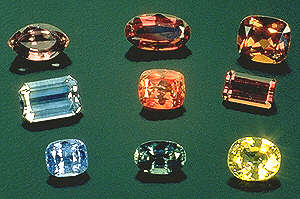
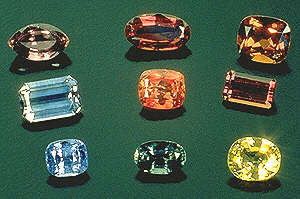
| Corundum comes in many colors (Photo by ICA/Bart Curren) |
In this text, rubies include all corundum with a red hue predominant; sapphires include all the corundum of all other hues. Nevertheless a world wide debate rages about the definition of ruby. American and European gem dealers contend that "ruby" only included red, not lighter shades such as pink corundum. The Asian dealers argue that there is not a differentiation between light blue and dark blue sapphires so why should this distinction exist for light and dark red stones? The issue has not been settled. Western dealers contend the only reason to give a stone the "ruby" label instead of calling it "pink sapphire" is to sell for a higher price. But we will go along with the Oriental philosophy since most rubies are mined and cut in the Orient.
| Colors: | All colors |
| R.I.: | l.76 - 1.78 |
| Durability: | Tough |
| S.G.: | 3.9 - 4.1 |
| Treatment: | Assume heating, (rarely surface diffusion for sapphires, oiling for low quality rubies) |
| Hardness: | 9 |
| Availability: | Fine rubies up to five carats; sapphires up to ten carats |
| Localities: | Ruby: Myanmar (Burma), Thailand, Africa, Vietnam Sapphire: Myanmar, Thailand, Australia, Sri Lanka, Montana, Tanzania |
| Price: | Low to very expensive |
| Common shapes: | Ovals, cushions, pears, emeralds cuts and others |
Rubies and sapphire are exciting gemstones; they come in a great variety of colors, shapes, and sizes, and some even display stars. Corundum has a hardness that is just below diamond. In fact, corundum is quite tough; they do not have cleavage so breakage is less of a problem. Of course, it is possible to chip or break a ruby or sapphire; this is true with any gem material.
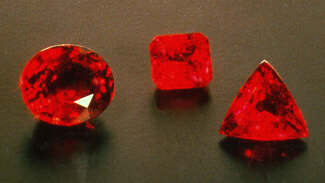
| Ruby, Tanzania (Photo by ICA/Bart Curren) |
Rubies
Rubies of fine quality are truly rare stones and command a price commensurate with their rarity and demand. Ancient Hindus valued ruby more than any other gems and named it accordingly "ratnaraj" or "king of precious stones". The purity of its red color defines the top quality rubies, which do not have any violet, orange, brown or blackish overtones. The best stones will not appear too dark or be diluted in color.
Rubies will have microscopic inclusions, these are not detrimental if they do not detract from the brilliance of the gem and are not eye visible. The inclusions in a ruby will identify its origin; they provide clues to separate natural stones from synthetics. Nearly all rubies are heated; this brightens some stones so it is tried on all of them. The presence of rutile needles as inclusions in the ruby may indicate the ruby has not been treated. If these non-treated rubies have fine color, good clarity and are well cut, they will command a top price because they are very rare.
Burmese rubies are considered to be the best when they have fine red color; most Burma rubies tend towards a pinkish color. The best stones are truly rare. Unheated Burmese stones may contain "silk"; silk is very short fine rutile needles that form at 60 degree angles to each other. When heated the silk burns out or alters, so silk can be positive value factor. Unheated rubies command a premium price. If there is a lot of silk the stone will show a six-rayed star when it is cut into a cabochon. Star rubies are judged by the strength and sharpness of the star, the body color, and the transparency of the stone. If you are looking for a fine ruby do not reject stones with microscopic flaws if they do not diminish the brilliance. Some rubies may be slightly hazy because of microscopic inclusions; each stone must be judge on its beauty. Natural rubies normally have inclusions.
| Ruby photo by ICA/Bart Curren |
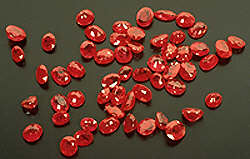
It is not unusual to find fine rubies that are not symmetrically cut. High quality ruby rough is extremely costly and cutting to ideal proportions will often be sacrificed to increase the finished weight of the finished stone. Generally the crown portion will be symmetrically cut; pavilions may be askew. It is best to buy fine rubies as loose stones so that you can examine the color and cut thoroughly. Rubies may have a shallow cut that sacrifices brilliance if the rough material was on the dark side or the rough did not have sufficient depth. When making a decision to buy a ruby you must look at it face up and judge its overall beauty: an asymmetrical pavilion may not detract from brilliance. Occasionally Burma rubies have irregular zones of color. This detracts from the value even if they are not visible in the face-up position but if the stone faces up well it may be a good buy if the price is lower than the price of an unzoned top color ruby.
The majority of rubies on the market today are mined in Thailand near the Cambodian border. Very fine Thai rubies do exist; but the majority are a darker color that lacks the intensity of the finest Burma rubies. They often have a slightly black, brown, or violet overtone. Thai rubies often have fewer inclusions than Burma rubies but Thai rubies are routinely heated, so inclusions are minimized.
African rubies from Kenya and Tanzania are not as common on the market in the United States as Thai rubies. Most African rubies are fairly heavily included and are cut into cabochons; a few are transparent enough to cut beautiful faceted stones. African rubies are often a fine intense red color. Some tend towards an orange red color.
Sri Lanka mines rubies along with sapphires; these rubies usually do not have an intense red color but tend towards less saturated pink shades.
Small rubies under a half-carat in size, are quite plentiful and will fall into the low or moderate price range depending on color, clarity and cut. Larger stones fall into the expensive per carat price range if the quality is high. Rubies weighing over five carat sizes are extremely rare in top grades and even in medium grades.
Small rubies are available in a wide variety of shapes; rounds, navettes or marquise, pears, ovals, squares, hearts, baguettes, triangular shapes, and emerald cuts. Large rubies are most often cut into ovals and cushions. Rounds, emerald cuts, and hearts can be found, but it might take some searching to find a particular quality in a fancy shape.
If you are looking for a ruby, be sure and view the stones under different lighting conditions. Rubies with an intense red color under store spotlights may appear less intense in more normal lighting. If the stone is dark, it should be less expensive than the truly intense medium red colors.
What if the stone is pink? If you like pink, then this is good. Very intense pink colors will fall into the expensive range if the stone is eye clean and well cut. Pastel pinks will generally fall into the moderate price category. It is acceptable for the seller to call these colors either "pink sapphire" or "pink ruby," as long as the price is fair. If the stone is more violet in hue than red it truly belongs to the sapphire category. The same is true for a stone that is more orange than red.
Sapphire
Sapphire, unqualified, usually refers to blue sapphires from pale to dark blue. Sapphire also includes all the other colors of corundum except red. Colors other than blue are called "fancy sapphires."
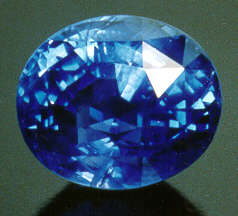
| (Sapphire, 30.73 carats, Sri Lanka. Photo by ICA/Bart Curren) |
Blue Sapphires
The finest color of sapphire regardless of origin, is an intense medium dark blue, without overtones of green or violet. Did we say intense? We are talking about a color that appears to be electric, not just pleasing but a pure, exciting blue. Chances are you have not seen an example of a very fine sapphire: they are extremely rare! Nice medium dark blue sapphires can be found and very dark and very light blue sapphires are fairly common. The best examples of sapphire are found in Kashmir in the Himalayas at an elevation of about l5,000 feet. These sapphires have been mined for centuries, but not in any organized manner. There has never been a plentiful supply, so there are very few of any quality on the market. Kashmir sapphires are distinguished by a slight sleepiness or velvety appearance caused by characteristic minute inclusions.
Burma also produces fine sapphires that will fetch top prices in the best qualities. Burmese sapphires can be found in a pure electric blue color. If unheated, they may have very small rutile needles similar to those found in Burma rubies that can indicate Burma origin.
Most of the exceptional sapphires available today are mined in Sri Lanka where there is a fairly consistent supply. These are sometimes still called Ceylon sapphires even though the country changed its name to Sri Lanka many years ago. Although each source produces a variety of qualities, fine Sri Lankan sapphires often have a fine pure blue color and are fairly clean, most Sri Lankan sapphires stone are heated to clarify them.
Australia produces the largest quantity of sapphires; some fine specimens are mined, but most of them have visible overtones of green or they are too dark.
Thailand mines sapphires that are quite blue; they also tend to be on the dark side.
In Cambodia, "Pailin" sapphires are mined when there is not political upheaval in the country. These can be very fine blue although sometimes a little dark.
Montana has fine blue sapphires from Yogo Gulch, which is one of the world's largest deposits. Yogo sapphires, unlike most of the other sapphire deposits in the world, occur in hard rock and they are very difficult to mine. These stones are generally quite small and the supply is unsteady.
| (Photo by ICA/Bart Curren) |
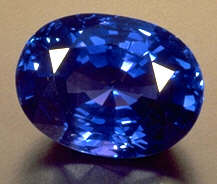
If you are in the market for a sapphire, take some time to see what fine sapphires really look like. Most of the sapphires you will see on the mass market are Australian stones that are very dark and have green secondary colors. Some are a very dark color that appears almost black; these should fall into the low to moderate price range. Really fine sapphires are blue and they appear blue under any lighting conditions. If a stone is too dark it will look black in dim light while the finer colors will still look blue.
Many sapphires are color zoned; Australian stones are typified by concentric hexagonal bands. If this detracts from the beauty of the stone the value goes down. Sri Lankan sapphires sometimes have a small spot of intense blue color in an otherwise colorless crystal. Expert Sri Lankan cutters can cut these so the stone faces up a marvelous blue color; these are referred to as "bluff stones." If a bluff stone is mounted it may be impossible to see the zoning. A bluff stone should be priced much lower than one of similar color that has an even overall color.
Pricing of sapphires is very complex. Purity and intensity of the blue color is the first consideration; secondary colors of green or violet or overtones that make the stone appear grayish will lower its value. Lightness or darkness is a factor; as the stone varies from a medium dark blue, to either light blue or dark blue, the value falls. Good clarity is essential to the value, although microscopic inclusions will not detract. Cutting must be a consideration to create the beauty of the stone. Avoid excessively deep stones because they are hard to set. Deep stones should cost less per carat since they are heavier than they should be.
A variety of sizes are available in sapphires. Small sapphires are readily available and fall in the low to moderate classification. All shapes are available. In larger sapphires all qualities are possible; but very fine stones are rare and will fall in the very expensive range. Most fine sapphires will be cut into oval or cushion cuts.
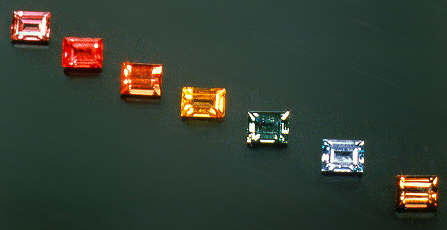
| Fancy Sapphires, Umba Valley, Tanzania (Photo by ICA/Bart Curren) |
Fancy Sapphires
All the other colors of sapphires-violet, orange, green, yellow, brown and black and all colors in between-fall into the "fancy sapphire" category. All prices and qualities are possible in fancy sapphires.
The most expensive of the fancy sapphire is the padparadscha which is derived from the Sinhalese word for "lotus blossom." The original padparadscha is a delicate orange-pink color that is principally mined in Sri Lanka. Today the term is used to describe all pink-orange to red-orange and orange sapphires. Top quality padparadscha sapphires are truly rare and command a very expensive price per carat. Top stones have a very intense orange-pink color. Prices drop as the stones become more pale. Clarity and cutting will be a factor in valuing but they are secondary to the color.
Violet sapphires can be beautiful gems. Since they do not fall in the ruby or blue sapphire category they are much lower in price. They are one of the bargains in the sapphire market. Most violet hued sapphires will show some sort of color change when they are viewed under daylight and incandescent light. If you are looking at violet sapphires it is essential to look at it under different lighting conditions. Most violet sapphires will fall into the moderate category although an exceptional stone may be expensive.
| (Photo by ICA/Bart Curren) |
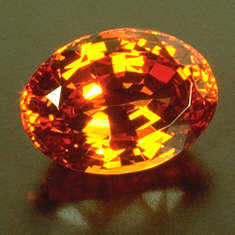
Yellow and gold color sapphires are readily available. These are mined in Australia, Thailand, Sri Lanka, and Tanzania. Yellow sapphires are available in a variety of sizes. Colors range from pale yellow through an intense golden yellow to an amber color. Many yellow stones were heated from Sri Lankan "Geuda" material; these stones are colorless when mined and turn yellow or blue when heated. Prices on yellow stones will vary from moderate to expensive depending on saturation of color, size, clarity and cutting.
Green sapphires are abundant from Australia and Thailand. The color of green is usually a dull green resembling an Army uniform green, almost a jungle camouflage color. If this has not created an exciting image, remember beauty is in the eye of the beholder. Most green sapphires will fall into the low to moderate price range; supply is adequate to meet demand. Occasionally there are some more interesting and attractive shades of green sapphire and each becomes an individual case to consider for valuation. An exceptionally pretty stone could fall into the expensive category.
All colors are possible in sapphire; sapphires mined in the Umba Valley in Tanzania come in the most unusual and exotic colors. Values of these will depend on intensity of color, size, clarity and cutting. In general they will run from moderate to very expensive in per carat price.
Star sapphires
Star sapphires have six rayed stars; this is called asterism. It occurs when there is sufficient rutile-tiny needles of titanium-in the stone. The rutile reflects light into a six rayed star. On a natural star sapphire you will need a pinpoint light source to observe the star. Synthetic star sapphires exhibit their stars under any lighting condition: some look painted on: they don't move with the light.
Star sapphires occur in a variety of colors. The most common star sapphire is a black star sapphire; these are opaque in body color and can exhibit a well defined star; Most of these are small and are low in price. Larger black stars, if fine in quality may be moderately priced. Blue, gray, pink star sapphires and star rubies can also be found.
To evaluate a star sapphire, color is the first consideration. A highly saturated color will command the highest price uneven concentrations of color in the stone lesson its value. Translucency is also critical, the more transparent the stone, the higher the value, if the star is sharp. Most star sapphires show visible hexagonal banding; this may detract from the stones beauty. Those with minimal banding will command the highest price. If flaws are visible they detract from the stones beauty and value. The definition of the star and centering of the star is important. Are the rays of the star straight? Wobbly legs are discounted. Cutting is important also; if the stone is cut excessively deep, the per carat price should be less. As you see, evaluating a star sapphire is complicated! Pricing will be equally complex but will fall into the moderate to expensive categories.
Photographs: Bart Curren and ICA Gembureau ; Alex Edwards, Pearl Sales Institute ; David Dikinis
You assume all responsibility and risk for the use of the safety resources available on or through this web page. The International Gem Society LLC does not assume any liability for the materials, information and opinions provided on, or available through, this web page. No advice or information provided by this website shall create any warranty. Reliance on such advice, information or the content of this web page is solely at your own risk, including without limitation any safety guidelines, resources or precautions, or any other information related to safety that may be available on or through this web page. The International Gem Society LLC disclaims any liability for injury, death or damages resulting from the use thereof.
Related Articles

Morro Redondo Tourmaline
Jade – Jadeite and Nephrite
The Four Cs of Gemstone Valuation

Yellow-Green and Green Beryl

The All-In-One Jewelry Making Solution At Your Fingertips
When you join the Ganoksin community, you get the tools you need to take your work to the next level.

Trusted Jewelry Making Information & Techniques
Sign up to receive the latest articles, techniques, and inspirations with our free newsletter.