Tubing Cutting Method
A jeweller and goldsmith has to cut tubing fairly regularly. My favorite methods include: cutting only on the upstroke using a jewelers sawblade; using a separating disc; rolling the tube with high pressure under an X-acto knife or sharp blade, then snapping the tube-this works pretty well as long as you have good leverage.
3 Minute Read

A jeweller and goldsmith has to cut tubing fairly regularly. My favorite methods include: cutting only on the upstroke using a jewelers sawblade; using a separating disc; rolling the tube with high pressure under an X-acto knife or sharp blade, then snapping the tube-this works pretty well as long as you have good leverage..
Any nick or 're-entrant angle' with a triangular needle file, sawblade etc will allow a tube to be snapped. The resulting break is not very clean and best used if you follow up with a small belt sander. The longer the remaining piece (thus the more leverage) the better this method is. If your tube section is very short then slide a rod into the tube to gain more leverage: then it will snap rapidly and easily.
A small tubing cutter may be made from an old file. I usually use my bench pin but there are times when it is useful. Only cut tubing on the upstroke and let the blade slide lightly in the slit on the down.
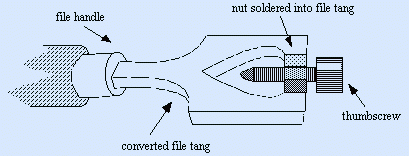 |
| Possible tube cutting jig |
Separating discs work very well for cutting tubing, both at right angles to the tube as well as oblique cuts and notches for sharp angled tubing bends.
Tubing can be cut while spinning when mounted in the flex shaft handpiece. Span the sawblade in upside down in the saw frame and hold the handpiece in your left hand with the teeth pointing away from the handle so that the tube rotates towards you and into the teeth of the blade. When the sawblade is held onto the tube it cuts it off. Assuming a three mm tube more or less one leaves it about a maximum of 3.5 cm or so out of the end of the chuck jaws. If it is longer there is some danger of it bending while spinning. The tube can then be cleaned up with emery paper while it is rotating and then marked to a given length with dividers. One can them mark the tube again with the dividers or vernier callipers and cut off another piece.
This method offers speed and a guaranteed right angled cut to the tube. If one is making tubing settings for a given size one holds a ball burr into the rotating tube which cuts the seat for the stone and then cuts the tube off to get a tube setting. If set up to make the same size settings it can be as fast as one every three seconds to make the seat and cut the setting off. As some stones like diamonds, synthetic corundum and spinel will take heat as long as there is no sudden temperature change one can even cut the seat into the tube with a round burr, place the stone into the setting and then set the stone in place by holding a piece of polished steel at an angle against the mouth of the setting. Then the set stone is cut off and soldered in place on the work. Just don't quench it!
One can cut rotating tubing in a flex shaft chuck rather crudely by holding a pair of snips or side cutters tightly onto it while it is rotating in the flex shaft. This has the effect of "spinning" the tube inwards simultaneously creating a bead with smoothly tapered ends. One can even close one end off completely by first cutting the tube with snips to bevel them inwards and then hold a piece of steel against the rotating tube end to close it. As mentioned before round nosed pliers work well. This has applications when making stick pin ends.
There are also professional (and professionally priced) specially hardened steel angle cutting jigs available for cutting wire, tubing and sheet at specific angles. One saws against the tool itself to obtain exact angles. Frei and Borel carry them in North America, Fischer amongst others in Germany.
Related Articles

Hints on Making Tubing

Metal Rolling and Drawing

How to Make Hoop Earrings

Making Your Own Tubing


The All-In-One Jewelry Making Solution At Your Fingertips
When you join the Ganoksin community, you get the tools you need to take your work to the next level.