One requires a taper on the end of the wire to grip it with when placed through a drawplate for drawing. One may obtain this taper in several ways.... (1999) Complete Story
Textile techniques are traditionally worked with fibers such as linen, cotton and silk. However, they can also be applied to metal.
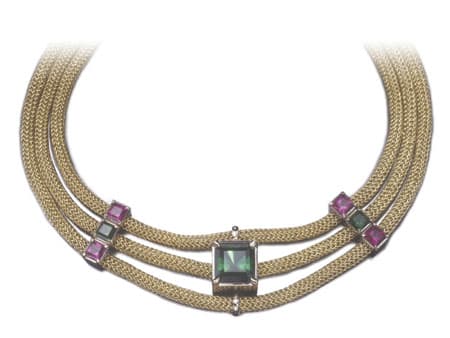
I weave high karat gold and platinum sheet and wire by hand. The process of weaving creates fabric. I shape that fabric into ribbons and ruffles, spirals and loops, which become earrings, brooches, necklaces and pendants. I create two collections of limited production and one-of-a-kind jewelry, each based on a different technique.... (2006) Complete Story
Jump rings may be made most easily by using a small hand drill with various sizes of mandrel. Take a broken burr, old needle file handles or a piece of drill rod and make a slit near the end. (I would use a separating disc to do this). Or one may drill a hole through the rod. Then it may be set into a hand drill or a flex shaft handpiece....
(1999) Complete Story
The links in this 16-in. (40.6cm) necklace are forged so they become flat and work-hardened. The pearl in the featured necklace is held in place merely by the tension between the wire loops in the pendant. Four styles of links define the spare and simple line of this necklace. Even the shape of the hook-and-eye clasp echoes the rhythm of the overall design.... (2008) Complete Story
Step by Step Tutorial - Making Three-lead Four-bight Turks-head. The Turks-Head is a general class of three-dimensional knot that lends itself well to decorative uses. Materials required: 18ga Silver wire... (2005) Complete Story
Would you like to reach Members of the Ganoksin Project to educate
them about the wonderful array of supplies, services and products
you have to offer?
Please request a copy of the Ganoksin Media Kit if you would like
more indepth information regarding Ganoksin's advertising services.