The Gem and Jewelry World's foremost Resource
on The Internet. Open to the public, Free of Charge! We are here to build a strong pool of
information for the benefit of Web's jewelers and craftsmen - and those
interested in jewelry and gemstones.
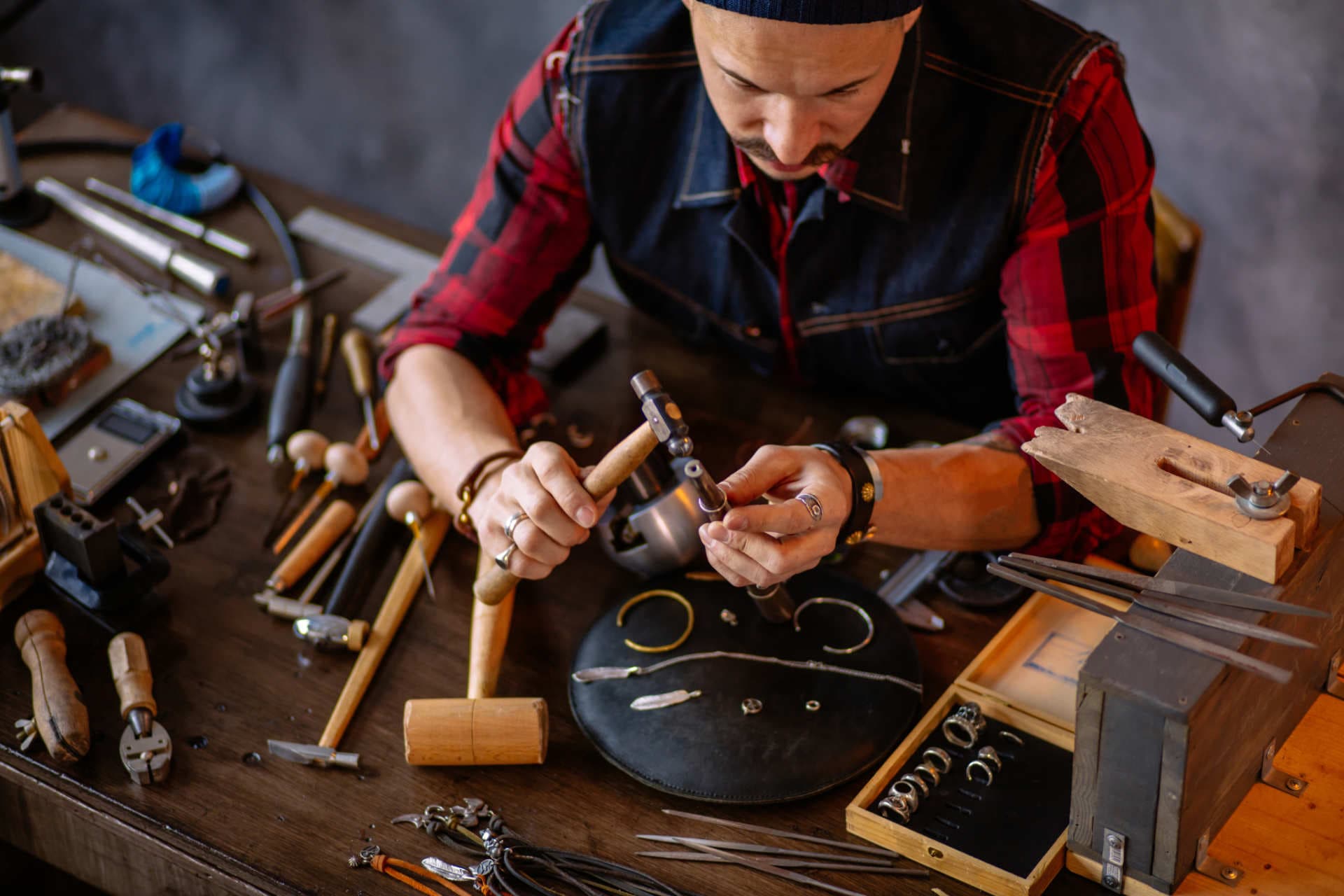
The next time you sit down at your bench, don't think of it as just a bench. Think of it as the cockpit of a plane. That's right, a plane. Sure, there are differences: Instead of dials, switches, and throttles, you have files, saws, and burnishers. But the same principle applies: Just like a pilot doesn't want a crucial switch out of reach, you don't want to have to move out of your way to get a tool. Your setup should be carefully designed to avoid problems and to make working easy and fast.... (2001) Complete Story
It is, however, usually best to bevel the openings of a tube slightly to give the rivet a better purchase in use. A beveled tube end produces a good flush rivet.... (1997) Complete Story
This is a mixture of potassium sulfides which has traditionally been used to darken or 'antique' silver and bronzes. This is usually called 'oxidizing' the surface though it has nothing to do with oxygen, what is really happening is that sulfur is reacting with the surface to produce the grays and blacks. So if you call it 'oxidizing' as most jewelers do just remember that is untrue. Most people who make jewellery are quite familiar with its use.... (2002) Complete Story
Jewelers use so-called -oxidising- solutions to darken metals like silver, copper, brass, nickel silver, bronze and, with specialized mixtures, on gold. Metalsmiths patinate both large and small objects, as well as jewelry. We usually think of patinas as being green, but they come in many colors. There are also metal dyes which are very adhesive. Paints, epoxy resins and other materials are also used to darken recesses on work. Metal coloring solutions are often made up of chemicals in toxic concentrations, so all chemical-lab precautions need to be taken with them.... (2005) Complete Story
A vertical copy stand is sometimes used for shooting prints, drawings, jewelry and other fairly flat objects. A copy stand is designed so that one has vertical movement of the camera while it faces down. There are usually fixed lights at 45 degree angles to the shooting surface. The vertical column that the camera is mounted on keeps the plane of the film parallel to the shooting surface which gives good results for.... (1996) Complete Story