950 Palladium: Manufacturing Methods
Palladium, long used as a luxurious jewelry metal, has recently experienced renewed interest largely due to its purity, natural white color and affordable pricing. Modern 950 palladium alloys containing various trace elements are superior to the palladium ruthenium alloys previously available for use in jewelry. The new 950 palladium alloys are:...
5 Minute Read

Palladium, long used as a luxurious jewelry metal, has recently experienced renewed interest largely due to its purity, natural white color and affordable pricing. Modern 950 palladium alloys containing various trace elements are superior to the palladium ruthenium alloys previously available for use in jewelry.
The new 950 palladium alloys are:
Pure
Palladium alloys formulated for jewelry predominately contain 95% palladium with the balance being ruthenium (another noble metal from the platinum group of metals, or PGM) and other trace elements. These trace elements are included in various combinations to create task specific alloys (i.e. for casting, fabricating, machining, etc.) for jewelry manufacturing processes.
Precious
Palladium is mined in only a few regions around the world. 7 million ounces of palladium were mined last year globally, compared to 7 million ounces of platinum and 80 million ounces of gold.
Naturally White
Palladium does not require rhodium plating to create or keep its bright, white appearance.
Comfortably Light
Palladium is nearly half the weight of platinum, opening up new avenues for jewelry designers focusing on white metals.
Durable and Wearable
Palladium is comparable to platinum when worn. It is strong, durable and tests have shown it outwears white gold.
Hypoallergenic
Palladium is not likely to cause skin allergies.
Workable
950 palladium alloys are desirably workable for jewelry design and manufacturing procedures. They are malleable, ductile, strong and durable and able to be worked in a variety of methods.
Here are some examples of pieces made with 950 palladium, using a variety of jewelry manufacturing methods.
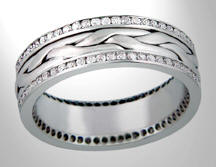 | This 950 palladium wedding band by Novell, Roselle, NJ is machine set with 108 0.01 carat round brilliant diamonds. The central design element features 950 palladium wires that were hand braided and formed. The band is machined from extruded 950 palladium ring tubing, a product of Johnson Matthey. Ring tubing is work hardened and available at a hardness of 180 Vickers. After the ring blank is machined, each of the elements is then hand assembled. Photo courtesy of Novell |
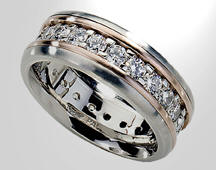 | This 950 palladium band by Novell features 23 0.10 round brilliant diamonds prong set with 14-karat pink gold trim pieces. The band is carved by machine from extruded ring tubing and the diamonds are machine set. After, the pink gold pieces are formed and the unit is hand assembled. Photo courtesy of Novell |
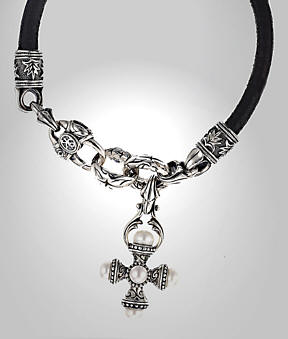 | This pearl cross bracelet design features unique interlocking cast 950 palladium links and a drop motif set with round cultured pearls. It was designed and manufactured by Scott Kay, Teaneck, NJ. The pieces are cast, hand finished and hand assembled. Since 950 palladium alloys are nearly half the weight of platinum alloys, this piece has a comfortable and wearable overall weight. Photo courtesy of Scott Kay, Inc. |
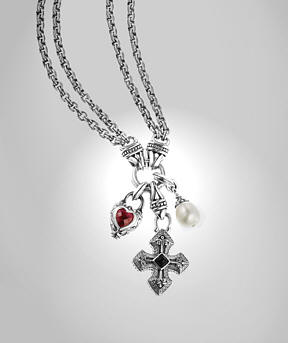 | This luxurious 950 palladium charm necklace by Scott Kay features 3 charms dangling from a hand made 950 palladium chain. The chain is handmade from palladium wire. The charms dangle from intricately carved palladium link pieces. The center gemstones are bezel set on 2 of the charms demonstrating the malleability of the material. Photo courtesy Scott Kay, Inc. |
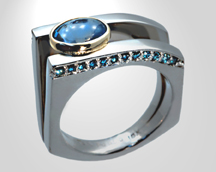 | Tom McLaughlin, shop manager and partner of Lennon's Jewelers, Syracuse, NY designed and made this 950 palladium and 18-karat yellow gold ring with a tourmaline center stone and blue diamond side stones using CAD/CAM design and manufacturing methods. The ring was cast, hand assembled, set and finished. The 18-karat yellow gold bezel was soldered onto the hand finished 950 palladium casting using gold soldering techniques. The small beads holding the blue diamonds on the side were a part of the computer generated wax model prior to casting. |
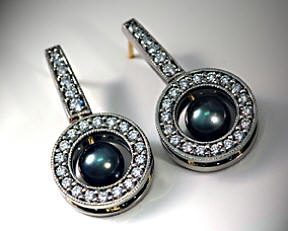 | This pair of 950 palladium and 18-karat yellow gold with cultured Tahitian pearls and diamond earrings were designed and made by Tom McLaughlin. For this piece, McLaughlin combined cast pieces and hand assembly. The bottom portion of the earrings has diamonds set on the front and back side and swivel when worn. |
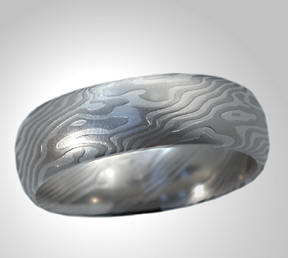 | The Mokume Gane wedding band featured here was designed and made by James Binnion of James Binnion Metal Arts, Bellingham, WA. The process begins by high heat bonding sheets of sterling silver and palladium to form the layers of metal prior to shaping and forming. The palladium in this application is the darker of the 2 alloys featured in this ring. |
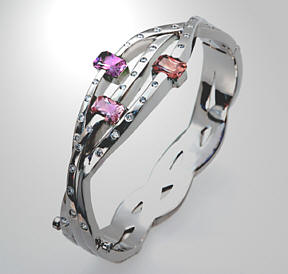 | Retail store owner, AGTA award winning designer and manufacturing bench jeweler Brenda Warburton of Austin and Warburton in Ann Arbor, MI shows the versatility of 950 palladium with this luxurious cast and hand assembled bracelet. She used CAD/CAM methods to produce the model and after casting used a laser welder to complete the assembly for the hinge and clasp mechanism. Warburton flush set the small round brilliant diamonds and channel/hammer set 3 emerald cut sapphires. Palladium's bright white color provides a striking background which reflects the best qualities of the diamonds and fancy color sapphires. |
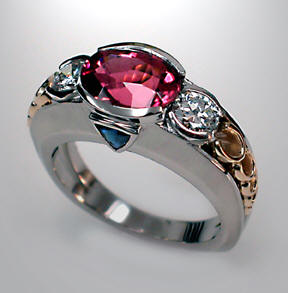 | Lainie Mann, Corvallis, MT designed this piece to feature the color contrast between naturally white palladium and yellow gold. It contains sapphire and diamond side stones and a tourmaline center stone. |
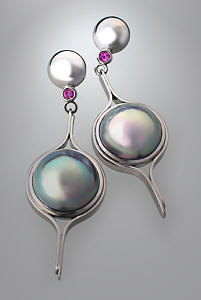 | These cultured Mabe pearl and pink sapphire earrings were designed by Lainie Mann and hand formed and fabricated using 950 palladium by Mark B. Mann. The top portion of the earrings was cut from sheet for formed in a dapping block. All bezel material was hand formed from wire. Palladium easy and medium and hard solder was used to connect the hand formed pieces. |
The Process
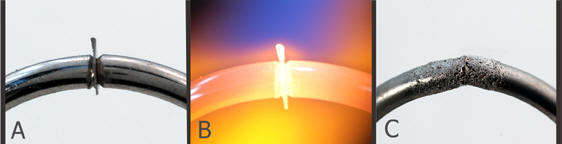
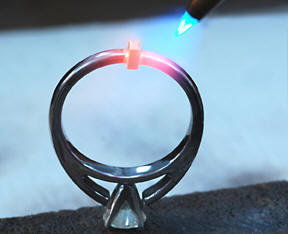
When attempting to weld a joint with a torch, the best result comes from using the above process. Begin with a butt joint with beveled edges and a thin piece of 950 palladium sheet measuring 0.12mm in thickness (A). Use a vented torch tip and with gas and oxygen as the fuel source and heat the joint until the small piece melts into the shank (B). The result shows a micro-pitted surface (C) where the joint was heated. The surface distortion is removed by filing and burnishing.
Best Method
For the best results when sizing a ring, the use a standard butt joint and hard palladium solder. If hard palladium solder is not available, 1300 platinum solder will provide good results. Be sure and use platinum soldering techniques.
Palladium Jewelry Manufacturing: Frequently Asked Questions:
![[]](/_next/image/?url=https%3A%2F%2Fwww.ganoksin.com%2Fwp-content%2Fuploads%2F2016%2F06%2Flistblack.gif&w=1920&q=75) Can you torch weld 950Pd shanks when sizing a ring?
Can you torch weld 950Pd shanks when sizing a ring?
Yes, but its tricky. The main problem with welding palladium is oxygen absorption and the result is exhibits micro-pitting at the joint. (When molten, palladium dissolves large amounts of oxygen and will become a "homogenous liquid" in the sense that the elemental oxygen is mixed with the liquid palladium on an atomic level. When the metal solidifies, the oxygen wants to change phase back into a gas, and is released from the metal as just that, a gas. But the metal usually solidifies before all the gas can be evolved; hence gas porosity in the form of pits.
Related Articles

Moissanite Necklace Repair with Welding Technology

Laser Mokume – The Satow Method

American Holloware Changing Criteria

Faster, More Efficient Laser Welders
The All-In-One Jewelry Making Solution At Your Fingertips
When you join the Ganoksin community, you get the tools you need to take your work to the next level.